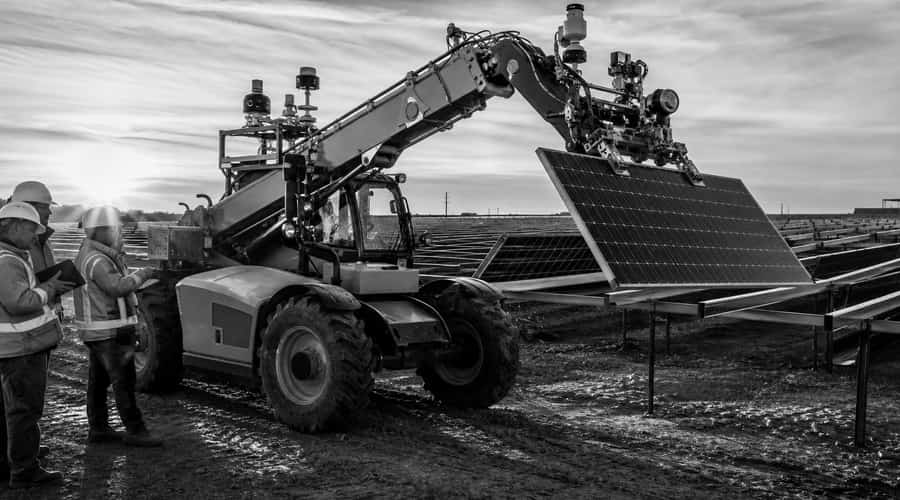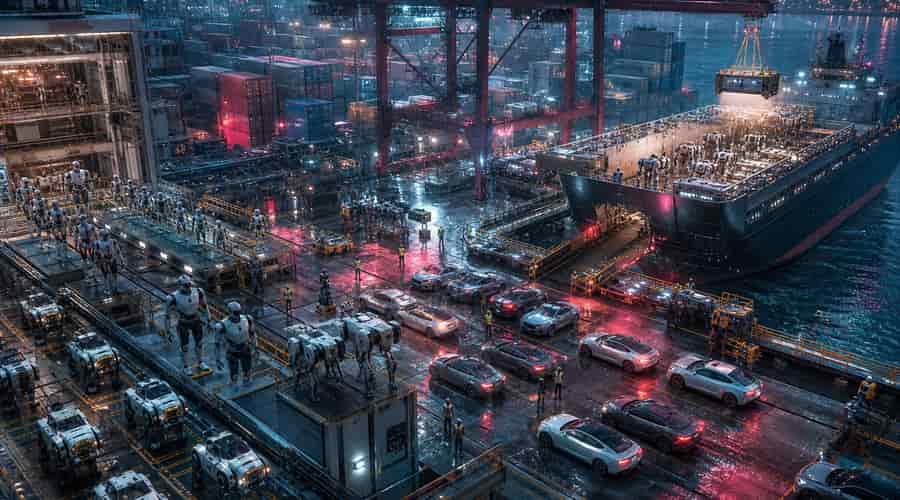
The label that once meant cheap plastic and short-lived electronics now ships everything from robots to AI hardware, electric vehicles included, and does it at scale. June's trade data shows the shift is no longer a slogan.
Say "Made in China" to anyone over forty and you'll likely get the old picture first: a flimsy toy, a charger that died in a month, a copycat gadget with a logo that looked almost right. That reputation took decades to build. China has spent years tearing it down, and June's export figures show how much of the rebuild has already happened.
China's exports jumped 27 percent in June from a year earlier, according to customs data reported by the Associated Press. Imports rose 36 percent. The trade surplus widened to $125.6 billion. Those are big numbers on their own, but the mix matters more than the headline. This wasn't just socks, toys and low-margin assembly work. It was AI-linked electronics, vehicles, robots and the equipment around them.
That's the point.
The Chinese manufacturing story you grew up with is not the one your customers, suppliers or competitors are dealing with now. If you're still treating China as only the cheap end of the supply chain, you're reading an old map.
The Robots Are the Headline
Robot exports tell the sharpest version of the story. Customs data cited by the South China Morning Post showed that China exported nearly $600 million worth of robots in June, including industrial, cleaning, surgical and bionic machines. More than 40 percent of those shipments went to the European Union, with another 8 percent going to the United States.
You don't build that volume overnight.
For the first half of 2026, industrial robot exports reached 6.29 billion yuan, about $930 million, up 18.6 percent year on year, according to data from China's General Administration of Customs reported by ECNS and CGTN. Surgical robot exports reached 480 million yuan in the same period, up more than threefold. Cleaning robots and intelligent bionic robots - humanoid robots, robot dogs, robotic fish and birds - recorded combined first-half exports of 18.09 billion yuan.
That last detail is worth keeping. A robot dog is not a semiconductor tool. A surgical robot is not a vacuum cleaner. China isn't winning one narrow export category here: it's building a wider robotics ladder, from home appliances to factory automation to medical equipment, and each rung gives its manufacturers more data, more suppliers, more buyers.
Official data from China's Ministry of Industry and Information Technology, carried by Xinhua and People's Daily Online, said Chinese-developed quadruped robots accounted for nearly 70 percent of global sales in the first half of 2026. The same data said China had developed more than 400 complete humanoid robot products, more than half the world's total.
Five years ago, that would have sounded like a pitch deck. Now it's customs data.
EVs And AI Hardware Carry The Weight
Robots make the cleaner headline, but electric vehicles and AI hardware are doing much of the heavier lifting. The Associated Press reported that trade in electronic components, computer spare parts and other computing hardware jumped nearly 57 percent in the first half of 2026 to 5.1 trillion yuan, or about $760 billion, as AI demand pulled through the supply chain. Fortune republished the AP report and quoted Wang Jun, vice minister of China's General Administration of Customs, saying trade in AI-related products was strong.
Cars are part of the same turn. The South China Morning Post reported that China's overseas shipments of plug-in hybrid electric vehicles doubled in volume, while exports to the EU tripled, making the bloc the largest market for Chinese vehicles. The Financial Times separately reported that China's monthly car exports passed 1 million units in June for the first time, reaching 1.06 million vehicles.
That is not background noise. If you run a Western auto company, sell battery materials, finance charging infrastructure or source industrial components, those shipments show up in your market whether you invited them or not.
The pressure is already political. Brussels has moved against Chinese EVs and solar products through anti-subsidy probes and tariffs, while Washington keeps tightening parts of the technology trade. But finished cars and solar panels are only the obvious targets. A country that can ship robots, batteries, AI-linked electronics and factory equipment has more ways round a single tariff wall than a country that only ships one thing.
That doesn't make China's position comfortable, though. The AP reported that China's economy grew 4.3 percent in the second quarter, the slowest pace since late 2022, even as exports surged. Retail sales rose only 1.3 percent. Fixed asset investment dropped 5.7 percent. Exporters are running hot. Consumers at home are not.
That imbalance is the hard part. A country can sell high-end goods abroad and still struggle to convince its own households to spend. China is doing both at once.
Beijing's next Five-Year Plan is meant to close that gap, with artificial intelligence, advanced computing and smart manufacturing expected to sit at the centre of the 2026 to 2030 agenda. The bet is plain enough: the same factories now exporting robots and AI hardware, EVs among them, should eventually build stronger demand at home too.
Maybe they will. But don't confuse export strength with a fully healthy economy. China's climb up the value chain is real, and the June data makes that hard to dismiss. The open question is whether the country can turn that manufacturing power into confidence at home, not just container ships leaving port.
Also read: Oracle's Default Insurance Costs Just Beat Its 2008 Financial Crisis Record, Singles Are Letting ChatGPT and Claude Write Their Dating Messages, and Google's AI Overviews Now Handle Most Searches Without a Single Click