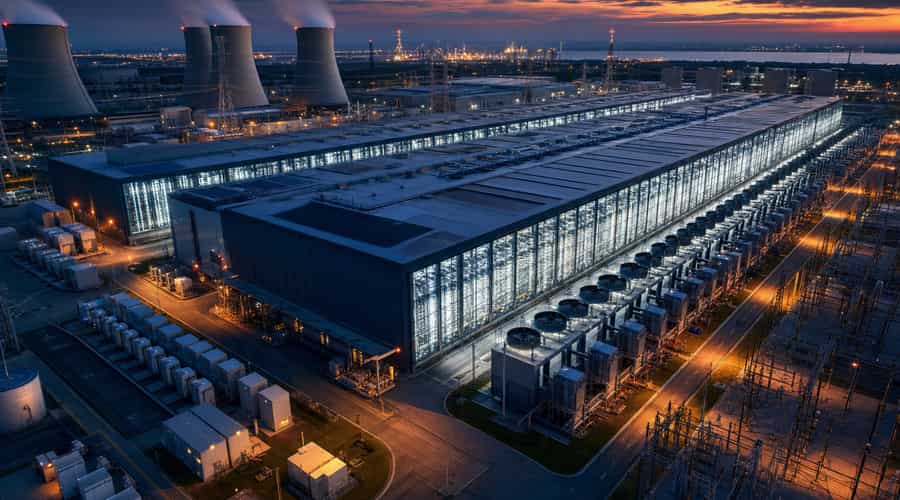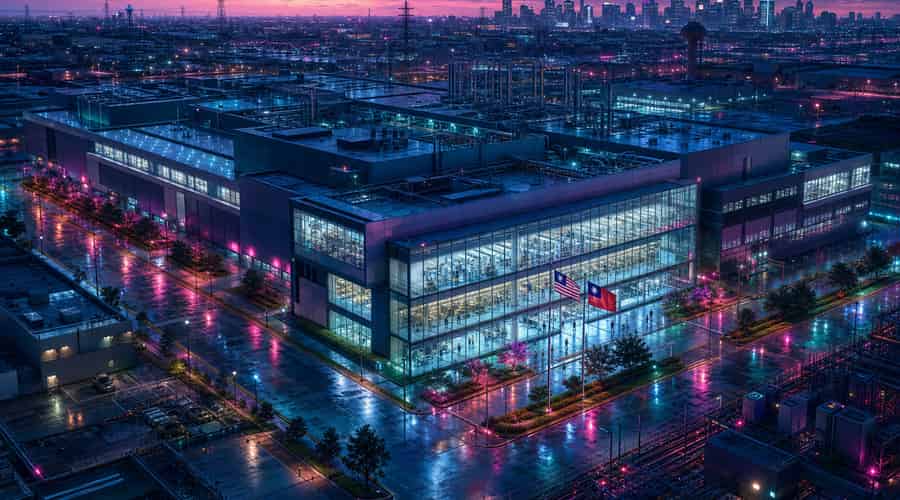
Wistron's Fort Worth factory is no longer a slide in Nvidia's American manufacturing pitch. It opened on July 21, and it is already producing GB300 Grace Blackwell Ultra systems in Texas.
The opening ceremony at Wistron's D1 facility in Fort Worth put Nvidia founder and CEO Jensen Huang and Wistron Chairman Simon Lin on the same stage. That image matters. It's one thing to promise American AI manufacturing and quite another to stand inside a 324,000-square-foot plant where the first US-built Nvidia GB300 Grace Blackwell Ultra Superchip has moved into mass production.
This is the hard part of the AI boom. Not model demos. Not valuation charts. The equipment has to be built somewhere, tested somewhere, repaired somewhere and shipped to customers that are already planning data centers years ahead. Wistron's Fort Worth plant is useful because it turns Nvidia's onshoring story into a place you can point to on a map.
According to Wistron's July 21 announcement, the company has put $700 million into the Fort Worth facility, its first US manufacturing site. More than 500 jobs created so far. The plant is expected to reach 1,000 workers by the end of 2026, and Nvidia said the site is scaling this year to produce tens of thousands of boards per month, with one manufacturing cell producing the GB300 Grace Blackwell Ultra Superchip and another set up for Vera Rubin.
That is real capacity. It is also a narrow kind of capacity, which you shouldn't confuse with a broad revival of every layer of semiconductor manufacturing. The most advanced chip fabrication still depends on TSMC's Arizona plants and the wider Taiwan-centered supply chain. Fort Worth is about assembling and testing AI systems in the US, which is still a big deal when Nvidia's customers want shorter lead times, local support and fewer political headaches around where their infrastructure is made.
Wistron is making Nvidia hardware with Nvidia tools
That's the neat detail. The factory runs on the kind of AI stack Nvidia sells. Nvidia's own case study says Wistron designed and simulated the plant using digital twins built with Omniverse, Metropolis, Nemotron and Cosmos, and that its simulation work cut some studies from 15 hours to 3.6 seconds. The company also says AI-driven operations have helped reduce energy use across Wistron facilities by an estimated 10%.
Don't overstate that. A factory running Nvidia software doesn't prove every manufacturer needs the same stack tomorrow. But it does show why Nvidia wants to own more than the GPU. If your chip, server design, simulation tools, factory software and training systems all come from the same ecosystem, switching away gets harder with every assembly line you add.
Wistron Chairman Simon Lin said in the company's announcement that the Fort Worth operation is not typical manufacturing, and that the plant is already producing GB300 Grace Blackwell systems before adding Vera Rubin. Huang, in Nvidia's blog post, called manufacturing an essential pillar for every economy and said US chip plants, packaging plants, computer system plants and AI factories are helping the country reindustrialize. Those are big words. The useful fact underneath them is smaller and stronger: a Taiwanese manufacturer has opened a Texas plant for Nvidia's newest AI systems.
Nvidia's $500 billion pledge now has a shop floor
Nvidia announced in April 2025 that it planned to produce up to $500 billion of AI infrastructure in the United States over four years, working with partners including TSMC, Foxconn, Wistron, Amkor and SPIL. That plan now has a shop floor. The same announcement said Blackwell chip production had started at TSMC's Phoenix plants and that supercomputer manufacturing sites in Texas, including Wistron's site in Fort Worth and Foxconn's in Houston, would ramp mass production over the following 12 to 15 months.
Fort Worth is the first visible proof that the Texas part of that timetable has moved from pledge to output. A $500 billion number is easy to repeat and hard to judge. A factory with 500 workers, two manufacturing cells and a stated target of tens of thousands of boards per month is easier to measure. You can count boards and jobs. You can also count delays if the ramp misses.
Foxconn and Quanta are still in the same race, and frankly, none of this is about patriotism alone. The prize is Nvidia's next wave of purchase orders. The companies that can assemble and test GB300 and Vera Rubin systems close to US data center demand - and support them once they're running - will have a better shot at keeping those orders when customers start worrying about tariffs, export controls and delivery windows.
The Fort Worth jobs figure is modest by old industrial standards. Five hundred workers doesn't transform a region by itself. But the work is different from the factory jobs politicians usually invoke: the site uses digital twin systems, AI-assisted quality control and training tools that Nvidia says include AR and VR workflows. If this model works, American AI hardware manufacturing will look less like nostalgia and more like a tightly controlled systems operation built around expensive boards, cooling demands and unforgiving customer schedules.
That is why this opening deserves attention. Wistron did not solve Nvidia's whole supply chain problem in Fort Worth. It did something more specific: it gave Nvidia's US manufacturing promise a working plant, a named product and a production ramp you can check again before the end of the year.
Also read: Samsung is in talks to take an equity stake in Mistral AI as the French startup seeks €3 billion at a €20 billion valuation • Fireworks AI closes $1.5 billion Series D at a $17.5 billion valuation as enterprises flee frontier API pricing • China signs 29 nations into a rival AI bloc while open-source models do the real work