
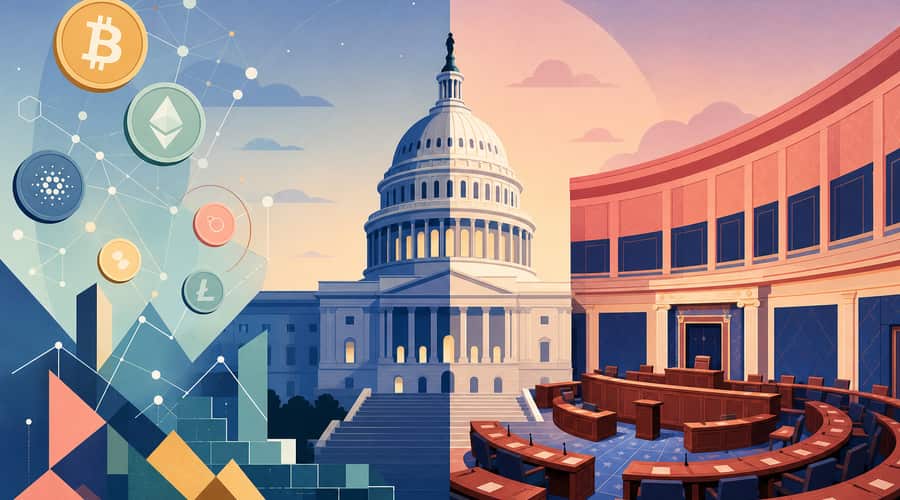
The CLARITY Act is still alive, but the ethics fight around Trump's crypto money has become the bill's hardest vote-counting problem.
The CLARITY Act was supposed to be the moment America finally gave crypto a legal home. It hasn't been. The bill is now stuck on a question you can't wave away with market-structure language: how should Congress write rules for an industry when the president's family has already made billions from it?
That is the problem sitting in front of Senate negotiators in late July 2026. The bill needs 60 votes to move through the Senate, and Democrats who might otherwise be available are still demanding stronger conflict-of-interest language. CoinDesk reported that Senators Ruben Gallego of Arizona and Angela Alsobrooks of Maryland, the two Democrats who helped advance the bill in committee, said in May they would not support final passage without an ethics provision. Those votes matter. There aren't many others to spare.
Senate Majority Leader John Thune told Bloomberg Government on July 14 that he expected a vote before the August recess. That's a narrow window. The Senate is due to leave Washington after the first week of August, and every day spent arguing over the ethics section makes the clean crypto vote that industry lobbyists wanted look less likely.
The White House tried to move the story this week. Investors Business Daily reported that Trump had agreed to ethics provisions negotiated with Republican senators Cynthia Lummis and Bernie Moreno, with enforcement expected to run through the Department of Justice. Democrats had not reviewed the finalized language at the time. That's not a deal. It's one side saying the deal exists.
The conflict is real money
The ethics fight isn't abstract. Reuters reported in June that the Trump family had made at least $2.3 billion from four crypto ventures since Trump returned to office, while more than a million investors in those projects had paper losses of roughly the same amount by the end of April. A later Reuters review of Trump's 2025 financial disclosure found more than $1.4 billion in reported income from family crypto ventures, including nearly $800 million from World Liberty Financial and $635 million from Trump meme coins.
World Liberty Financial is the center of the story because it makes the conflict easy to understand. Reuters reported in 2025 that the Trump family had a claim on 75% of net revenues from WLFI token sales and 60% from World Liberty operations once the core business started. Bloomberg also reported that a Trump-affiliated company receives 75% of net revenue from token sales under the project's offering documents. You don't need a law degree to see the problem.
There is a foreign-money angle too. The Wall Street Journal reported in January 2026 that an investment firm tied to Sheikh Tahnoon bin Zayed Al Nahyan of the UAE bought a 49% stake in World Liberty Financial for $500 million. Separately, CoinDesk reported in June that World Liberty's USD1 stablecoin had grown to about $4.6 billion in circulating supply. Those are two different facts, and they should not be blurred together. One is an ownership deal. The other is a stablecoin supply figure.
Senate Republicans released updated text on July 22 with ethics rules covering federal officials, including the president, vice president and members of Congress, according to Crypto Briefing. The problem is the expiration date. The provision sunsets on January 20, 2029, unless Congress renews it. Senator Elizabeth Warren, the top Democrat on the Senate Banking Committee, said the new text still leaves major loopholes and gives DOJ sole enforcement power while blocking state attorneys general and private parties from bringing actions. Frankly, that is exactly the kind of enforcement design Democrats were never going to accept quietly.
The market already noticed
Crypto investors have been trading the bill like a catalyst. The Wall Street Journal reported that Coinbase rose 9.6% on July 21 after news of the White House and Republican senators reaching an ethics agreement, while Circle gained 8.6% and Bitcoin closed at $66,417.04. Polymarket odds also moved higher after the reports, recovering to roughly the low-40% range after sliding earlier in July.
Don't confuse that bounce with a solved problem. CoinDesk Research said Bitcoin spot ETFs recorded $4.67 billion in net outflows in the second quarter of 2026, the largest quarterly outflow since the products launched in January 2024. July inflows helped, but they were repairing damage from May and June, not proving that institutional money had returned for good.
The bill itself still does something the industry badly wants. It would draw a federal line between assets overseen by the SEC and spot-market activity overseen by the CFTC, giving exchanges and token issuers a clearer path than the enforcement-heavy approach that defined the Biden years. Coinbase, Circle and the rest of the listed crypto trade don't need poetry from Washington. They need rules they can build around.
But you can't separate the rules from the person signing them. The CLARITY Act may have enough policy agreement to pass in normal circumstances. These aren't normal circumstances. If Democrats believe the bill lets Trump keep profiting from World Liberty, meme coins and stablecoin-linked arrangements while his administration oversees the market, the 60-vote math gets brutal fast.
The industry's best argument is still that the US should not leave crypto regulation to court fights and agency improvisation while Europe works under MiCA. That argument has force. It also runs straight into a simpler one: clean markets need clean rules. If the Senate can't write an ethics provision that survives contact with Trump's own crypto income, the CLARITY Act may never get the vote its supporters spent years trying to secure.
Also read: Galaxy Digital bets $5 million that Bitcoin can be made quantum-proof before Q-Day arrives; Abu Dhabi just gave tokenized gold the regulatory stamp it needed to go mainstream; Augustus raises $180 million to give the world's fintechs a direct line into the US dollar