Israel wants sovereign AI infrastructure fast, but the country's own electricity regulator has just shown you the hard limit. A cabinet resolution can speed up planning. It can't create 27,000 megawatts of spare power.
The ambition is real. Israel's government approved a National Artificial Intelligence Program this year, and its National AI Directorate held its first industry consultation on July 5, 2026. Earlier, on February 22, 2026, Government Resolution 3907 moved to treat large data centers as national infrastructure, giving facilities above 50 megawatts a route through the National Infrastructure Committee and capping submissions at 10 plans a year. That's the policy machine Israel has built to become an AI power.
Then the grid answered.
Israel's Electricity Authority has suspended the processing of new data center grid connection requests for 140 days after applications reached roughly 27,000 megawatts. JNS reported on July 22 that the figure is about three times the country's average electricity consumption. The Jerusalem Post, citing the regulator, put the average load at about 9,000 megawatts and Israel's all-time peak at about 17,000 megawatts during the August 2025 heatwave. You don't need to be an energy analyst to see the problem. The queue is bigger than the country can absorb.
Prime Minister Benjamin Netanyahu has put the national security case for AI plainly in public remarks and government statements, and that part isn't hard to understand. For a small country surrounded by hostile actors, relying entirely on foreign cloud capacity and imported compute is not a comfortable position. The Israel Innovation Authority has already opened discounted access to 1,000 Nvidia B200 accelerators through the national supercomputer program, with 70% of the capacity set aside for companies and 30% for academic research.
But 1,000 GPUs are a foothold, not sovereignty. Reports around the national plan have described a much larger ambition for sovereign GPU capacity, with outside summaries putting the potential hardware bill in the tens of billions of dollars. That's before you deal with land, cooling, fiber, substations and gas supply. AI infrastructure is not a slogan. It's steel, water, chips and power contracts.
Overseeing implementation is Almog Cohen, a Jewish Power lawmaker appointed deputy minister in the Prime Minister's Office with responsibility for the AI push. Israel Tech Insider identified him as the official tasked with helping move the center of gravity of the national AI plan toward the Negev and Galilee. His appointment drew criticism because his public background is in politics and policing, not semiconductors or data centers. Frankly, the bigger issue isn't Cohen. It's physics.
The grid pushed back
The Electricity Authority's freeze is not a small administrative pause. According to The Jerusalem Post, the system operator Noga warned that it could not approve additional server-farm connection requests without risking grid stability. During the 140-day halt, regulators will examine the effect on electricity prices, competition, gas reserves and economic redundancy before deciding what the system can actually promise.
Existing commitments are much smaller than the speculative rush. Israeli reports put already approved server-farm commitments around 1,500 megawatts. If even those projects are built, data centers could become a material share of national electricity use in the early 2030s. The backlog is something else entirely.
Israel has been investing in transmission, but the numbers in the energy system don't move on startup timelines. The Institute for National Security Studies notes that a 2023 grid development plan totaled about NIS 22 billion, with roughly NIS 12 billion designated for connecting renewable energy facilities. That is serious money. It is still not a magic bridge from 9,000 megawatts of average demand to a 27,000 megawatt data center queue.
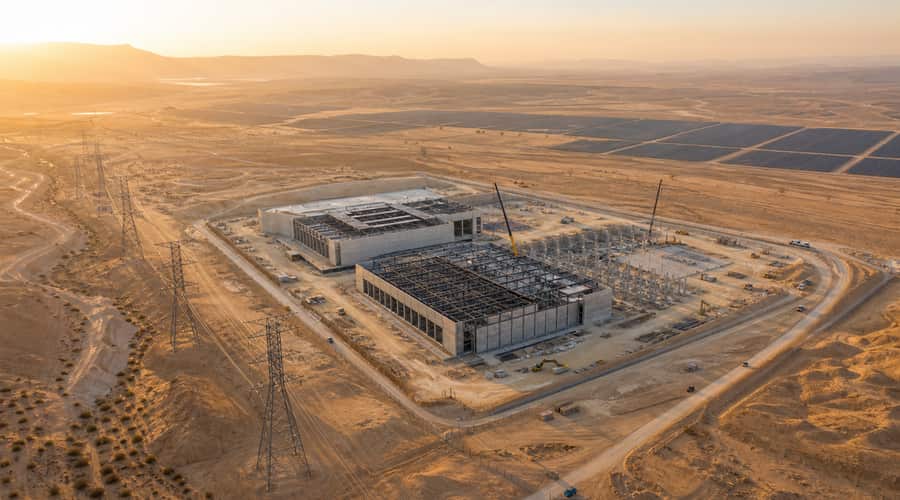
The locations matter too. The government wants more infrastructure in the Negev and Galilee, which makes political and development sense. The Negev also means heat and water scarcity - cooling loads don't disappear because a planning file moved faster. If you're building AI factories in the desert, you need to say where the electricity and cooling are coming from before the ribbon cutting.
Some real projects are moving. Globes reported in February that Dalia Energy, Serverfarm and the Israel Infrastructure Fund plan a 130-megawatt Ofek data center outside Ashdod, backed by a $1.5 billion construction investment and designed to open commercially in the second half of 2029. The site is tied to a planned 850-megawatt gas-fired power station near Ashdod port, which is exactly why it looks more credible than a grid request floating in a queue.
Mega Or and Nebius are already operating in Modi'in. The Jerusalem Post reported last October that their AI computing facility uses about eight megawatts of power, houses 4,000 Nvidia GPUs costing about $300 million, and allocates 25% of capacity to the Israel Innovation Authority for the national supercomputer. Globes later reported that Nebius signed an 80-megawatt lease with Mega Or for additional sites in Israel. Those are real commitments. They also show how quickly the load climbs.
The chip strategy is thinner than the power demand
Israel's stronger hand is design, not fabrication. The country has Intel and Tower Semiconductor operations, a deep cyber and software base, and a growing cluster of chip startups. Hailo is the obvious name here: TechCrunch reported that the Israeli edge AI chipmaker raised a $136 million Series C in 2021 at around a $1 billion valuation, and Hailo later announced another $120 million funding extension in 2024 alongside its Hailo-10 accelerator.
Nvidia is also expanding in the south. The Jerusalem Post reported this month that Nvidia inaugurated a new 3,000-square-meter R&D center in Beersheba's Gav Yam High-Tech Park, tripling the size of its previous local site. That is the kind of detail you should watch. Talent clusters are easier to grow than power grids, and Israel already has the talent.
The strategic logic holds. Sovereign AI means you control more of the compute stack, not just the application layer sitting on rented foreign cloud. For Israel, that instinct makes sense.
The execution is the hard part. You can designate data centers as national infrastructure and fast-track the planning. You can talk about the Negev and Galilee as future AI corridors. But once 27,000 megawatts of requests land on the electricity system, the story stops being about ambition and starts being about capacity. Israel has set a national AI target. Now it has to build the power system underneath it.
Also read: Infosys trims its revenue forecast as enterprise clients route budgets to AI instead of outsourcing; AI data centers have pushed America's largest power grid to its breaking point; Intel's stunning 2026 revival faces its biggest test as Q2 earnings land today