Etched has not shipped Sohu at scale yet, but investors are already pricing it like one of the few serious ways to loosen Nvidia's grip on AI inference.
Etched came out of stealth on June 30, 2026, with more than the usual startup noise. The San Jose company, founded in 2022 by Harvard dropouts Gavin Uberti, Chris Zhu, and Robert Wachen, said it had raised $800 million across four previously unannounced rounds, signed more than $1 billion in customer contracts, achieved first-pass silicon on TSMC's N4P process, and begun validating a rack-scale inference system built around its Sohu chip.
That would have been enough. Then the Wall Street Journal reported that Etched was negotiating two more financings at once: a Sequoia-led round valuing the company at roughly $10.3 billion, and a separate Jane Street-led round at $20 billion. Neither had closed when the Journal published its report in mid-July, and terms can still move. But you don't need the paperwork to be final to see the point. The market is paying for a way out of the Nvidia queue.
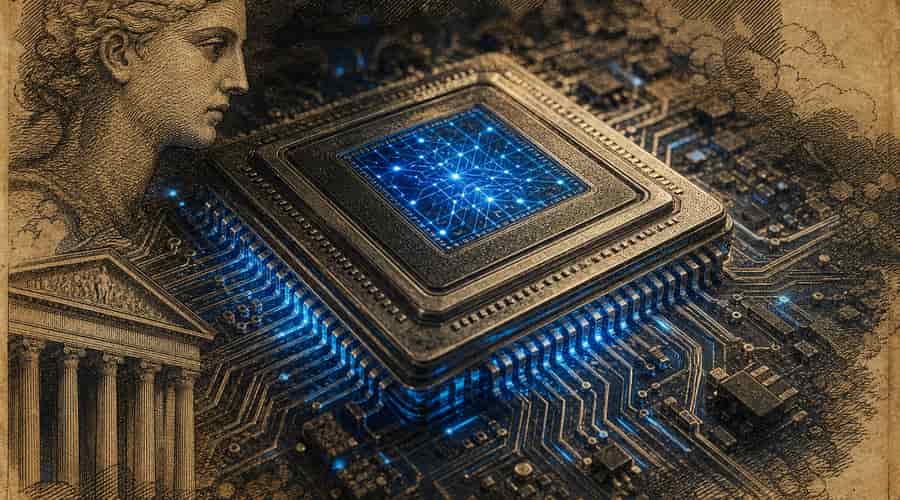
Sohu is an application-specific integrated circuit built for transformer inference. One job. Etched's own materials say an 8-chip Sohu server can deliver more than 500,000 tokens per second on Llama 70B, compared with about 23,000 tokens per second for an 8-chip H100 server. The chip carries 144GB of HBM3E memory, and the company says its first racks ship this summer.
Read that carefully. Those are company claims, not independent production benchmarks. No outside customer has published numbers showing Sohu doing that work under normal serving traffic, with real uptime requirements, changing context lengths, and the messy batching patterns that AI products actually see. If you're buying infrastructure, that distinction matters. A demo number gets you a meeting. A stable rack earns the purchase order.
The straightforward pitch is that general-purpose GPUs are overbuilt for inference. Nvidia's H100 and B200 can train models, run simulations, render graphics, and do plenty of things a customer deploying a chatbot will never ask of them. You pay for that flexibility whether you use it or not. Etched's argument is sharper: if frontier models keep leaning on transformers, a chip that gives up generality can pour more silicon into the exact path tokens travel through at inference time.
That is a real argument. It is also a dangerous one.
Sohu's upside comes from the same place as its risk. Earlier Etched materials described Sohu as unable to run CNNs, LSTMs, SSMs, or other non-transformer models, precisely because the architecture was hardwired for transformer workloads. In its June 30 announcement, Etched said its systems were running models including DeepSeek, Qwen, Mamba, and Llama, and were designed for models of different shapes and arbitrarily large parameter counts. Fine. But the company still owes customers a clear explanation of how far that flexibility really goes. Mamba and other state-space approaches exist because researchers are not finished questioning transformer attention.
The bet behind the price
Etched's last disclosed valuation was about $5 billion, from a December 2025 financing led by Stripes with participation from Peter Thiel, according to the company's June 30 release and earlier Bloomberg reporting. A Sequoia round near $10.3 billion would double that. A Jane Street round at $20 billion would quadruple it. For a company whose first systems are still being validated with customers, that is not normal semiconductor math.
It is AI infrastructure math. Investors are not paying for Etched's current revenue base. They are paying for the chance that Sohu becomes a credible alternative for customers that don't want every inference dollar flowing through Nvidia. Frankly, that is the whole story. The $1 billion in customer contracts matters because it shows real demand before shipment, but booked contracts are not recognized revenue, and they usually depend on the hardware arriving and performing.
Etched is not alone in chasing the gap. Cerebras has pushed wafer-scale hardware. Groq built its reputation around predictable low-latency inference. Tenstorrent and SambaNova are still trying to prove their own architectures at scale. Etched has picked the narrowest lane of the group: build around the dominant model architecture, move fast, and accept that a major architectural turn could hurt badly.
That is why the $20 billion figure is both impressive and unsettling. It would put Etched near the valuation range of semiconductor companies with far longer operating histories, while Sohu is still moving from validation into first customer shipments. You can understand why investors want in. You should also understand what they are underwriting. They are not buying certainty. They are buying a scarce seat in the fight over inference economics.
Also read: Apple Maps will be embedded inside Ford's EV platform in 2027, bypassing CarPlay entirely • Cursor builds a CFO playbook for AI spending before SpaceX absorbs it at $60 billion • Israel wants to become an AI superpower but its power grid may have other ideas