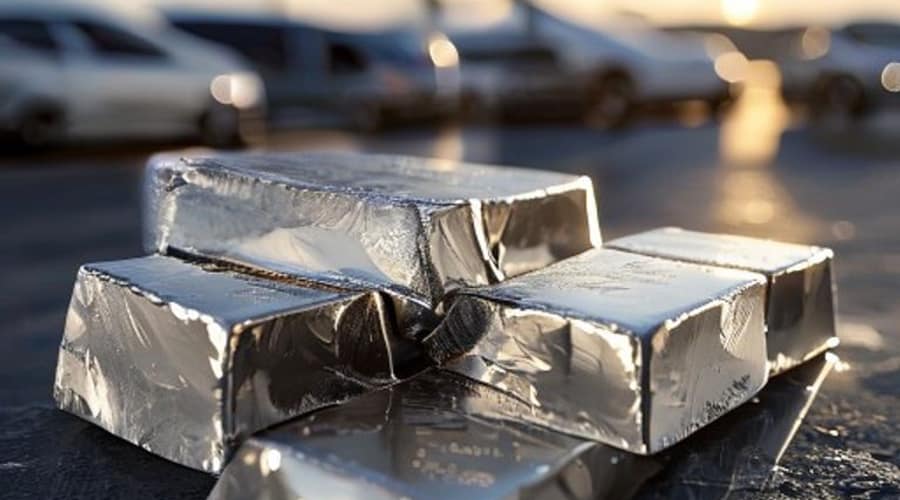
Silver rebounded to $58.40 an ounce on July 24, 2026, as physical buyers stepped in ahead of next week's Federal Reserve meeting, while the Silver Institute confirmed the metal is running a 46.3 million troy ounce supply deficit for the sixth consecutive year.
You probably didn't notice silver move on Thursday. That's exactly the point. While gold commands the headlines and bitcoin captures the retail imagination, silver has been quietly building one of the more compelling structural cases in any asset class - a persistent physical shortage layered under a dual demand story that most investors haven't fully priced in.
The July 24 move was textbook: spot silver climbed $1.13, or roughly 2%, to $58.40 as physical buyers stepped into a brief dip, with September futures trading near $57.92. The catalyst wasn't a geopolitical shock or a central bank announcement. It was the combination of a Fed meeting on July 29 pulling in rate-sensitive buyers and steady industrial demand doing what it does every week, absorbing supply.
The World Silver Survey 2026, published in April by the Silver Institute with research by Metals Focus, put the 2026 supply gap at 46.3 million ounces, wider than the 40.3 million ounce deficit in 2025. That's six straight years of the market consuming more silver than it produces. Since 2021, cumulative drawdowns from above-ground stocks have reached an estimated 762 million ounces. Metals Focus projects annual deficits of 50 to 80 million ounces persisting through 2030.
What keeps this deficit from correcting itself is structural. About 70% of silver is extracted as a byproduct of copper, zinc, and lead mining. Those operations respond to base-metal economics, not silver economics. When silver's price rises, the mines producing it don't necessarily drill faster, because silver isn't why those mines exist. That supply constraint is real, and it doesn't resolve quickly.
On the demand side, solar PV absorbed roughly 151 million ounces in 2026, even after panel manufacturers made modest efficiency gains that reduced silver content per cell. Electric vehicles are adding another layer: each battery electric vehicle uses approximately 25 to 50 grams of silver, between 67% and 79% more than a conventional combustion-engine car. That gap widens every year EV share grows. With global EV deliveries projected to scale from 17.6 million units in 2024 toward 65 to 75 million annually by 2030, automotive demand alone is a meaningful and growing claim on the market. Add data centres and AI infrastructure - where silver-intensive connectors and cooling systems are proliferating - and you have industrial demand pulling hard in several directions at once.
What Wall Street is actually saying about silver price in 2030
Bank of America has put forward a base case of $135 an ounce by end-2026, with a bull scenario stretching to $309 if physical shortages intensify. J.P. Morgan expects silver to average $81 an ounce across 2026, already more than double the 2025 average. Those are very different numbers. Looking further out, consensus 2030 price targets across major institutions cluster in the $100 to $150 range, more than double where silver sits today. The Silver Institute has projected a cumulative 200 million ounce supply deficit by 2030 if current trends hold.
The wide spread between the J.P. Morgan and Bank of America numbers reflects genuine disagreement about how much of silver's demand surge is structural versus speculative. That's a reasonable debate. But both institutions are pointing in the same direction, and neither is pointing at $58.
Silver's tension - the thing that makes it unusual among commodities - is that it operates in two separate markets simultaneously. That's the complication. As a monetary metal, it moves with rate expectations, dollar strength, and investor risk appetite. As an industrial input, it moves with manufacturing cycles, solar installation rates, and EV penetration. Those forces don't always pull together. Right now they're pulling in different directions: rate uncertainty is creating short-term price chop while industrial demand quietly absorbs physical supply quarter after quarter.
Most investors treat silver as a supercharged gold trade - something you buy when you want gold but with more volatility. That framing misses the industrial story entirely. The Silver Institute's bar and coin demand data shows retail buyers in North America and Asia are increasingly aware of it, with physical demand forecast to rise about 18% in 2026. Industrial buyers never stopped being aware of it. They're the reason the deficit exists in the first place.
Frankly, the math here isn't subtle. Six years of drawdowns from a finite above-ground stock, demand from solar and EVs growing faster than supply can respond, and Wall Street targets implying the price roughly doubles by the end of the decade. The Fed meeting on July 29 will move silver in the short term, probably in both directions. That's noise. The deficit isn't noise.
Also read: Silver Rallies to $56.83 an Ounce Even as Fed Rate Hike Odds Rise • Silver is being pulled two directions at once and that is exactly why it could outrun gold • Gold Falls 25% From Its Record Even as Iran and the US Trade Strikes