
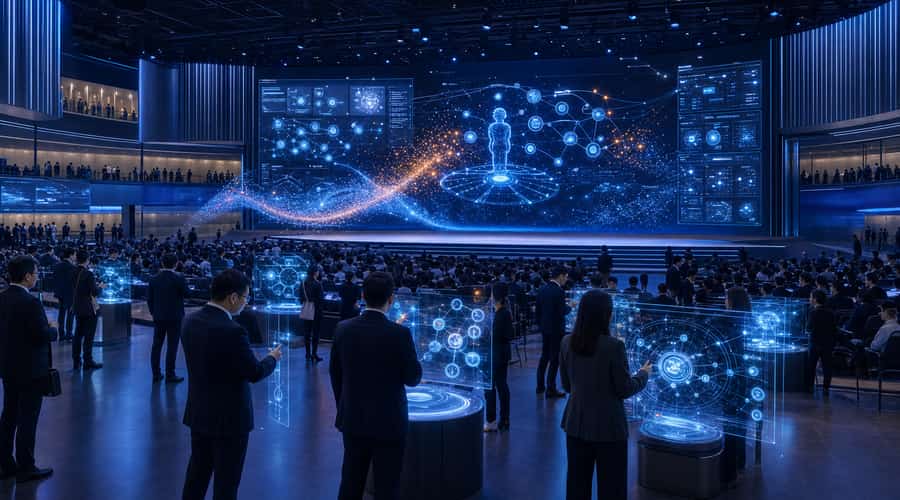
China's four biggest tech companies showed up in Shanghai with the same pitch: let us build your company's AI workforce.
The World Artificial Intelligence Conference in Shanghai wraps up today after four days, and the useful signal wasn't another chatbot demo. Ant Group, Tencent, Alibaba and Baidu all turned up around the same idea: enterprise clients, not consumers. According to the South China Morning Post, Ant Digital Technologies, the digital technology arm of Alibaba's fintech affiliate Ant Group, unveiled Agentar 2.0, a platform it describes as a "commercial AI agent super factory." The pitch is specific. It ships with 200 pre-configured "digital expert templates" and hundreds of ready-made agent tools, built so a company can deploy an autonomous AI worker without coding one from scratch.
You don't need to squint to see why this matters. For years the working assumption in Silicon Valley was that America's frontier labs would keep pulling further ahead while Chinese firms played catch-up on raw model capability. That gap has all but closed. Stanford's 2026 AI Index found the performance spread between the top US model and the leading Chinese contender on the Arena leaderboard had shrunk to 2.7 percent by March, down from a range of 17.5 to 31.6 percent in 2023. The same report put US private AI investment at $285.9 billion in 2025, more than 23 times China's $12.4 billion, while noting that private investment alone likely understates Chinese spending.
So if the models are converging, the fight moves somewhere else. That somewhere is the enterprise. WAIC 2026 was built for exactly that shift. Shanghai's city government said the event drew more than 1,100 companies, more than 3,000 exhibits and over 300 global product debuts across the Shanghai World Expo Exhibition and Convention Center, Zhangjiang and West Bund. The H1 Application and Ecosystem Pavilion was the cleanest tell: agents, industrial models, fintech systems and end-user devices all pushed toward the same question. What happens after a chatbot stops being a novelty and starts doing actual office work?
The pitch, company by company
Alibaba Cloud went first with infrastructure. On July 18 it launched Agent Native Cloud, built around AgentTeams for orchestrating multiple specialized agents at once and Agentic Computer, a secure sandboxed environment for running them. Alibaba backed the pitch with its own numbers. Inside the company, 15 coordinated agents now handle 85 percent of developer support requests, and operational support time is down 90 percent - while software release cycles have dropped to a single day. Those are internal figures, not independently audited. But they're the kind of specific claim that gives a sales pitch teeth.
Tencent Cloud came at it from the workspace angle, debuting WorkBuddy Enterprise AI Workspace alongside upgrades to ClawPro and its Agent Development Platform. It's playing catch-up. Parent company Tencent Holdings is also leaning harder on Yuanbao as it tries to close ground on ByteDance and Alibaba in consumer AI. Its corporate messaging app WeCom began testing an AI agent called Dayuan in late June, and recent WeCom app notes say the assistant is now available to try. Dayuan pulls context from group chats, documents, meeting records, emails and calendars, so it can answer a request without being re-briefed every time.
Baidu took a different route, showing DuMate, the general-purpose agent it introduced at Baidu Create in May. DuMate can break down a task and work through it step by step, reaching across multiple mobile apps and files to finish it. It's a smaller reveal than Ant's or Alibaba's. But it points the same direction: agents that operate software the way a person would, not agents that just answer questions about one.
The lock-in is the business
None of this is charity. Ant Group chief executive Cyril Han Xinyi said the company wants agents that restructure how enterprises work, not tools that simply speed up tasks someone was already doing. That's a bigger claim than it sounds. Speeding up a task is a feature. Restructuring a workflow is a sale that keeps renewing itself, because once a company rebuilds its operations around one platform's agents, switching providers gets expensive fast.
Here's the thing: the most interesting story isn't which platform wins first. It's what happens once four well-funded companies decide the same market, corporate workflow automation, is worth fighting over in the same city in the same week, with model quality no longer the deciding factor. Price will decide it instead, and so will integration - along with the unglamorous question of who actually gets a finance team off a spreadsheet faster. That fight is just getting started. It's happening in Shanghai first.
Also read: David Sacks Says US AI Safety Rules Let China's Kimi K3 Win on Security Fixes • Singapore Will Make Companies Disclose When Your Data Trains Their AI • TSMC Doubles Down on Arizona as It Sees Years of AI Chip Demand Ahead