TSMC just told Wall Street the AI chip boom isn't over, even after investors spent the past week treating chip stocks like the trade had broken.
Taiwan Semiconductor Manufacturing Co. posted a record quarter on July 16 and used the same earnings cycle to send a blunt message to rattled investors: demand for its most advanced chips isn't slowing down. It's compounding. CFO Wendell Huang told analysts the company expects "strong, multi-year" demand for AI chips, according to Reuters. CEO C.C. Wei went further, saying his conviction in what he called the "multi-year AI megatrend" remains very high, and that customers are describing their orders as structural demand, not a temporary surge.
The numbers behind that confidence are hard to wave away. TSMC's second-quarter revenue hit $40.2 billion, up roughly 34% from a year earlier. Net income jumped 77% to NT$706.56 billion. That's a single-quarter record, and it marks the company's ninth straight quarter of double-digit profit growth. Gross margin climbed to 67.7%, above the top end of TSMC's own guidance. The company raised its full-year 2026 revenue growth forecast from "above 30%" to "slightly above 40%" in dollar terms, and lifted its capital spending budget from a range of $52 billion to $56 billion up to $60 billion to $64 billion.
Arizona Is No Side Project
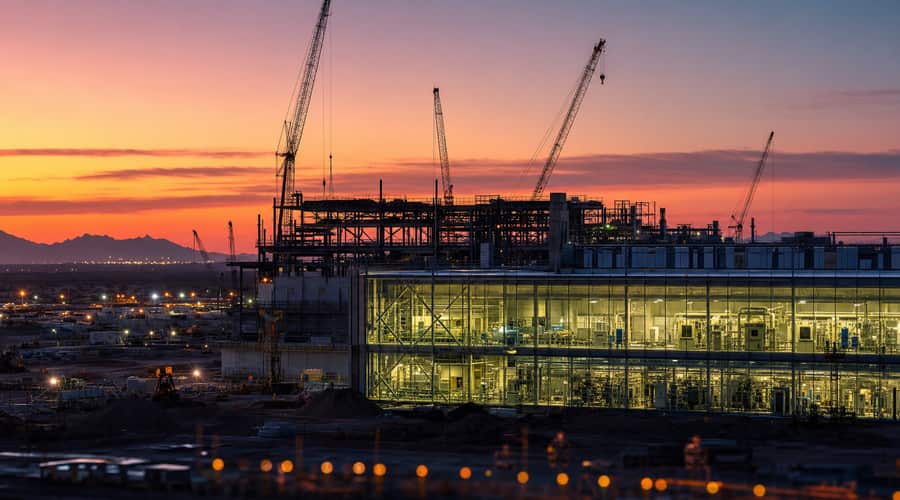
Then there's Arizona. TSMC said it will pour another $100 billion into its US operations, pushing its total American investment commitment to $265 billion. Huang said the company is "very happy" with progress at the site, even as it works through a shortage of construction workers there. Samsung and Intel are both racing to build out their own US foundry capacity, but TSMC's CFO made clear that customer demand, not just political pressure or competitive theater, is what's driving the acceleration.
That distinction matters. If you're watching the chip trade from the outside, a $265 billion US buildout can look like a monument to the top of the cycle - the spending that always shows up right before things turn. A company spends hardest when confidence is highest, and investors have seen that film before. But TSMC isn't a social media app chasing usage before the revenue shows up: it's the manufacturing bottleneck for Nvidia and Apple - and everyone else in the advanced-chip world besides. So ask who's standing behind the orders.
The Selloff Was Real
Semiconductor stocks tipped into a bear market the same week TSMC handed down that guidance. The Philadelphia Semiconductor Index ended July 17 down just over 20% from its late-June record, and Bloomberg reported that chip companies had shed about $3.3 trillion in market value since June 22 - Marvell and Arm fell more than 30% from their peaks, and so did Intel. If you've watched that bleed and wondered whether the AI infrastructure story has snapped, TSMC just handed you a data point that cuts hard against the panic.
The trigger wasn't one thing. Chinese startup Moonshot released Kimi K3, an open-weight model that investors read as evidence that frontier AI capability may not always require the newest, priciest chips. Meta then announced Meta Compute, a unit built to resell its own surplus AI training and inference capacity, which traders took as a signal that even the biggest spenders may have more capacity than they need right now. SK Hynix added to the nerves by delaying part of its HBM4 memory expansion in favor of higher-margin DDR5 output.
None of that panic shows up in TSMC's own numbers. Or in Micron's. The memory maker reported fiscal third-quarter revenue of $41.46 billion on June 24, against its earlier outlook of $33.5 billion plus or minus $750 million, then guided the current quarter to $50 billion plus or minus $1 billion. Micron also disclosed 16 strategic customer agreements. Several carry take-or-pay terms, meaning buyers commit to minimum volumes even if the market cools in between.
Frankly, that detail is worth sitting with.
Take-or-pay contracts aren't the language of customers casually testing a trend. They're a bet that supply stays tight for years, not quarters, and Micron's customers just signed that bet in writing.
Skeptics have a fair point too. TSMC and Micron are supply-side companies with every incentive to talk their book, and a foundry locked into a $265 billion, multi-year capital plan can't exactly announce a pause without frightening everyone attached to the chain. But the selloff wasn't triggered by evidence that chipmakers were losing orders. It was triggered by a bet that AI infrastructure spending has outrun what today's applications actually need, a debate about capacity utilization two or three years out, not about whether TSMC can fill this year's order book. On that narrower question, the company just gave the clearest answer available. Yes. And it's building more.
What happens next depends less on one earnings call than on whether hyperscalers keep signing contracts like the ones Micron just described. TSMC ships the chips. It doesn't decide whether the world needs them. That answer comes from Nvidia, Google, Amazon and Microsoft over the next two quarters, not from a foundry in Hsinchu.
Also read: Moonshot Quietly Fixed Real Security Bugs In Kimi K3's Coding Tool • Indian AI startup Emergent hits $1.5 billion valuation a year after launching • Kimi K3 Got So Popular It Ran Out Of GPUs For New Subscribers