Ionic Digital is trying to turn Celsius Network's bankruptcy wreckage into a Nasdaq-listed infrastructure story, backed by a $400 million raise and a decade-long AI data center lease in West Texas.
Celsius Network's collapse left creditors with a mess. Ionic Digital is now asking public-market investors to look at the same wreckage and see something else: power, land, and a 234-megawatt campus in Ward County, Texas, that AI companies suddenly want badly.
The company filed an S-1 with the SEC on June 29 under the ticker IOND, choosing a direct listing instead of a traditional IPO. According to the filing details in the company's registration statement, Ionic was formed in January 2024 to acquire Celsius Mining's assets out of bankruptcy and now says it has $1.95 billion in contracted future revenue. That's the number you have to sit with. This isn't only a Bitcoin miner trying to clean up an ugly origin story. It's a crypto bankruptcy estate being repackaged as digital infrastructure.
The timing helps. Ionic closed a $400 million private placement on June 26, three days before the S-1 appeared on EDGAR. The raise was priced at $53.00 per share of Series A convertible preferred stock and valued the company at $2 billion before the new money. Attestor, Oaktree Capital Management, Sachem Head Capital Management, Citadel, and Weiss Asset Management were listed among the investors. You don't need to romanticize that roster. Those funds are there because distressed crypto power assets have become much easier to sell when the buyer can say AI data center capacity in the same breath.
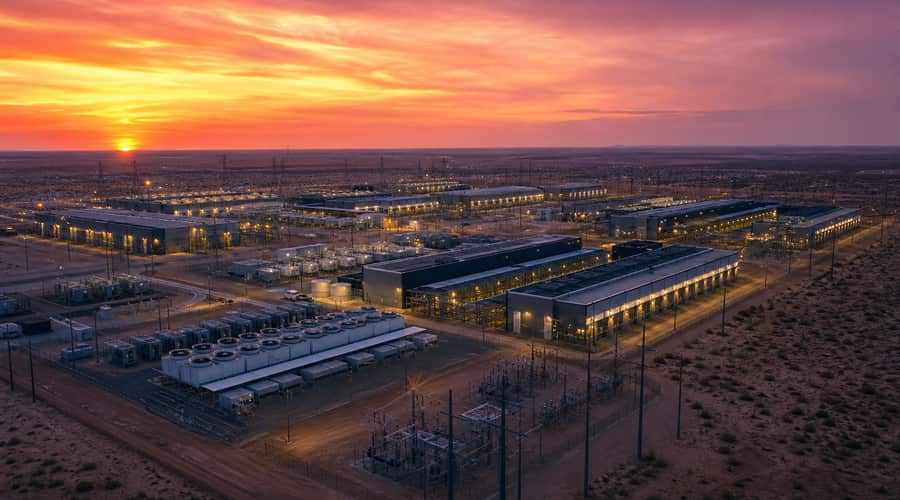
The Ward County site is the center of the pitch. Ionic took Celsius Mining's 234 MW campus in West Texas and signed a 126-month triple-net lease with Nscale, described in the filing as a global hyperscaler. Nscale is converting the facility into an AI and high-performance computing data center. Ionic keeps the asset and collects rent. The tenant does the conversion work. That's a much cleaner story than running machines through the next Bitcoin cycle and hoping the economics behave.
Bitcoin mining still matters to the numbers, but it no longer carries the whole case. Ionic reported $152 million in mining revenue for the twelve months ended March 31, 2026. The Nscale lease, by contrast, represents $1.95 billion of contracted revenue over more than ten years. A miner's revenue swings with Bitcoin prices, network difficulty, power costs, and regulatory mood. A long lease is different. It lets Ionic talk to investors as a landlord to compute demand, not just as another mining operator exposed to crypto volatility.
Frankly, that's the whole trade. The same land and power that looked stranded inside Celsius's failure now look useful because AI companies are hunting for large blocks of electricity. The asset didn't move. The market's appetite did.
The direct listing choice says something too. In a conventional IPO, underwriters price the deal, sell new shares, and usually lock insiders up for a period. Ionic is taking the other route. It registered up to 10.8 million shares for sale by existing holders, with J.P. Morgan, Jefferies, and BTIG acting as financial advisers rather than traditional underwriters. No new primary capital is being raised through the listing itself.
That only works if the company believes the market can find a price without the usual IPO machinery. Spotify did it in 2018. Palantir and Coinbase followed in 2020 and 2021. Ionic isn't those companies, and investors shouldn't pretend otherwise, but the comparison explains the mechanism. Existing holders get liquidity. Public buyers set the price in real time. The company avoids fresh dilution after already raising $400 million privately.
The lineage still cuts both ways. Celsius filed for bankruptcy in 2022 after becoming one of the clearest examples of crypto's easy-money era ending badly. Ionic may now have Oaktree and Citadel on the cap table, but the public company story begins with creditor claims, court-supervised asset transfers, and delays in getting to market. As recently as 2025, Celsius creditors were weighing liquidation while Ionic's listing timeline dragged. That history doesn't disappear because the end market changed from mining to AI infrastructure.
Public investors also have to take Nscale seriously as a counterparty. The lease is valuable only if Nscale completes the conversion and operates the campus at scale across the 126-month term. The filing's contracted revenue figure is useful, but contracted doesn't mean risk-free. A newer hyperscaler is not the same thing as Microsoft, Amazon, or Google signing the paper. If you're buying IOND after it starts trading, you're not buying the private placement at $53.00. You're buying whatever price the market gives a complicated asset with a cleaner story than its past.
Still, this is why the filing is current and worth attention. Ionic shows how fast the market has reclassified power-heavy crypto assets since the AI infrastructure boom began. A bankrupt lender's mining footprint has become a Nasdaq listing candidate with a $2 billion private valuation, a decade-long tenant commitment, and nearly $2 billion in contracted revenue. That's not a tidy redemption story. It's a reminder that in 2026, electricity can rehabilitate almost anything if the buyer says the word AI.
Also read: A 20-year-old high school dropout just raised $31 million to stop AI data centers from poisoning themselves • Google makes personalized AI image generation free and the pressure on image startups just got real • Hugging Face's CEO says being labeled too dangerous is the best enterprise marketing an AI lab can get