Omen AI has raised $31 million because liquid-cooled AI racks now have a very unglamorous problem: bacteria in the coolant can turn expensive compute into an expensive outage.
The AI infrastructure boom has reached the part no one puts in a keynote. Dense GPU racks need liquid cooling, and that cooling depends on a careful mix of water and biocide. Push the water ratio too high to pull out more heat, and you make the system friendlier to bacterial growth. Let that growth spread, and an operator can be staring at a five-to-six-hour rack shutdown that Omen says can cost millions. You can call that maintenance. The customer calls it lost compute.
That is the problem Zach Laberge is trying to sell against. Omen AI, the company he founded in 2024, has closed a $31 million Series A led by Nava Ventures, bringing its total funding to $40 million. CRV, Vanderbilt University, Mann+Hummel, Starhill Holdings and Hard Launch Capital joined the round, along with personal investments from executives at Bridgestone, GM and Johnson Controls. TensorWave, an AMD-based AI compute cloud that already uses Omen's product, also invested.
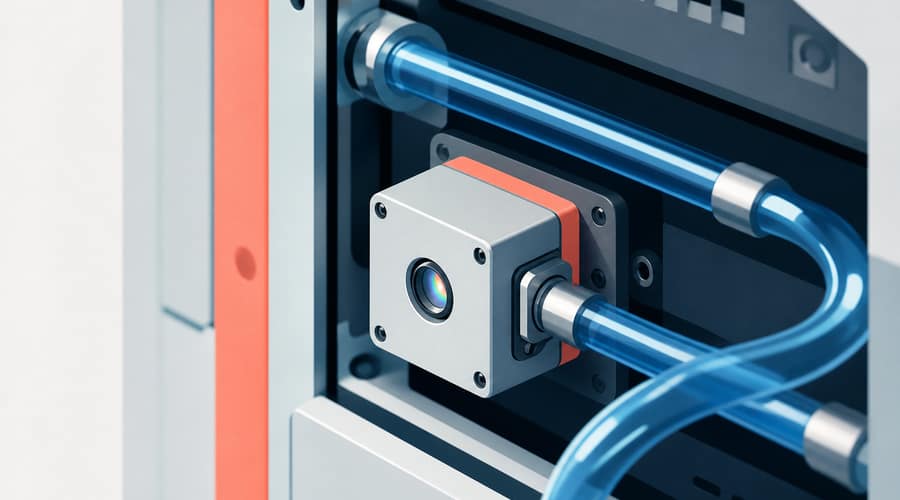
As TechCrunch reported, Omen's product is a miniature spectrometer that watches coolant fluid in real time and detects bacterial growth before it reaches the concentration that forces a flush. That matters because the fix is much cheaper while the problem is still chemistry. Operators can rebalance the water-to-biocide mix before contamination turns into downtime. Omen says it is already working with roughly a dozen data center customers.
Laberge is 20. That detail will carry the headline, and fair enough, because it is unusual. He started his first company at 14, raised $3 million to put sensors on construction equipment, and dropped out of high school to build it. Omen is his second company, founded when he was 18.
Don't let the biography swallow the business. The more important point is that Laberge has spent his short career around expensive physical systems that fail in expensive ways. Construction equipment and liquid-cooled data center racks don't look alike, but both punish you when you discover a problem after the asset is already down. Sensors are not glamorous. They are how you stop guessing.
The investor list tells you the same thing. Mann+Hummel is a filtration company. Bridgestone and Johnson Controls executives understand industrial systems where fluids, heat and maintenance schedules decide whether equipment keeps working. Nava Ventures led the financing, but the strategic names are the sharper signal. This is not really an AI software story. It is an industrial sensing story happening inside buildings full of AI hardware.
That distinction is useful because too much AI infrastructure coverage stops at the loudest objects: Nvidia chips, giant campuses, power contracts, model companies raising another huge round. Those things matter. But if you run a compute cloud, the rack that is already sold to a customer is the asset you need alive today. A five-to-six-hour outage is not a theoretical efficiency loss. It is capacity you cannot invoice, customers you have to explain things to, and technicians doing emergency work because a fluid system got away from them.
Frankly, this is where the picks-and-shovels phrase starts to feel too broad. Power companies, cooling vendors and data center developers are obvious AI infrastructure bets now. Omen sits lower in the stack. It is betting that the operational layer, the fluid monitoring, maintenance timing and contamination prevention, becomes valuable because every operator is trying to run hotter, denser and closer to the edge of what the hardware can tolerate.
There is still a hard question in the middle of the story. Omen's market grows only as liquid cooling spreads, and adoption is uneven across the data center industry. The highest-density AI racks need it first. More conventional facilities can move more slowly. That gives Omen a clear opening with AI compute clouds and advanced operators, but it also means the company has to prove its product before larger sensing, filtration or industrial analytics companies decide bacterial contamination in coolant loops is worth chasing.
A dozen customers is a start, not a moat. TensorWave's decision to invest after using the product is more useful than a generic endorsement, because it suggests Omen solved a real customer pain well enough for that customer to put money into the round. Now Laberge has to do the less headline-friendly work: turn a clever sensor into a reliable operating standard for data centers that cannot afford surprises in their cooling loops.
Also read: Google makes personalized AI image generation free and the pressure on image startups just got real • Hugging Face's CEO says being labeled too dangerous is the best enterprise marketing an AI lab can get • Waymo walks away from Uber in Phoenix and it tells you everything about where this industry is heading