
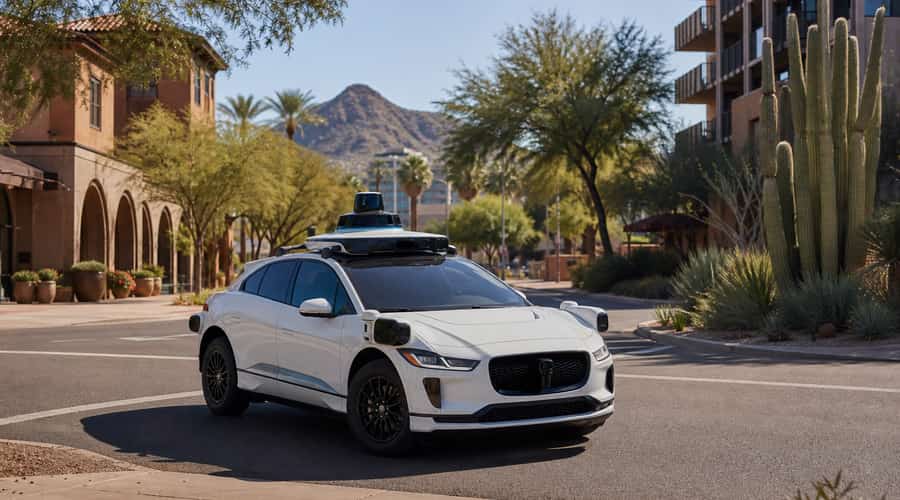
Waymo has pulled its Phoenix robotaxis off Uber, and the split tells you more about power than partnership. Once Waymo can bring riders to its own app, Uber's role starts to look less essential.
The breakup was quiet enough that riders spotted it first. Waymo vehicles stopped appearing in Uber's Phoenix app in May, according to TechCrunch, and Bloomberg reported on June 29 that the three-year arrangement is now over. The deal that began in 2023 covered passenger rides and Uber Eats deliveries. In Phoenix, those Waymo cars are now back inside Waymo's own world: the Waymo app for rides, Via for public transit connections in Chandler, and DoorDash for delivery. Uber says it has another autonomous partner coming to Phoenix. It hasn't said who.
That silence is the story.
When Waymo and Uber signed the Phoenix deal in 2023, the logic was obvious. Uber had riders, payments, routing habits, and a giant app people already opened without thinking. Waymo had the harder technology, but it still needed distribution. Phoenix was the right place to test that bargain. Waymo opened its driverless service to the public there in 2020, and the city gave it wide roads, reliable weather, and a market where robotaxis had time to become normal.
Two and a half years later, Waymo doesn't need Uber in Phoenix the way it once did. Recent market reporting puts Waymo at more than 500,000 paid rides a week across 11 U.S. cities, and The Verge reported this month that Waymo has begun selling a $29.99 monthly Waymo Premier membership in San Francisco, Los Angeles, and Phoenix. You don't launch a subscription product for another company's customers. You launch it when you think the customer relationship belongs to you.
That's why Phoenix cuts deeper than Austin or Atlanta. Waymo vehicles are still available through Uber in those two markets, so this isn't a total divorce. But Phoenix was where the model had the most history. It was the proof of concept for Uber as the demand layer and Waymo as the vehicle layer. Waymo just decided that in its oldest commercial market, the layer in the middle can go.
You can see the same pattern in Waymo's expansion map. In Nashville, Waymo has worked with Lyft, Uber's biggest U.S. rival. In London, where Uber is already entrenched, Waymo has lined up Moove as a fleet partner. In Phoenix, it has the Waymo app, DoorDash, and the Via connection. Different partners, different cities, same message: Waymo wants optionality, and it doesn't want Uber sitting between every rider and every car.
Uber is not sitting still. In March, Business Insider reported that Uber agreed to buy 10,000 autonomous Rivian R2 vehicles, invest up to $1.25 billion through 2031, and take an option for as many as 40,000 more. Those vehicles are supposed to start in San Francisco and Miami in 2028. Uber has also built a wider autonomous portfolio around partners including Avride, Wayve, Lucid, Nuro, Waabi, Baidu, WeRide and others. On paper, that's the right answer. Don't depend on one supplier. Don't let Waymo set the price of your future.
But here's the thing: most of those partners are not operating at Waymo's scale today. A Rivian robotaxi slated for 2028 is a plan. Waymo in Phoenix is a product you can open on your phone now. Avride and Wayve may matter a lot, but if Uber names either type of partner for Phoenix, the first question is not whether the press release sounds credible. It is whether riders can actually get a driverless car at meaningful volume.
The business model pressure is simple. Uber built a huge company by standing between riders and fragmented supply. Human drivers come and go. Uber aggregates them, prices the trip, owns the habit, and takes its cut. That works when no single driver has leverage. It looks different when the supply side is Alphabet-backed Waymo, which has its own app, its own cars, its own safety record, and enough riders to start charging for priority pickup.
Waymo also has a reason to keep more of each fare. If it can fill cars directly in Phoenix, there is no reason to split revenue with Uber just for the privilege of teaching Uber's app where demand exists. Every direct ride gives Waymo pricing data, customer habit, route history, and brand loyalty. Those are not small things. They are the business.
There are still reasons for Waymo to use Uber in newer markets. Austin and Atlanta give Waymo instant reach, and Uber gets robotaxis in front of users without owning the technology. Partnerships survive when both sides need something. Phoenix shows what happens when one side stops needing as much.
Frankly, Uber's problem is not that Waymo left one city. Uber's problem is that the best autonomous vehicle company has shown it can graduate from being a supplier to being a direct competitor. If robotaxis become scarce, valuable supply, the owner of the car and software has leverage over the app. Phoenix is the first clean reminder of that.
Also read: London Stock Exchange Group turns AI from threat into its strongest growth engine • Congress is circling the health data business model that AI startups built their futures on • Taiwan Raided Super Micro's Offices Today as the Nvidia Chip Smuggling Case Reaches a New Front