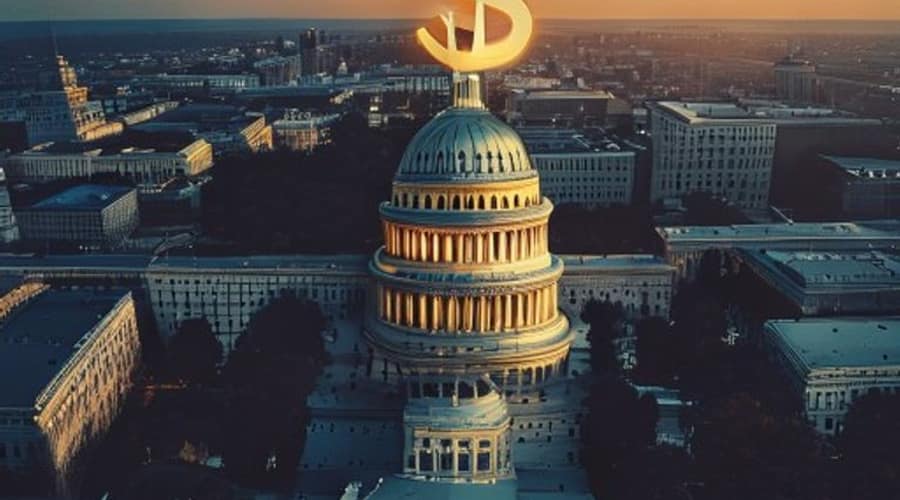
With interest on the national debt now topping $1 trillion a year and the 10-year Treasury sitting at 4.69%, Bank of America's fiscal forecast lands like a rate-hike notice for every founder with a pitch deck.
Bank of America's research team published its fiscal 2026 deficit forecast on July 24, and the number is $1.9 trillion: $7.5 trillion in federal spending against $5.6 trillion in revenue. The Office of Management and Budget pegs the gap at $2.06 trillion. Either way, the US is borrowing more than $155 billion every single month, according to Fortune, and paying roughly $24 billion a week just in interest on what it already owes. That's not an abstraction. It is the dominant structural fact in the capital markets right now, and it reaches directly into every Series A term sheet and venture fund model being written today.
The milestone that matters most is the $1 trillion interest figure. The federal government will spend more servicing its debt in fiscal 2026 than it spends on national defense, which the Congressional Budget Office puts at $947 billion. That crossover isn't a rounding error or a one-year anomaly. The CBO projects interest costs will rise to $2.1 trillion by 2036, up 106 percent over the decade. It will exceed Medicare spending by 2028. By 2048, it becomes the single largest line item in the entire federal budget. You don't need to squint to see what this means for the Fed's room to act: a central bank trying to cut rates while the Treasury is flooding the market with new supply is fighting against itself.
What it does to startup valuations
The 10-year Treasury yield closed at 4.69% on July 24. That's the risk-free rate against which every venture-backed company's future cash flows get discounted, which means startup valuations compress automatically when yields are elevated. A company worth 20x revenue when the 10-year sat at 1.5% might be worth 10x or less at 4.69%, even with identical fundamentals. This isn't a market mood. It's arithmetic. And the fiscal backdrop suggests those yields aren't coming down to the post-2008 floor anytime soon.
Heavy Treasury issuance keeps bond supply high, which pressures prices down and yields up, which gives the Fed less room to cut without igniting inflation. Markets currently price a fed funds trough around 3%, but reaching that floor requires inflation to cooperate. It hasn't fully. So the window for cheap money stays narrow, and founders who built their capital stack on the assumption that low rates would return are sitting on a structural miscalculation, not a temporary one.
The Bank of America Global Fund Manager Survey for July found that 45% of respondents now name an AI bubble as the leading tail risk. That's worth pausing on. Even in a market where AI money is conspicuously flowing, with Together AI closing an $800 million Series C and Proxima Fusion raising €411 million in recent weeks, the smart money is flagging concentration risk. Venture dollars are coming back, but they're piling into a narrow band of AI infrastructure, defense tech, and physical-world deployment plays. Founders with less specific stories are discovering that the frothy 2021 environment isn't the baseline. It was the anomaly.
The practical implications for capital structure are blunt. Debt-funded growth strategies, the kind that made sense when money was essentially free, now carry a hurdle rate that most early-stage revenue profiles can't clear. Founders who stretched runway by layering on venture debt at floating rates are facing a refinancing environment that looks nothing like the one when they signed. The exit math shifts too. Acquirers and public market investors discount terminal values more aggressively when the 10-year is near 5%, compressing the multiples that make late-stage returns work.
A regime change the industry won't name
Frankly, the story the BofA forecast tells is less about 2026 specifically and more about a regime change that has been visible since 2022 but that a lot of the industry has been reluctant to name. Cheap capital wasn't a feature of capitalism. It was a specific policy choice made in specific circumstances, and those circumstances are gone. What replaced them is a government that must roll over and service tens of trillions in existing debt at current rates while running a fresh $2 trillion annual shortfall, all while the Fed tries to thread a needle between growth and inflation. That combination keeps the 10-year elevated, keeps the risk premium wide, and keeps the multiples on growth assets under pressure.
None of this means startups can't be built or funded. The rounds are still happening. But the ones getting done are going to companies that can make a case on near-term economics, not promised scale five years out. The CBO's baseline, as reported by the Bipartisan Policy Center, shows deficits widening across the entire ten-year window under current law. The fiscal pressure doesn't ease. If anything, it compounds.
Founders who treat the current rate environment as a temporary inconvenience to be managed until the Fed pivots are making a bet that the fiscal math doesn't support. The smarter adjustment is to price the cost of capital correctly, right now, and build accordingly. The $1 trillion interest bill is not a warning. It's already the reality.
Also read: Tokenized stocks just outtraded crypto on Hyperliquid and the numbers are hard to ignore • DeepSeek tells investors to wait as its $71 billion fundraising round stalls • Defense tech investors bet on the Iran war and lost