Marc Lore has put another $650 million behind Wonder, and the real pitch is no longer just faster food. He wants public-market investors to believe a restaurant can behave like software.
Marc Lore has been here before. He built Diapers.com and sold it to Amazon for $545 million. He built Jet.com and sold it to Walmart for $3.3 billion. Now he is trying to do something harder: take a food company public before the market decides it is just another delivery business with better language around it.
According to Fortune, Lore said Wonder will be "ready and prepared to go public early next year" after closing a $650 million Series D on July 16, 2026. Wonder's own announcement put the pre-money valuation at $9 billion, which works out to about $9.65 billion after the new money. Goldman Sachs, Jefferies and J.P. Morgan acted as placement agents. The company said existing investors Accel, GV and New Enterprise Associates joined the round, along with new backers including AllianceBernstein, ARK Invest and Kayne Anderson Rudnick Investment Management.
That's a serious cap table. It also raises the bar.
Lore's IPO clock is unusually public. The Information reported that he has written March 31, 2027 on whiteboards in Wonder's Midtown Manhattan office as the date by which the company should be ready. You don't write a date like that on a wall unless you want employees and investors to feel it - bankers too. It turns a financing round into a deadline.
Wonder is still awkward to describe, which is part of its problem and part of its appeal. A single Wonder location can run dozens of restaurant concepts from one kitchen, including names tied to Bobby Flay and other chefs. Customers can order from more than one concept in the same transaction through Wonder's app. Wonder cooks the food and handles delivery itself. After buying Grubhub in a deal valued at $650 million that closed in 2025, it also owns a national delivery marketplace. Blue Apron, which Wonder bought in 2023, gives it meal kits too.
This is the bet.
If Wonder can pull those pieces into one operating system for meals, it stops looking like a restaurant roll-up and starts looking like infrastructure. If it can't, you are left with kitchens, delivery labor, brand licensing and the old restaurant problem of making thin-margin food businesses behave like venture-backed software companies. Frankly, that is the part public investors will care about more than the founder story.
The Kitchen Is The Pitch
Wonder's July 16 announcement said its footprint had tripled from 46 locations in May 2025 to 140 locations. Fortune described the company as operating 135 food halls across 10 East Coast states, a small difference that probably reflects timing, but the direction is clear enough. Wonder is opening locations quickly, and the new funding is earmarked for physical expansion, marketplace growth and the robotics and AI push.
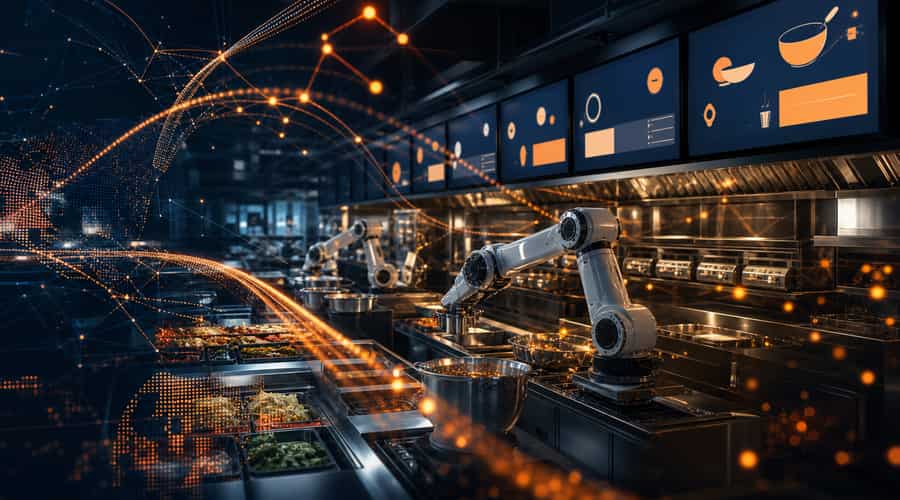
The robotics piece is not decoration. Fortune reported in June that Wonder's Infinite Kitchen technology, acquired from Sweetgreen, can make about 500 bowls an hour, compared with Lore's estimate that a human worker would probably make 30 to 45. Sweetgreen announced in November 2025 that it would sell the Spyce assets to Wonder for roughly $186 million. Lore told Fortune the bowl system was due to arrive in its first Wonder kitchen the next month, and he also talked about an "infinite sauce machine" and an automated beverage system planned for next year.
That part is real.
A restaurant chain can add kiosks and better scheduling software. Wonder is trying to change the unit itself. Its pitch is that one kitchen can make many brands, switch menus on the fly and keep labor lower through automation than a traditional multi-restaurant setup ever could. At Fortune's Brainstorm Tech event, Lore said Wonder owns 26 restaurant brands and can run all of them with three people late at night. Those numbers make the case better than any startup phrasing does.
The IPO Will Test The Math
Lore has also started talking about Wonder Create, an AI tool that lets people generate a virtual restaurant concept from a prompt. Fortune reported that the system could produce a name, menu, pricing, photos and nutrition information in about two minutes, with users able to push concepts live for $10 a month. Semafor reported that Lore sees influencers using that kind of tool to create delivery-only brands and drive customers back into Wonder with lower acquisition costs.
You can see why ARK Invest showed up. Wonder's press release quoted Cathie Wood saying the company fits the kind of scalable model ARK looks for, and the release tied the funding explicitly to the robotics and AI bet - food infrastructure, in Wood's framing. A plain restaurant company would be a strange fit for that portfolio. A platform that turns kitchens into programmable capacity makes more sense.
But scale changes everything.
Wonder's 140-location footprint is tiny next to national chains. Domino's has thousands of US stores. McDonald's has well over 13,000 domestic restaurants. Wonder doesn't have to look exactly like either company, but it does have to prove that its kitchens can expand without complexity eating the savings that automation is supposed to create. Delivery, food quality, equipment uptime and local demand all have to work in the same model. Dinner is operationally ugly.
That is why the March 2027 target matters. Lore is not only raising money, he is setting up a public-market story with a clock attached. Investors are being asked to believe Wonder can make restaurants more programmable - delivery more controlled, virtual brands cheaper to launch. At a $9 billion pre-money valuation, they are not paying for a clever food hall. They are paying for proof that the kitchen can become a platform.
Also read: Guillermo Rauch says AI agents now trigger more than half of all Vercel deployments • Two-thirds of all venture capital is now flowing to AI startups and non-AI founders are feeling it • Corgi tripled its valuation to $4 billion in eight weeks and is using the money to open coffee shops