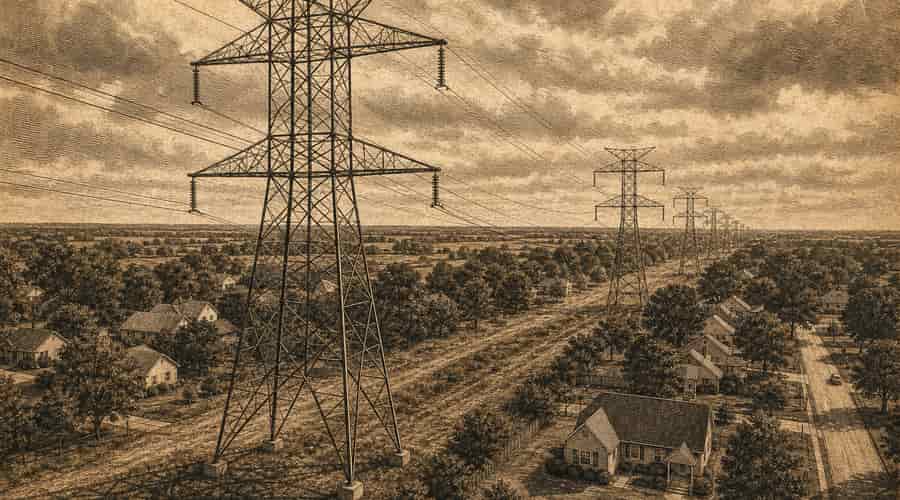
Georgia Power says its new Ashley Park-Wansley transmission line is public infrastructure. Families in its path see something plainer: homes being cleared so AI data centers can get power.
Angela Hall bought her Coweta County home in 2003 through a USDA loan program meant to help single mothers in rural areas. Now Georgia Power wants that land for a 35-mile, 500-kilovolt transmission line running between the Ashley Park substation in Fayette County and Plant Wansley in Heard County, crossing Fulton and Coweta counties along the way.
This is not a small easement dispute. CBS News reported in July 2026 that Georgia Power needs to acquire more than 300 parcels for the line, including residential properties, and that the company estimates 70% to 80% of the power on the new line will help serve data centers. Fortune reported the project could level nearly 30 homes. If you're one of those families, the distinction between public grid reliability and private AI expansion doesn't feel academic. It feels like a moving truck.
Hall's daughter, Ansley Brown, has made the case publicly on TikTok and in interviews. CBS quoted her saying the family sees the process as theft, because they don't have the money to fight Georgia Power. Georgia Power told CBS that eminent domain is a last resort and that it has worked to negotiate in good faith. The company also told Fortune that negotiations with Brown's family have concluded, though the specific terms were not disclosed in that report.
The Public Use Fight
Eminent domain exists because some infrastructure can't be built parcel by parcel through ordinary bargaining. Roads, rail lines, water systems and transmission corridors all run into the same problem: one landowner can block a project that serves a broader public need. That is the clean version of the law.
This case is messier.
Georgia Power's own project page says the Ashley Park-Wansley line is meant to strengthen the grid and improve reliability. It also says the project is not being built for a specific customer or facility. You can see why the company says that. A regulated electric utility serves the grid, not a named tenant in a warehouse full of servers.
But you can also see why residents aren't buying the neat public-use framing. Georgia Power's broader capacity expansion has been repeatedly tied to data centers. The Associated Press reported that the utility says it needs 10,000 megawatts of new capacity, enough to power about 4 million Georgia homes, with 80% of that flowing to data centers. The Georgia Public Service Commission approved the generation expansion in December 2025, with a construction cost reported at $16.3 billion. That is a very large public machinery wrapped around a very private demand curve.
Wisconsin is already showing where this argument goes next. Wisconsin Public Radio reported that the Wisconsin Institute for Law & Liberty warned American Transmission Co. that a proposed power line serving the Port Washington data center campus would not satisfy state or federal public-use requirements. That project is different from Georgia's, but the underlying question is the same: when a transmission line mainly exists because one or a handful of data center campuses need power, how public is the use?
Courts have given utilities room to build transmission lines for decades. They won't abandon that easily. Still, AI data centers are forcing an old legal category into a new shape, and residents are right to push on it. A 500-kilovolt tower outside your bedroom is not made less intrusive because the company calls it regional infrastructure.
The Buildout Behind The Homes
Georgia Power's pressure is not coming from one project alone. Its Ashley Park-Wansley page says the line is one of the first projects under a 10-year transmission plan that includes more than 1,000 miles of new transmission lines. Plant Wansley, once a coal site, is also being remade with new gas generation and battery storage. This is a full grid rebuild, not routine maintenance.
The AI boom is the accelerant. Data centers need huge blocks of power, fast, and Georgia has spent years making itself attractive to that industry with land, tax incentives and utility planning. The Atlanta Journal-Constitution reported in 2024 that data centers were responsible for roughly 80% of Georgia Power's expected new load. By 2026, that forecast had turned into homeowners being told where towers and easements may go.
Frankly, the burden is landing in the wrong place first. Amazon, Microsoft, Google, OpenAI and the rest of the AI economy can talk about national competitiveness all they like. The immediate cost is being carried by people who measured their lives in gardens, children, animals and paid-off rooms, not megawatts.
There is a fair argument for building more power infrastructure. Georgia is growing. The grid does need investment. But if data centers are driving most of the new demand, then utilities and regulators need to be blunt about who benefits, who pays and who loses land. Don't ask homeowners to call it shared progress when the first shared thing is their loss.
For families in Coweta, Fayette, Fulton and Heard counties, Georgia Power's timeline is already visible. The company's project schedule lists clearing and grading in early 2027, construction later that year, and line completion in the second quarter of 2028. The legal fight may shape future AI infrastructure. It won't put Angela Hall's house back where it was.
Also read: Singapore's Ropedia raises $30M to teach robots how to do chores by watching humans • Chinese AI models are taking US market share and the price gap explains everything • Data centers have been cutting your electricity bill for years and the AI buildout may end that