Broadcom's AI numbers didn't show a broken cycle. South Korea's market showed something more uncomfortable: when Samsung and SK Hynix become the whole trade, one wobble in AI expectations can turn into a market-wide selloff.
South Korea's KOSPI didn't fall 9.99% on June 23 because Broadcom had a bad quarter. It fell because investors had built a market around the idea that every AI-linked number would keep arriving better than expected, and Broadcom gave them something less useful than a disaster: a strong report that still failed to calm them.
That distinction matters. Investor's Business Daily reported that Broadcom's fiscal second-quarter revenue reached $22.19 billion for the quarter ended May 3, ahead of the $22.13 billion analysts tracked by FactSet expected, while adjusted earnings of $2.44 a share also beat estimates. AI semiconductor revenue rose 143% year-on-year to $10.8 billion. CEO Hock Tan said the company expected AI semiconductor revenue to grow more than 200% year-on-year in the current quarter to $16 billion. MarketWatch noted that Broadcom's total revenue forecast of $29.4 billion for the July quarter was above the FactSet consensus of about $28.3 billion.
So no, this was not a clean guidance miss. Calling it one gives the market too much credit. Broadcom's stock fell more than 13% in after-hours trading after the report because investors wanted a larger raise, cleaner margin comfort and fewer reasons to ask whether the AI trade had already priced in the next several quarters. When a company posts those numbers and still gets sold, you learn something about expectations, not demand.
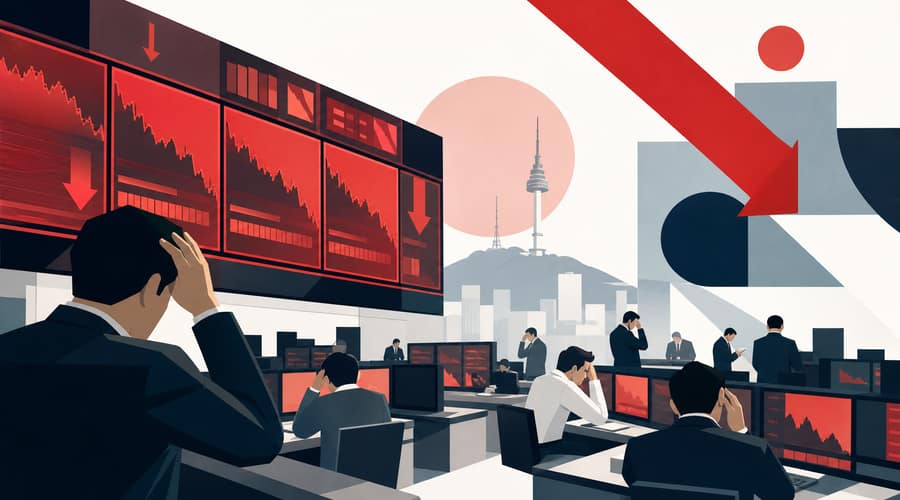
Seoul learned it quickly. Business Insider reported that the KOSPI dropped nearly 10% on June 23, its worst single-day fall in more than three months, with Samsung Electronics closing down 12.3% and SK Hynix down 12.5%. The Korea sell-off was ugly enough to trigger a 20-minute trading halt. Barron's reported the same day that Micron fell 13% in New York as the pressure moved through the memory-chip trade.
Samsung and SK Hynix are not ordinary index members. The Wall Street Journal reported on June 26 that the two chipmakers account for more than half the KOSPI's value. That is the part you should not skip. A broad national stock index had become a concentrated bet on memory chips, AI servers and the belief that hyperscaler spending would keep moving in one direction. When those two stocks fall together, the index doesn't bend. It breaks.
The Broadcom reaction was only one part of the trouble. Reuters reported that MSCI kept South Korea in its emerging-market category, citing persistent market-accessibility hurdles, especially in the onshore foreign-exchange market. MarketWatch also noted that South Korea's regulator had warned about leveraged exchange-traded funds tied to single stocks after a fast approval process. Add a hawkish Federal Reserve backdrop and a crowd of investors already sitting on large AI gains, and the selling did not need much help.
Frankly, this is what crowded trades do. They look disciplined while prices rise, then suddenly every separate issue starts acting like one issue. Broadcom's $16 billion AI semiconductor guide, MSCI's classification decision, leveraged ETF anxiety and Fed-rate nerves are different facts. In the KOSPI, they became the same trade because Samsung and SK Hynix had carried so much of the market's 2026 advance.
The story stayed current after the first break. Business Insider reported that the KOSPI rebounded more than 5% on June 25 as SK Hynix surged on plans for a Nasdaq listing, then fell again on June 26, dropping as much as 8% intraday and triggering a second trading halt that week. If you needed proof that June 23 was not a stale one-day panic, the rest of the week gave it to you.
For investors, the useful point is not that AI infrastructure demand has vanished. Broadcom's verified numbers don't say that. They say the opposite. The useful point is that a market can be right about a long-term trend and still be too concentrated, too levered and too dependent on perfect quarterly language. If your AI exposure runs through the same handful of memory, networking and accelerator names, you are not just betting on demand. You are betting that expectations never get ahead of it.
Korea can reduce part of this problem by fixing the market-access barriers MSCI keeps flagging, including foreign-exchange access. Developed-market status would not make Samsung and SK Hynix smaller, but it could bring steadier passive flows into a market that now swings too hard on momentum. Leave the structure as it is, and the next Broadcom earnings call, Micron forecast or ETF warning will always have a straight path into the KOSPI.
Also read: GCash parent Mynt files for a $1.5 billion IPO that would reset what Southeast Asian fintech is worth | Solana's price crash to multi-year lows tells only half the story of what the network is actually doing | X Money rolls out to more verified users and its 6% savings rate is just the opening move