AI did not need the cockpit recording to bring dead pilots' voices back online. It only needed the image that safety investigators thought was safe to publish.
The National Transportation Safety Board has run into a very modern version of an old transparency problem. Its public docket system, built to let journalists, families, lawyers, pilots and safety researchers inspect accident evidence, was temporarily taken offline after internet users reconstructed approximations of cockpit voice recorder audio from sound spectrum images in investigation files.
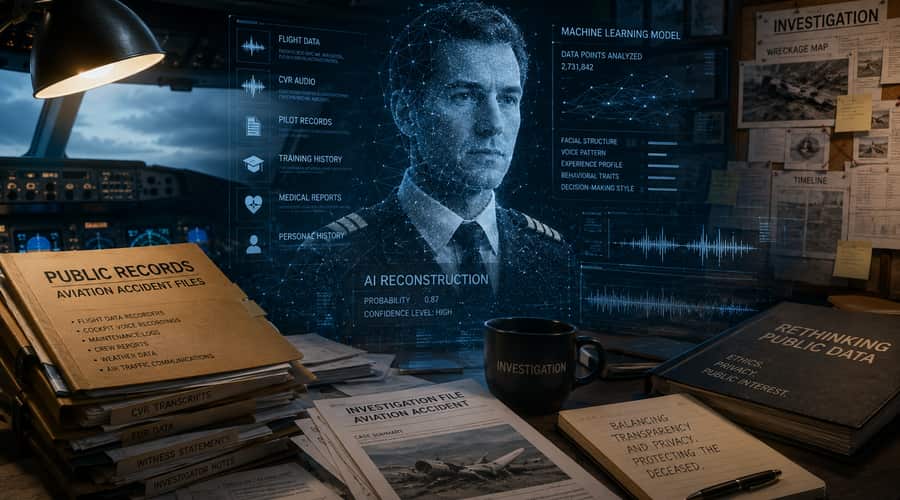
The case centers on UPS Flight 2976, the MD-11 cargo aircraft that crashed in Louisville, Kentucky, on November 4, 2025. The NTSB does not release cockpit voice recordings, and federal law places tight limits on public disclosure because those recordings capture highly sensitive conversations in the final moments of flight. But the docket included a spectrogram, a visual representation of sound. That image became enough raw material for people to work backward.
According to TechCrunch, users combined the spectrogram with the publicly available cockpit transcript to create AI-assisted approximations of the cockpit audio, and those reconstructions began circulating online. The NTSB said advances in image recognition and computational methods had enabled people to reconstruct approximations from sound spectrum imagery released as part of its investigations. That sentence should make every AI founder dealing with sensitive data sit up a little straighter.
This story is easy to describe as AI resurrecting dead pilots, and that is partly true. But the more important point is that the leak did not come from an audio file being posted by mistake. It came from a derivative technical artifact that still contained enough signal to be useful. The agency published an image. The internet treated it as recoverable data.
That matters because many institutions have built privacy policies around file types rather than information content. Audio is restricted, so audio is not posted. A transcript is permitted, so a transcript is posted. A spectrogram looks like analysis, so it may feel safer than a recording. In a world of stronger reconstruction tools, that distinction becomes much weaker.
The NTSB restored public access to much of its docket system on Friday but kept 42 investigations closed pending review, including the UPS Flight 2976 matter. That is a practical response, but it also shows how quickly one technical surprise can interrupt an entire public records workflow. The same problem will not stay confined to aviation. Hospitals, courts, insurers, police departments and workplace investigators all hold files that may contain hidden biometric or behavioral signals.
For aviation, the balance is especially difficult. Cockpit voice recorders exist to improve safety, not to feed public curiosity. Investigators need the recordings to understand alarms, crew coordination, aircraft systems and timing. Families and crews need confidence that those final conversations will not be turned into online spectacle. At the same time, public dockets are one reason aviation safety has such a strong learning culture. They let outsiders inspect facts, challenge assumptions and apply lessons across fleets.
AI companies should treat this as a warning
The enterprise lesson is not that every model should be banned from sensitive records. It is that data provenance, consent and technical redaction now have to cover more than the obvious file. If an image can be used to rebuild a voice, then the image belongs inside the same governance perimeter as the voice. If a transcript can be paired with acoustic residue to create a more convincing reconstruction, then those files cannot be reviewed in isolation.
This is where the post-ElevenLabs voice market gets more serious. Synthetic audio is moving beyond celebrity memes, podcast experiments and customer service voices. The business opportunity is in regulated environments: investigation tools, training simulations, accessibility, localization, legal review and secure internal analysis. But high-value use cases bring a different standard. A company selling into aviation, health care or legal services cannot simply say its model works. It has to prove where the data came from, who approved its use, how outputs are marked, and how misuse can be traced.
The UPS case also cuts against the idea that consent is only a consumer product issue. Deceased workers, surviving families, employers, unions, regulators and the public may all have competing interests in the same recording. A training department might see value in a realistic reconstruction. A family may see a violation. A regulator may see a breach of statutory intent even if no original audio file was posted.
There is also a harder question for public agencies. If the law prohibits release of cockpit audio, what counts as release when a permitted document can be transformed into audio with widely available tools? The answer will probably require policy, not just better redaction. Agencies may need to test public records against reconstruction risk the same way security teams test software against exploits.
The immediate market implication is clear. AI audio companies that want institutional customers will need more than realistic voices. They will need audit trails, watermarking, consent management, redaction tools and policies that treat derived data as potentially sensitive. The next phase of synthetic voice will not be won only by whoever sounds most human. It will be won by whoever can prove they know when a voice should not be brought back at all.
Also read: The S&P 500 rally is reopening the exit conversation • Blue Origin is turning Florida into a launch capacity bet • Stellantis is pushing deeper into Qualcomm's automotive software stack