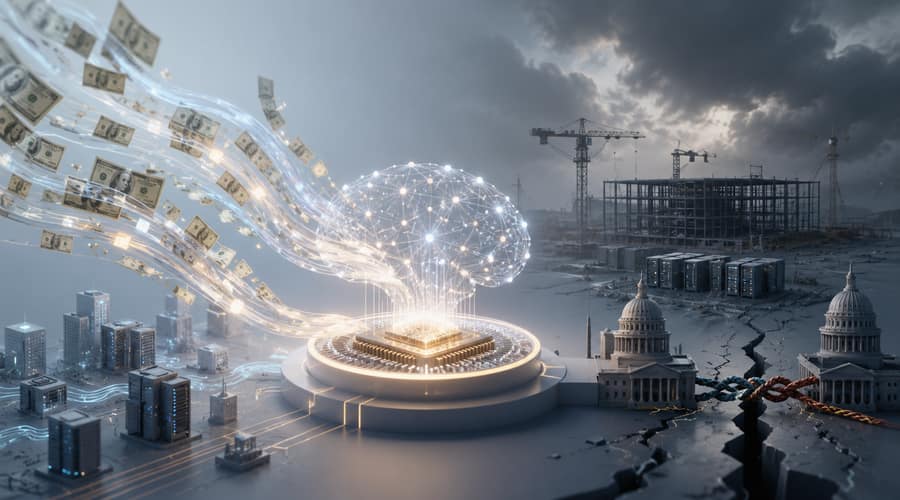
Artificial intelligence startups captured $242 billion in venture capital during Q1 2026, surpassing the sector's entire 2025 total in just three months.
Roughly 80 cents of every venture dollar allocated globally between January and March landed in artificial intelligence. The concentration is staggering: four companies, OpenAI, Anthropic, xAI, and Waymo, accounted for 65% of all venture capital deployed worldwide. OpenAI alone pulled in $122 billion, a single round that dwarfs what entire technology sectors raise in a decade.
This is not a broad market recovery. It is a gravitational collapse toward a single thesis. According to figures referenced by BeInCrypto, total global venture investment reached approximately $300 billion across roughly 6,000 funded companies. Remove the AI column and the picture looks grim for everyone else. Seed-stage founders in fintech, SaaS, and consumer technology are watching round sizes shrink while late-stage AI deals inflate beyond historical norms.
Here is where the story gets complicated. Money is not the bottleneck, physics is. A Bloomberg investigation recently found that roughly half of the AI data centers planned to come online in the United States during 2026 have been either delayed or cancelled outright. Transformer shortages, power grid strain, and supply chain tangles are throttling the physical buildout required to run these models. Only about one-third of the projected 12 gigawatts of new capacity is actually under construction.
That creates an awkward disconnect. Startups are sitting on war chests they cannot fully deploy because the infrastructure to train and serve their models does not exist yet. You can raise $30 billion, as Anthropic did at a $380 billion valuation, but you cannot conjure a power plant. This gap between funded ambition and operational reality is the defining tension heading into Q2 and beyond.
The Autonomous Workplace Arrives
While investors pour capital into foundational models, the application layer is moving fast. Coinbase CEO Brian Armstrong revealed the exchange is now testing AI agents that appear in Slack and email alongside human employees. The first two are modeled after prominent former Coinbase executives Fred Ehrsam and Balajis Srinivasan. Armstrong suggested the company could eventually employ more AI agents than people, a signal that enterprise adoption of autonomous systems is accelerating faster than most anticipated.
This is not limited to crypto exchanges. Major financial institutions, logistics companies, and healthcare providers are all racing to integrate agentic AI into workflows. The productivity gains are real, but so are the displacement concerns. Elon Musk responded to this trend by proposing what he calls "universal HIGH INCOME" through federal government checks, arguing that AI-driven productivity will outpace inflation. Andrew Yang echoed the sentiment, pushing for faster legislative action on AI-funded income programs.
The political friction is intensifying. Senator Bernie Sanders warned that AI companies plan to spend $300 million influencing the 2026 midterm elections, and he urged Democrats to confront what he termed "the AI Oligarchs." When tech barons are proposing universal income programs while simultaneously planning nine-figure political spending, you can sense the fault lines forming.
What Matters Next
The central question for the rest of 2026 is not whether AI can attract capital. It clearly can, at levels that make the 2021 crypto boom look modest. The question is whether the physical infrastructure can catch up fast enough to justify the valuations. If data center delays persist into the second half of the year, expect a harsh repricing of the most aggressive bets. For founders outside the AI umbrella, the funding winter is unlikely to thaw until late 2027. Capital has made its choice, and the concentration is only deepening.