
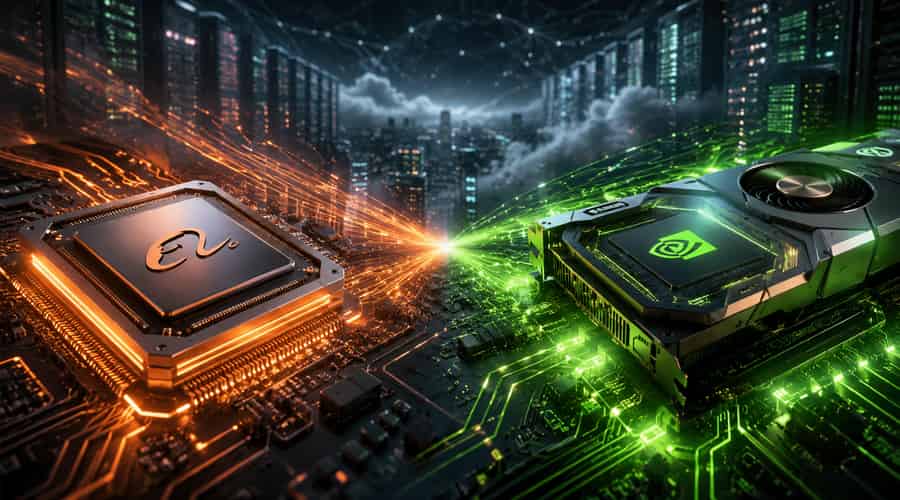
Alibaba is pushing deeper into AI hardware at a moment when China’s biggest technology companies can no longer treat chips as someone else’s problem.
Alibaba’s latest chip move is not just another product announcement. It is a signal that the company wants more control over the infrastructure beneath its AI ambitions, from the Qwen model family to the cloud systems that customers use to run those models.
Reuters reported this week that Alibaba unveiled a next-generation chip designed for agentic AI, the kind of workload that requires models to plan, call tools, hold context, and complete multi-step tasks with less human supervision. That matters because the AI race is moving from impressive demos to repeatable execution. The companies that can run these systems cheaply and reliably will have an advantage that goes beyond model rankings.
The timing is hard to separate from U.S. export controls. Chinese technology companies still want access to Nvidia’s strongest hardware, but they cannot build long-term AI strategies around chips that may be delayed, restricted, or politically complicated. That has pushed Alibaba, Baidu, Huawei, and other domestic players to invest more heavily in their own silicon, even where those chips still trail Nvidia at the high end.
There is also a business logic here that is easy to miss. Alibaba is not building chips in isolation. It has Qwen models, a large cloud business, and a customer base that already needs inference capacity, model hosting, and AI infrastructure. If its own chips can handle more of that work, Alibaba can reduce costs, tune hardware more closely to its software, and sell customers a more complete AI platform.
The company has already been moving in that direction. Its semiconductor unit T-Head introduced the Zhenwu 810E earlier this year, and reports from Chinese technology outlets said the chip had been deployed in large Alibaba Cloud clusters and optimized for Qwen workloads. Reuters also reported in September 2025 that Alibaba and Baidu had started using internally designed chips for at least some AI training work, partly replacing Nvidia systems for smaller or less demanding models.
That last point is important. This is not a clean break from Nvidia, and nobody should pretend otherwise. Reuters noted at the time that Alibaba and Baidu had not fully abandoned Nvidia for their most advanced models. The practical strategy is more layered: use domestic chips where they are good enough, preserve access to Nvidia where possible, and avoid being fully dependent on a supply chain shaped by Washington and Beijing.
The Nvidia pressure points
Nvidia still dominates advanced AI hardware, but China has become the most politically sensitive part of its business. Export limits have narrowed the chips that can be shipped into the country, while Chinese regulators and state-linked buyers have been pushing domestic alternatives. That creates a market where demand for Nvidia remains intense, but the risk attached to depending on it keeps rising.
The pressure was visible again this month. Reuters, citing Bloomberg, reported that U.S. authorities suspect Nvidia-equipped Super Micro servers were smuggled to China through Thailand, with Alibaba named among the alleged end customers. Alibaba denied wrongdoing, telling Reuters it had no business ties with Super Micro, OBON, or the brokers cited in the indictment, and said banned Nvidia chips had never been used in its data centers.
Even with that denial, the episode underlines the basic problem. Advanced AI chips are now strategic assets, not ordinary enterprise hardware. When supply is restricted and demand keeps climbing, companies look for alternatives, governments watch every shipment, and investors have to treat infrastructure access as part of the AI investment case.
Alibaba’s spending plans show how seriously it is treating that reality. Reuters reported last week that the company expects to exceed its previously announced 380 billion yuan, or about $55.96 billion, AI and cloud investment plan over three years. Its Cloud Intelligence Group revenue rose 38% year over year to 41.63 billion yuan, giving management a clearer argument that heavy AI spending is starting to connect with real demand.
For investors, the bigger signal is that Alibaba is no longer behaving like a pure e-commerce company adding AI features around the edges. It is acting like a platform company trying to own more of the stack beneath its products. That is expensive and operationally difficult, but it also gives Alibaba more control over performance, pricing, and product design.
The broader market should read this as part of a longer shift. Nvidia remains the standard setter, but China’s largest technology companies are building domestic alternatives fast enough to change procurement decisions, especially for cloud inference and internal model workloads. If Alibaba can turn its chip work into reliable capacity for Qwen and Alibaba Cloud, the AI boom becomes less about who has the best model on a leaderboard and more about who can keep enough compute online when the politics get harder.
Also read: Google and Volvo push Gemini into the driver's seat • SpaceX's push into developer tools with Cursor shows hardware-first firms want the software that builds their products • Google moves deeper into AI security as Mythos gains traction