
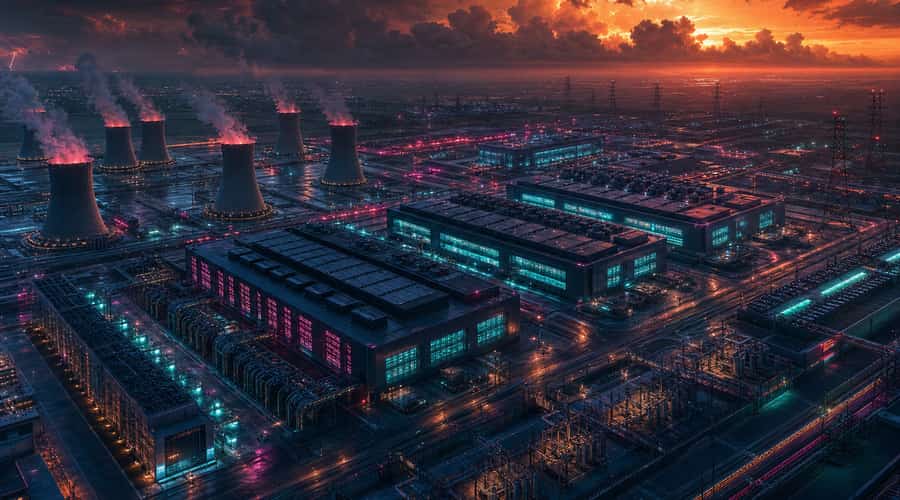
BloombergNEF now says US data centers could need 194 gigawatts of power by 2035, an 83% jump from its December forecast. AI hasn't just strained the grid. It has strained the people trying to model the grid.
Seven months. That's all it took for BloombergNEF to nearly double its own forecast for US data center power demand. According to Latitude Media's July 21 report on BloombergNEF's new outlook, US data centers could reach 194 gigawatts of power capacity by 2035, up from the firm's December forecast of 106 gigawatts. That would put data centers at about 20% of US electricity consumption by the middle of the next decade, compared with 5.9% today.
That is not a rounding error. It's a warning.
Other forecasters have been dragged in the same direction. EPRI's 2026 Powering Intelligence report says its revised projections are about 60% higher than its 2024 estimates, with data centers consuming 9% to 17% of US electricity by 2030. S&P Global's 451 Research lifted its 2030 US data center grid power forecast from 134.4 gigawatts in an October 2025 outlook to 183.2 gigawatts in an April 2026 release. When BloombergNEF, EPRI and S&P Global all move sharply upward in the same window, the story isn't only that AI uses a lot of electricity. You already knew that. The story is that the buildout is outrunning the assumptions used to finance it.
The models are chasing the builders
Four companies sit near the middle of that pressure. Rabobank, citing BloombergNEF's data center capacity database, said Meta, Amazon Web Services, Microsoft and Google controlled about 13 gigawatts of live IT capacity in North America as of September 30, 2025, equal to 42% of the region's total live IT capacity. Latitude Media reported that Amazon, Google, Microsoft and Meta could collectively spend $700 billion this year, based on their quarterly earnings calls.
Look at the order of events. The hyperscalers announce facilities, utilities scramble for interconnection plans, forecasters revise their numbers, and investors then pretend the new forecast was always obvious. It wasn't. BloombergNEF's December forecast was already large. The July number makes it look cautious.
For anyone with money in energy or compute-adjacent infrastructure, the 83% revision is the thesis in one figure. Data center REITs such as Equinix and Digital Realty benefit when capacity keeps expanding, but the cleaner question now sits upstream. Who can deliver power, fast, at a scale that doesn't collapse under permitting delays, transformer shortages and local opposition?
Nuclear has become the answer many tech companies want to hear. SMR Intel's nuclear data center tracker says 13 announced projects had committed 9.8 gigawatts of nuclear capacity for AI infrastructure as of early July, with Microsoft, Google, Amazon and Meta all tied to nuclear deals. Microsoft has its 20-year agreement with Constellation tied to the planned restart of Three Mile Island Unit 1. Google has a deal with Kairos Power. Amazon has backed X-energy. Meta has been linked to multiple nuclear procurement efforts.
One gigawatt is roughly the output of a traditional nuclear reactor. Some next-generation AI campuses are being planned at a scale where that comparison stops sounding dramatic and starts sounding operational. A single large campus can become a power system problem in its own right.
Power is becoming the product
BloombergNEF's own public writing earlier this year said developers were prioritising speed to power while grids struggled to keep up, with operators turning to behind-the-meter procurement and old power plants, and nuclear agreements where they could get them. Latitude Media's July report added a harder detail: BNEF has tracked 124 gigawatts of announced on-site gas capacity for data centers, although only a small share is under construction. That caveat matters. Announced capacity doesn't cool servers. Built capacity does.
For founders and VCs, this changes where the interesting companies are likely to appear. Cooling, grid software, demand response, distributed generation and workload scheduling are not side markets if electricity access is the bottleneck. They're part of the critical path. A startup that helps a data center shift inference to cheaper hours or prove flexible demand to a utility is no longer selling a nice efficiency tool. It's selling permission to build.
The same pressure changes the chip market. If power is the constraint, efficiency becomes the premium. Full stop. Nvidia still has the commanding position in AI accelerators, but chips and systems that produce more inference per watt will be judged differently when power contracts, substations and generation sit inside the cost of compute. AMD, hyperscaler custom silicon, networking gear, cooling loops, you name it, all get pulled into the same calculation.
Frankly, the uncomfortable part is not BloombergNEF's 194-gigawatt forecast. It is what happens if this one is also too low. The US has not built energy infrastructure on this kind of timetable in recent memory, and local resistance is already showing up in county board rooms, state legislatures and the ratepayer fights that follow. AI may still be sold as software. The bill underneath it is concrete, steel, turbines, substations and land.
That is the part you should watch.
Also read: Claude Fable 5 helped crack the Jacobian Conjecture after 87 years of failure • Curative CEO canceled a $600,000 Salesforce contract after vibecoding a replacement CRM in two months • OpenAI's Codex and ChatGPT Work just crossed 10 million weekly users and the coding wars have a new shape