America's AI buildout has run into a local permission problem. The chips may be scarce, but community support is starting to look just as hard to secure.
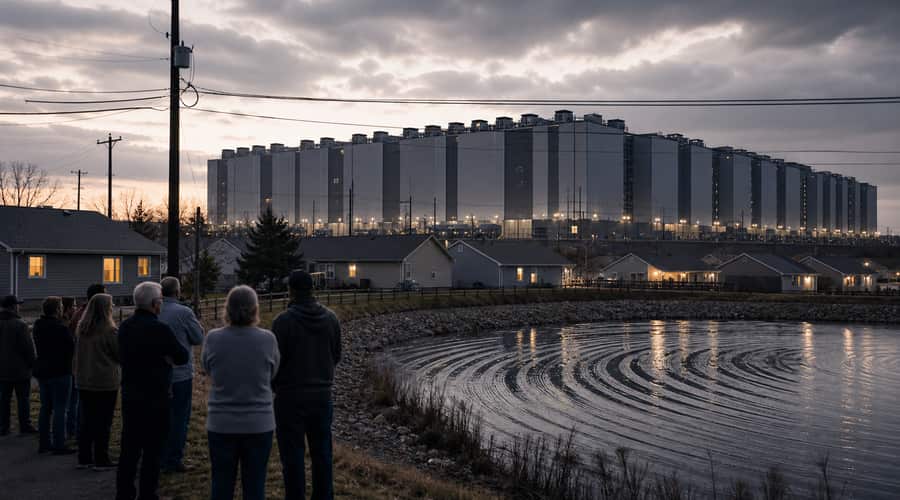
The new fight over artificial intelligence is not happening inside a model lab. It is happening in town halls, utility hearings and county zoning meetings, where residents are being asked to accept the physical footprint of the AI boom.
According to Gallup's May 13 report on its March 2 to 18 survey, 71% of U.S. adults oppose building an AI data center in their local area, including 48% who are strongly opposed. Only 27% support one, and just 7% strongly support it. That is a sharp warning for an industry that has treated compute capacity as a problem of capital, chips and power contracts.
The striking part is the comparison. Gallup found that 53% of Americans oppose a nuclear energy plant in their area, far below the opposition to an AI data center. Nuclear plants have carried decades of political baggage, yet AI infrastructure is now drawing a stronger local reaction in the poll. That should get the attention of every hyperscaler, cloud provider and infrastructure investor trying to turn capex plans into operating capacity.
This is not simply a vague dislike of new development. Gallup found that 70% of adults worry at least a fair amount about the environmental impact of AI data centers, with 46% worrying a great deal. Among opponents, resource use was the dominant concern. Water and energy were each mentioned by 18% of opponents, while 16% cited pollution, including noise, air and water pollution. About one in five pointed to quality-of-life concerns such as traffic, population growth and land use.
Data centers used to be easier to sell as quiet industrial facilities with a clean digital story. The AI version is different. These campuses can be enormous, they pull large and steady power loads, and they increasingly arrive with questions about water, backup generation, transmission upgrades and who pays when the grid needs to expand.
Pew Research Center's January 20 to 26 survey adds useful context. More Americans said data centers are mostly bad than mostly good for the environment, 39% to 4%. They also viewed them more negatively than positively for home energy costs, 38% to 6%, and for nearby quality of life, 30% to 6%. The public still sees some upside for jobs and local tax revenue, but that is not enough to erase the suspicion that the benefits and costs land in different places.
That matters because the AI infrastructure race is no longer theoretical. The International Energy Agency has said global data center electricity consumption is set to more than double to around 945 terawatt-hours by 2030, with U.S. data centers accounting for nearly half of electricity demand growth between now and then. When demand moves at that scale, it stops being a back-office technology story and becomes an energy and land-use story.
For developers, the political risk is now part of the project model. ConstructConnect reported this week that data center starts reached $46.5 billion through March 2026, with another $63.2 billion in late-stage projects expected to start between April and December. At the same time, local fights are surfacing from Seattle to Upstate New York to Ohio, where the questions are not just whether a project can be financed, but whether residents believe it deserves grid capacity, tax incentives and land.
Community Benefits Are Becoming Infrastructure
The companies that understand this will treat community agreements as part of the build, not a public-relations add-on. A data center that promises hundreds of construction jobs but only a few hundred permanent roles will need a better local case than employment alone. Residents want to know whether their electricity bills rise, whether water stays available, whether backup power dirties the air, and whether the tax base actually improves public services.
Some companies are already adjusting the playbook. In New Mexico, Oracle shifted Project Jupiter away from a gas-turbine-and-diesel plan toward a Bloom Energy fuel-cell microgrid after regulatory setbacks, with the company saying the redesign would reduce nitrogen oxide emissions, use negligible water and avoid pressure on local electricity rates. In Indiana, Meta has promoted more than $120 million in water and public infrastructure improvements tied to its Lebanon campus, along with closed-loop cooling expected to use zero water for much of the year.
Those examples show where the industry is heading. The next successful projects will need visible offsets: grid upgrades that do not fall on households, credible water plans, noise controls, local tax transparency, and contracts that make benefits enforceable. Without that, opposition can turn a technically feasible site into a delayed or cancelled one.
This is also a timing issue for AI companies. Investors have been watching Nvidia supply, accelerator availability and model demand. But the bottleneck may shift from chips to megawatts, and then from megawatts to permission. A server cannot generate revenue until the building is powered, connected and accepted by the place around it.
The market implication is straightforward. AI infrastructure will still be built, because demand for compute is real and the largest technology companies have the balance sheets to chase it. But the cheap assumption that communities will accept every project is fading. The winners will be the builders that can make the local bargain believable before the opposition organizes, because once a data center becomes the issue in a local election, the capex clock starts moving a lot more slowly.
Also read: Pope Leo makes AI warfare a governance test for startups • Stealth clipping campaigns are making organic virality harder to trust • Orthrus makes local AI inference economics look worth rechecking