AI companies have a new infrastructure problem, and it is not just chips or power. The public is starting to treat data centers as an unwanted neighbor.
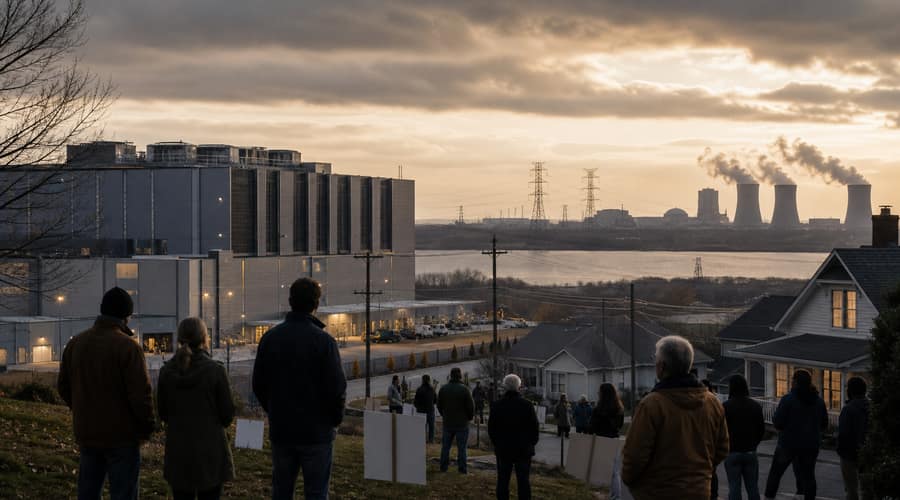
The race to build artificial intelligence infrastructure has run into a very local kind of resistance. Americans are now more likely to oppose an AI data center near them than a nuclear power plant, a finding that should make every hyperscaler, utility and state development agency pay attention.
According to new Gallup data reported by Forbes and The Washington Post on May 13, 71% of Americans somewhat or strongly oppose an AI data center being built in their area. Nearly half, 48%, say they are strongly opposed. By comparison, 53% oppose a nearby nuclear energy plant. That is still a majority, but it is also a warning sign for the AI industry: nuclear power, long treated as the classic local-permitting nightmare, is now the less unpopular option.
This matters because AI is not floating somewhere in the cloud. It needs land, transmission lines, backup generators, cooling systems, substations and enormous amounts of electricity. The public is beginning to connect the software they see on a screen with the industrial footprint required to make it work.
The opposition is not only about artificial intelligence as an idea. It is about water, power bills, noise and whether communities believe they are getting a fair exchange. Semafor, citing the same Gallup findings, noted that half of opponents pointed to resource use, including water, electricity and environmental impact, while 22% cited quality-of-life concerns and about one in five pointed to higher costs.
That lines up with what other surveys have been showing. Pew Research Center found in March that Americans were far more likely to say data centers are bad for the environment and home energy costs than good. Redfin, using an Ipsos survey released in early May, found that 47% of U.S. residents opposed an AI data center in their neighborhood, with concerns tied to electricity, water, noise and large industrial structures.
For years, data-center developers had a fairly simple pitch. They promised investment, construction work and tax revenue. That can still be powerful, especially in places looking for a larger tax base. But the Gallup numbers suggest that pitch no longer lands by itself. A community looking at a server farm is asking a more direct question: will this project make life better here, or will it mostly serve companies and customers somewhere else?
That is where the politics get harder. A factory can point to permanent jobs on-site. A port can point to trade moving through town. A data center can bring a large capital investment, but once construction is finished, the number of long-term jobs can look modest next to the size of the building, the power draw and the public attention.
Nuclear looks different in the AI era
The nuclear comparison is especially uncomfortable for the AI sector because nuclear power carries its own history of fear, delay and local resistance. Yet the new polling shows that many Americans now seem to understand the tradeoff differently. A nuclear plant is visibly tied to energy supply. A data center is visibly tied to energy demand.
That distinction could reshape how AI buildouts are powered. Microsoft has backed a plan to restart the Three Mile Island Unit 1 reactor through a power purchase agreement with Constellation. Amazon, Google and other large technology companies have been exploring nuclear, geothermal and other firm power sources as the grid strains under new demand. The message is clear enough: the industry knows that buying renewable credits and plugging into an already stretched grid will not answer every political objection.
But pairing AI with nuclear does not automatically solve the local trust problem. In some places, it may combine two difficult permitting fights into one. Residents who worry about water use or transmission lines will not stop asking questions because the power source has a cleaner emissions profile. They will want to know who pays for upgrades, who gets priority during shortages, what happens to utility bills and how much of the benefit stays local.
This is the part the AI industry has been slow to accept. Infrastructure projects are not won only with national competitiveness arguments. People may accept that AI matters to the economy and still reject a facility at the edge of their town. They may believe the United States needs more computing power and still oppose a project that looks like a burden pushed onto their community.
The practical answer is a new community-benefits playbook. Not a glossy website. Real commitments. Developers will need to be clearer about water use, power sourcing, noise controls, tax arrangements, local hiring and how they will keep costs from being shifted onto households and small businesses. They will also need to show up earlier, before zoning votes and construction plans make residents feel boxed in.
There is an opportunity here for the companies that move first. A developer that can prove it is bringing new power onto the grid, funding local infrastructure and creating durable community value will have an advantage over one that arrives with a familiar promise of economic development and expects gratitude. The AI capex race is still about chips, models and energy. But after this Gallup poll, it is also about permission. The next phase of AI infrastructure will be built town by town, and the towns are no longer quietly saying yes.
Also read: Overworked AI agents are giving founders a new alignment warning • Cerebras IPO puts a public price on the AI infrastructure boom • Blackstone brings the AI data center trade to public investors