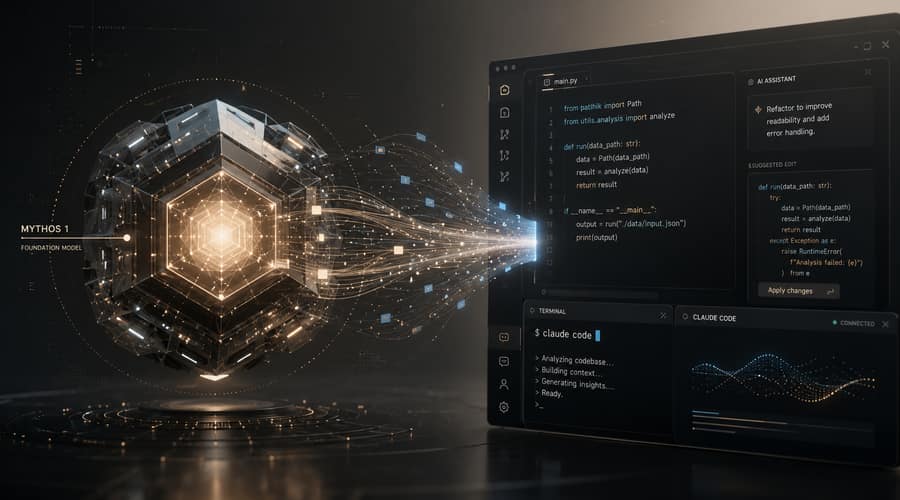
Mythos 1 appears to be moving from a restricted security research system into Anthropic's developer product line. That could make secure coding a core feature of Claude Code, not a separate audit step.
Anthropic's security story is starting to look less like a laboratory project and more like a product strategy. New product strings spotted in Claude Code and Claude Security reportedly reference access to the Claude Mythos model, suggesting that the company's most sensitive vulnerability-finding work is being prepared for a developer-facing surface.
That matters because Mythos was not introduced as just another coding model. Anthropic positioned Claude Mythos Preview as a powerful system for finding and exploiting software vulnerabilities, then kept it under restricted access through Project Glasswing. The model was framed as useful for defenders, but dangerous if broadly released without stronger safeguards.
Now the signal is different. As TestingCatalog reported on May 23, recent Claude Code and Claude Security strings point to a product called Mythos 1, including language around access to the Claude Mythos model in those tools. That does not prove a public launch is live today, and Anthropic has not announced broad availability. But it does suggest the company is building the rails for Mythos-class security work to appear where developers already write, review and ship code.
The practical shift is simple. Security reviews are most useful when they happen before the code reaches production. For years, startups have treated vulnerability scanning as something that happens in CI pipelines, external audits or late-stage reviews. That approach catches some issues, but it also creates a familiar problem: engineers discover the security work after the feature is already mentally finished.
Claude Code already sits closer to the moment of creation. If Mythos 1 becomes part of that workflow, Anthropic can turn secure coding from a periodic inspection into a live development habit. A founder using Claude Code would not just ask for a feature, a refactor or a test. The same environment could also surface risky logic, insecure assumptions and exploitable patterns before they harden into technical debt.
This is where the numbers around Mythos become important, but they need care. Anthropic's May 22 Project Glasswing update said it and its partners had found more than ten thousand high- or critical-severity vulnerabilities in essential software. Its public disclosure dashboard separately showed 1,596 vulnerabilities disclosed across 281 open-source projects as of May 22, with 97 patched upstream. Those are not the same number, and the difference tells the real story. Finding bugs is becoming faster than validating, disclosing and fixing them.
That bottleneck is the reason Mythos inside Claude Code would be meaningful. Startups do not need another dashboard that produces a long queue of warnings nobody owns. They need security output that is tied to the code, the pull request and the engineer who can make the fix. The closer Anthropic gets to that workflow, the more valuable Claude Code becomes as a development platform.
The competitive angle is getting sharper
Anthropic is not the only company trying to own the developer's daily workflow. GitHub Copilot has the distribution advantage inside Microsoft and GitHub. Cursor has become a favorite among teams that want an AI-first coding environment. OpenAI's Codex work has also pushed the market toward agents that can modify, test and reason across codebases.
Mythos gives Anthropic a different wedge. Most coding assistants compete on speed, context length, model quality and how naturally they can make changes across a repository. Security gives Claude Code a harder business case. If a tool can help engineers ship faster and reduce expensive vulnerabilities, the buyer is no longer only the developer who likes the experience. The buyer can also be the CTO, the security lead and the founder trying to keep a small team from accumulating hidden risk.
There is also a trust problem Anthropic will have to manage carefully. Mythos Preview was powerful enough that Anthropic said it did not plan to make it generally available in its preview form. The company also said its eventual goal was to let users safely deploy Mythos-class models at scale once stronger safeguards existed. If Mythos 1 is now appearing in product infrastructure, customers will want to know what changed.
That question is not academic. A model that can find vulnerabilities can also help explain how to exploit them. Anthropic's advantage will depend on whether it can make the defensive use case feel controlled, auditable and useful without opening a path for misuse. Enterprise customers will ask where the model runs, what data it sees, how findings are validated and whether sensitive reports can leak beyond approved teams.
For startup teams, the immediate takeaway is not to wait for a perfect security agent. It is to assume that AI coding tools are about to compete on security as much as productivity. If Mythos 1 becomes visible in Claude Code, the next wave of developer tooling will not be judged only by how quickly it writes code. It will be judged by how well it understands the consequences of that code before anyone ships it.
Also read: Apple opens LiTo as 3D AI becomes a developer race • Solana's hackathon surge shows builders are ignoring SOL's slump • Apple is using fraud numbers to defend its App Store control