Local opposition to data centers is no longer a side issue for the AI boom. It is becoming a real infrastructure constraint, with projects canceled, politicians pressured, and investors starting to watch the backlash more closely.
The AI industry has spent the past two years talking about chips, models, and power contracts. Now it has a more awkward problem: communities are saying no. At least 20 proposed U.S. data center projects were canceled after local pushback in the first quarter of 2026, according to Heatmap Pro data, representing more than $41.7 billion in planned investment and at least 3.5 gigawatts of electricity demand.
That is not a small permitting delay. It is a sign that the physical buildout behind AI is running into a political limit. Heatmap reported that researchers added roughly 100 new local data center fights to their database in the first three months of the year alone. For an industry built on the assumption that compute capacity will keep expanding, that should be uncomfortable.
The public mood is shifting quickly. Gallup’s March 2 to March 18 survey found that 71 percent of U.S. adults oppose constructing AI data centers in their local area, including 48 percent who are strongly opposed. Only 27 percent were in favor. Gallup also found that opposition to AI data centers is higher than opposition to nearby nuclear power plants, which stood at 53 percent in the same survey.
The concerns are practical, not abstract. Half of those opposing local AI data centers cited excessive use of resources, including water and energy. Others pointed to pollution, noise, traffic, and quality of life. These are the kinds of complaints that show up in zoning meetings before they show up in earnings calls. But eventually they do show up.
The Backlash Is Moving Beyond Zoning
The resistance is also becoming more intense. The Soufan Center, in a May 5 analysis, warned that violent expressions of anti-AI sentiment have been growing online, particularly around data centers. The most common threat it identified involved physical sabotage of proposed or operating facilities.
That rhetoric has already spilled into real incidents. On April 6, Indianapolis councilman Ron Gibson said 13 bullets were fired into his home, along with a note opposing data centers. A separate incident involved a 20-year-old man from Texas who threw a Molotov cocktail at OpenAI CEO Sam Altman’s residence before later attempting to force entry into OpenAI’s headquarters, according to The Soufan Center.
These cases are still outliers, and they should be treated as such. But they matter because local officials are often the easiest targets in this debate. A frontier AI lab can harden its headquarters and hire security. A township trustee or city council member deciding a rezoning application usually cannot. That changes the risk profile for every controversial project.
Saline Township Shows The New Playbook
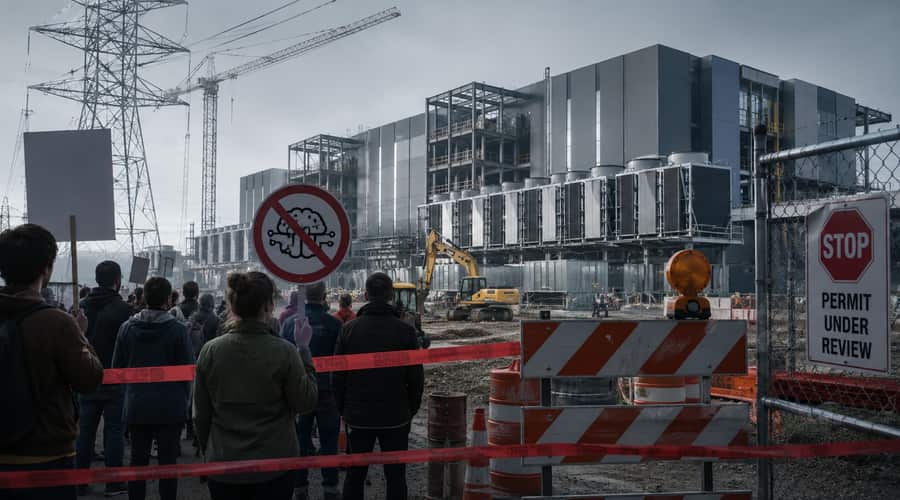
The clearest example is Saline Township, Michigan, where a community of fewer than 3,000 people appeared to block a major data center project. The township planning commission and board both voted against rezoning 575 acres for the development. Residents organized, protested, and argued that the project would reshape their community.
Then the developer sued. Related Digital, tied to billionaire Stephen Ross’s real estate empire, brought legal action after the rejection. The township faced the prospect of expensive litigation and ultimately settled. Construction began weeks later on a 21 million square foot campus valued at roughly $16 billion and linked to Oracle and OpenAI’s Stargate infrastructure initiative.
The project is expected to draw about 1.4 gigawatts of electricity, an amount often compared with the output of a nuclear plant. That comparison explains why the politics are so difficult. Supporters see tax revenue, grid investment, and a place in the AI economy. Opponents see farmland replaced by industrial-scale infrastructure serving companies headquartered somewhere else.
The Startup Risk Is Real
For startups, the lesson is not that AI infrastructure will stop being built. It will not. The lesson is that access to compute is no longer just a question of Nvidia supply, cloud credits, or hyperscaler capex. Local politics is now part of the supply chain.
That favors the largest players. Microsoft, Amazon, Google, Oracle, and OpenAI can absorb delays, negotiate community benefits, and litigate when needed. A startup building on top of leased capacity cannot. If a region becomes constrained, the smaller company experiences the result as higher prices, limited availability, slower deployment, or fewer choices.
Axios recently noted that Morgan Stanley analysts now see public pushback as a binding constraint on data center buildout. That phrase matters because it translates public frustration into investor language. A backlash that once looked like a local nuisance is becoming a market variable.
Founders should treat this as an operating risk. Applications that assume infinite elastic compute in one region are more exposed than they look. Products that can shift workloads, tolerate latency, or use smaller models more efficiently will have more room to maneuver if capacity tightens.
The AI boom is still moving, but it is moving through towns, grids, courtrooms, and public hearings. The next constraint may not be a missing GPU. It may be a county board room full of voters who have decided the tradeoff is not worth it.