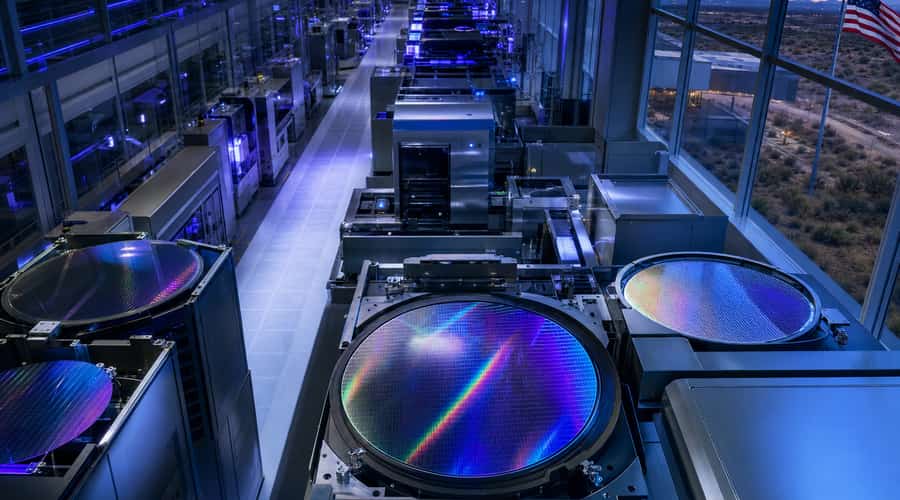
Trump announced on June 18 that Apple has agreed to partner with Intel to design and manufacture chips domestically, sending Intel shares up nearly 9% and crystallizing a supply chain bet that has been building for over a year.
The announcement came the way most things do in the current administration: a Truth Social post. But the commercial logic behind it is real and worth taking seriously. Apple, a company that has built its Silicon franchise almost entirely on TSMC's advanced nodes, is now committing to work with Intel's foundry on domestic chip production. For Intel, whose foundry business has spent years searching for its first major outside customer, this is the endorsement that changes the narrative entirely.
The Wall Street Journal had reported a preliminary deal in May, but Trump's post on Thursday confirmed it formally. According to CNBC, Intel only just began production of its most advanced node, 18A-P, at the VLSI Symposium in Honolulu on June 16, entering what the industry calls "risk production," an early-stage milestone that precedes volume manufacturing. Apple signing on as a foundry customer at precisely this moment is not a coincidence. It's a bet that Intel's 18A and the next-generation 14A node behind it are going to close the gap with TSMC, and that the insurance value of having a domestic alternative is worth the risk of being early.
Apple has been feeling the squeeze. As AppleInsider reported earlier this year, Nvidia has been crowding Apple out of TSMC's advanced capacity, booking an estimated 60% of TSMC's CoWoS advanced packaging output for 2026 according to Morgan Stanley. TSMC's CEO has called that packaging capacity "extremely tight and sold out through 2026," and TSMC has already begun raising prices on its most advanced nodes by 3% to 10% starting this year. Apple, which disclosed in its last earnings that it was supply-constrained by TSMC's leading-edge nodes, doesn't control when the pressure eases.
There's a geopolitical dimension too, one that Apple executives have been careful not to say out loud but that every serious supply chain planner has run the numbers on. TSMC's most advanced 2nm production remains concentrated in Taiwan. TSMC is building a fab near Phoenix capable of 4nm production, but Apple's most critical custom silicon, the chips that go into iPhones and Macs, requires the leading edge. Domestic 18A production at Intel's Arizona facilities would give Apple a credible fallback in a Taiwan contingency scenario. That's not a reason to switch. It's a reason to have options.
Frankly, the technical gap between Intel and TSMC on leading-edge silicon has been closing faster than most observers expected. Tom's Hardware's analysis of Intel 18A versus TSMC's competing N2 node found that Intel's process is faster at the same power budget, though TSMC retains a density advantage. Neither is a runaway winner. For chips where speed matters more than transistor density, Intel could genuinely compete.
What this does for Intel's foundry thesis
Intel's stock has already surged roughly 240% in 2026, partly on the back of the preliminary Apple deal reports in May that sent shares up 14% in a single session. By Thursday's close, the confirmation added another 9%. Intel started the year trading near $20. It's now sitting well above $100, a recovery that has also turned the US government's 9.9% equity stake, acquired when the Trump administration converted $8.9 billion in CHIPS Act commitments into 433 million shares at $20.47 apiece, into an unrealized gain of roughly $26.5 billion as of late April, per Bloomberg.
But the stock move is almost beside the point for Intel's foundry strategy. The fundamental problem for any foundry is that semiconductor fabs require enormous capital commitments years before revenue arrives, and customers won't commit to a foundry that doesn't have other customers. It's a chicken-and-egg trap. Apple getting in changes that equation. It signals to Qualcomm, MediaTek, and every other fabless designer that Intel's process is real and that a serious customer has done the technical diligence and found it credible enough to stake product on.
Intel's 14A node, which is where volume production at scale will happen, won't reach mass manufacturing until 2029. Apple won't be shipping Intel-made chips to consumers for at least two to three years. The deal remains preliminary and neither Apple nor Intel has confirmed it directly, leaving Trump's post as the primary public source. And Intel still has to prove it can manufacture for an outside customer at Apple's quality bar, which is among the most demanding in the industry.
None of that makes the deal less significant. It makes it a long-term signal rather than a short-term product story. Apple is telling the industry it believes Intel's foundry will be viable, and it's willing to put its supply chain where its analysis is. For the US chips-at-home industrial bet, which has been more aspiration than commercial reality since the CHIPS Act passed, that is the most concrete validation it has received. The question now is whether Intel can execute on the timeline it's committed to, because Apple has a way of making suppliers very aware of what happens when they don't.
Also read: Dream raises $260 million at a $3 billion valuation as sovereign cybersecurity AI hardens into its own asset class • Apple's iPhone 18 Pro will cost more because AI hyperscalers are hoarding memory chips • South Korea's food delivery duopoly faces its biggest antitrust reckoning yet