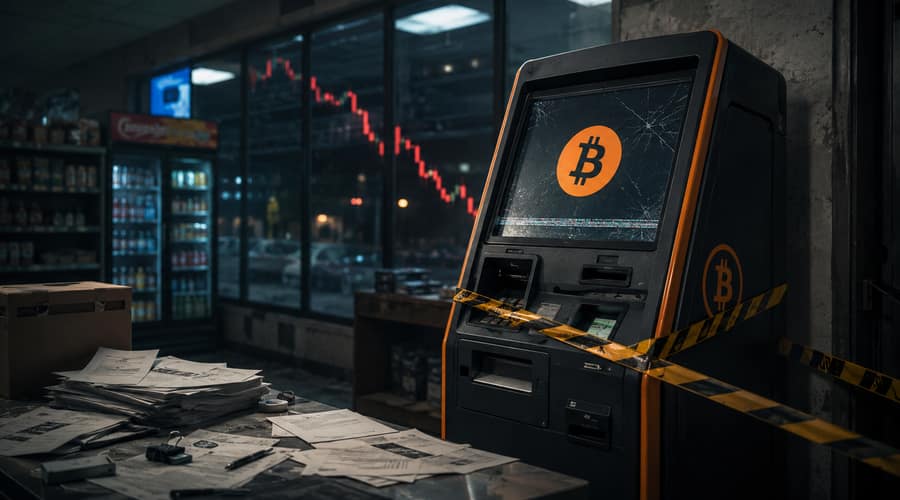
Bitcoin Depot, once North America's largest Bitcoin ATM operator, has filed for Chapter 11 and taken its network offline, showing how regulation, costs, and changing user habits have weakened the retail crypto kiosk model.
Bitcoin Depot announced a voluntary Chapter 11 filing in the U.S. Bankruptcy Court for the Southern District of Texas on May 18 and said it has taken its Bitcoin ATM network offline as it pursues an orderly wind-down and sale of assets, according to the company's filing and press release. The move turns one of crypto's most visible retail brands into a test case for a business model that looked far stronger during the last bull market than it does today.
The Atlanta-based operator, which traded on Nasdaq as BTM, said it had filed customary first day motions and planned to wind down operations under court supervision. Its Canadian entities are included in the U.S. process and are expected to begin related Canadian proceedings in due course, the company said in its announcement. Market reaction was immediate, with shares falling sharply after the filing as investors priced in the likelihood that equity holders may recover little or nothing.
Public filings and reporting show the bankruptcy was preceded by serious financial deterioration and disclosure problems. Bitcoin Depot disclosed a late Form 10-Q filing and cited material weaknesses tied to cash-in-transit reconciliation, while recent reports pointed to a steep drop in revenue, weaker profitability, and strained liquidity. That combination left the company with fewer options as regulatory costs and legal pressure kept rising.
Why this matters for the kiosk industry
Bitcoin Depot was the largest single operator of physical crypto on-ramps in North America, with roughly 9,000 kiosks deployed across retail and convenience locations at its peak. Its failure is a practical test of the retail BTM thesis: that casual users would keep using walk-up machines to turn cash into Bitcoin even as apps, exchanges, and payment products became easier to use.
That premise has weakened. For a customer with a smartphone, a verified exchange account, and access to bank transfers or debit cards, the kiosk experience can look expensive and inconvenient. Bitcoin ATMs still serve some cash-heavy users, but the addressable market is narrower than operators once assumed, and narrower markets are difficult to support when a company has leases, servicing costs, compliance staff, and public-company obligations.
Regulation has added another layer of pressure. States have tightened anti-money-laundering expectations, transaction limits, licensing rules, and supervision around crypto kiosks, increasing compliance costs and operational friction for operators that already need to manage large distributed networks. Bitcoin Depot's CEO, Alex Holmes, directly pointed to tougher state obligations, litigation, and enforcement as reasons the current model had become unsustainable.
Numbers and context
Reporting from market sites and industry outlets placed Bitcoin Depot's recent revenue and margin deterioration at the core of the distress. Several sources cited a near-50 percent year-over-year revenue decline in the most recent quarter, collapsing gross profit margins, and a net loss that reversed a prior-year profit, all of which left liquidity tight and options limited for a publicly traded operator.
Those figures matter because Bitcoin ATMs depend on transaction volume, spreads, and fees, not just the number of machines in the field. The fees charged to users can be high, but that does not protect the operator if volumes fall, cash logistics become harder, compliance spending rises, and maintenance obligations stay fixed. A kiosk network can move from scaled infrastructure to stranded cost quickly when traffic softens.
The timing also matters. Bitcoin itself has remained a mainstream financial asset, with ETFs, public-company treasury strategies, and institutional trading products pulling more activity into regulated digital channels. That shift does not remove retail demand, but it changes where that demand goes. The more crypto access looks like brokerage, payments, and mobile banking, the harder it becomes for standalone kiosks to justify their footprint.
What comes next
The company says it will seek to sell assets through the Chapter 11 process while winding down the network, and court filings will determine creditor recoveries and the fate of remaining corporate entities. Potential buyers could include payment processors, crypto service providers, or asset purchasers interested in software, customer data, or kiosk hardware, though those assets may be worth far less than their deployment cost now that the network is offline and regulation remains a burden.
For the broader industry, Bitcoin Depot's collapse lowers the public-market credibility of the kiosk business and raises the bar for any operator that hopes to scale. Investors and retail partners will now look harder at compliance systems, sustainable unit economics, and whether revenue can move beyond basic buy-sell activity at a physical terminal.
That recalibration favors models with stronger recurring revenue, deeper integration into digital wallets and exchanges, or services that capture larger transaction sizes with lower operating friction. It also signals to retailers and landlords that hosting a kiosk carries more counterparty risk than it once did, which could reduce willingness to renew placements or approve new installations.
Bitcoin Depot's Chapter 11 is not just a corporate failure, it is a structural moment for how retail crypto access will evolve. As regulation tightens, app-based access improves, and the economics of small physical transactions stay fragile, the future of crypto kiosks looks far narrower than the industry once assumed.
Also read: Solana is facing a builder backlash over its Phoenix push • SEC Poised to Greenlight Tokenized Stocks, Opening Wall Street to Blockchain Trading • Vitalik Buterin Says AI Plus Formal Verification Could Finally Tame Smart-contract Risk