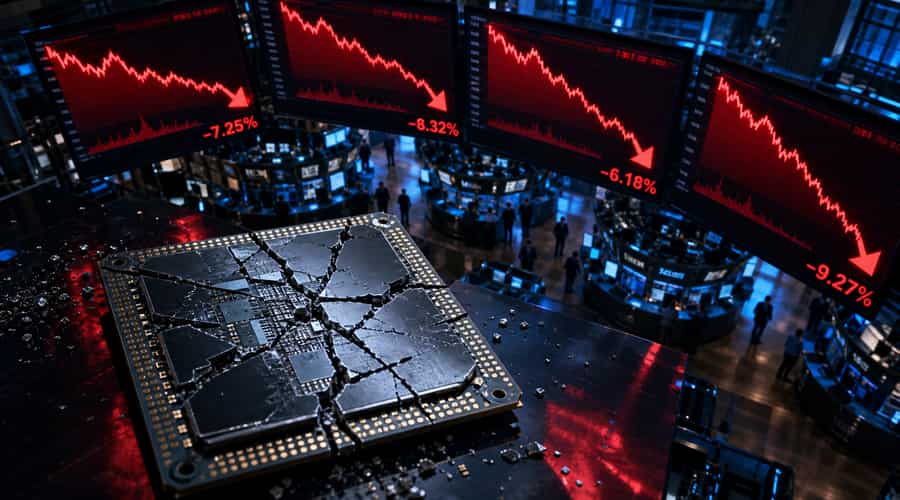
Savita Subramanian's rare take-profits call landed just as the AI trade was starting to look crowded, and Broadcom's cautious guidance gave investors a reason to test it.
The warning was unusually direct for a major Wall Street firm. Bank of America's equity strategy team, led by Savita Subramanian, published a note in early June titled "Too many red flags. Take profits," citing 70% of the firm's bear-market signposts. The S&P 500 was trading near 7,430, while BofA's year-end target sat at 7,100, leaving about 4.5% of downside in the firm's own forecast before the year was out.
The market did not wait around. On June 3, Broadcom reported fiscal Q2 2026 revenue of $22.19 billion, up 48% year over year, with AI semiconductor revenue reaching $10.8 billion, more than double the same period a year earlier. On paper, it was one of the strongest quarters in the company's history. The stock still fell hard in the sessions that followed. What broke the mood was not the quarter Broadcom delivered; it was the level of certainty investors wanted and did not get. The company guided current-quarter AI semiconductor revenue to about $16 billion, a huge number in normal conditions but slightly below some analyst expectations in a market that had been trained to expect a bigger raise.
Hock Tan's comments added another pressure point. Broadcom remains a central partner for Google's TPU program, but Tan also acknowledged that Google would likely diversify some sourcing. That was not a demand collapse. It was not even a lost customer. Still, in an AI market priced for clean growth curves, even a hint of supplier diversification can change the way investors think about concentration risk. By June 5, the PHLX Semiconductor Index had fallen 10.3%, its worst one-day drop since March 2020, while Broadcom, Nvidia, Micron, and other AI-linked tech names helped erase more than $1 trillion in market value.
As Axios noted, Subramanian's team focused on the unusually wide spread between technology winners and losers, where the performance gap between the best and worst groups reached 120 percentage points, the highest since February 2000. That comparison matters because it does not depend on a prediction. It describes what has already happened. When leadership gets that narrow, the market becomes more vulnerable to one disappointing signal from one large stock.
BofA's broader argument was not that investors should abandon equities. It was that index-level strength had started to hide weaker internal dynamics. High P/E stocks had been leading low P/E stocks by a wide margin, a classic sign that speculation is carrying more of the load. That is a different problem from ordinary volatility. It means the market can still look healthy on the surface while the risk underneath becomes more concentrated in a smaller group of companies.
A compounding factor arrived with the May 2026 CPI print at 4.2%, the highest annual inflation reading in three years. Earlier expectations for at least one Fed rate cut this year were largely pushed aside after the data. For AI infrastructure stocks, higher-for-longer rates are not simply a headline risk. They change the math. A data center buildout that depends on years of future cash flow becomes less attractive when the discount rate rises, especially after valuations have already moved ahead of confirmed returns.
A Funding Boom Meets Public Market Discipline
Q1 2026 shattered venture funding records globally, with AI driving much of a $300 billion investment wave, according to Crunchbase data. That number tells you how much capital still wants exposure to the theme. It also explains why the Broadcom selloff matters beyond public markets. Late-stage AI companies hoping to raise at premiums now have to answer a harder question: why should a private investor pay a richer multiple than public markets are willing to assign to Nvidia, TSMC, or Broadcom, companies with real revenue and auditable margins?
Some companies will still raise easily. Startups with strong enterprise demand, clear retention, and credible infrastructure economics remain attractive because buyers are still spending. Others will face flatter valuations, more structured terms, or delayed rounds while investors wait to see whether the public market repricing holds. That is how public volatility travels into private markets. It does not close the funding window overnight, but it changes who gets clean terms.
The honest answer to whether June marks a reset or the beginning of a longer de-rating depends heavily on the next round of AI earnings, especially Nvidia's late-August report. If hyperscaler capex from Meta, Microsoft, Google, and Amazon is still accelerating, the selloff will look like a correction inside a continuing bull market. If Broadcom's caution foreshadows slower demand or more pricing pressure across custom AI chips, June may be remembered as the moment investors stopped rewarding record AI quarters automatically.
The AI infrastructure trade is not broken. What has broken is the assumption that every strong AI earnings report deserves a higher multiple. That is a healthier market, but it is also a less forgiving one. Investors now have to separate companies with durable demand from companies that were simply carried higher by the same story.
Also read: PIMCO declares AI has crossed a macroeconomic threshold while warning the credit loss cycle has already begun • Adobe's record AI results could not outrun its growing leadership vacuum • MediaTek doubles its AI chip target to $2 billion and enters the data center