Meta's Muse Spark is not the strongest frontier model across the board, but its HealthBench Hard lead and low API price give developers a reason to run the numbers again.
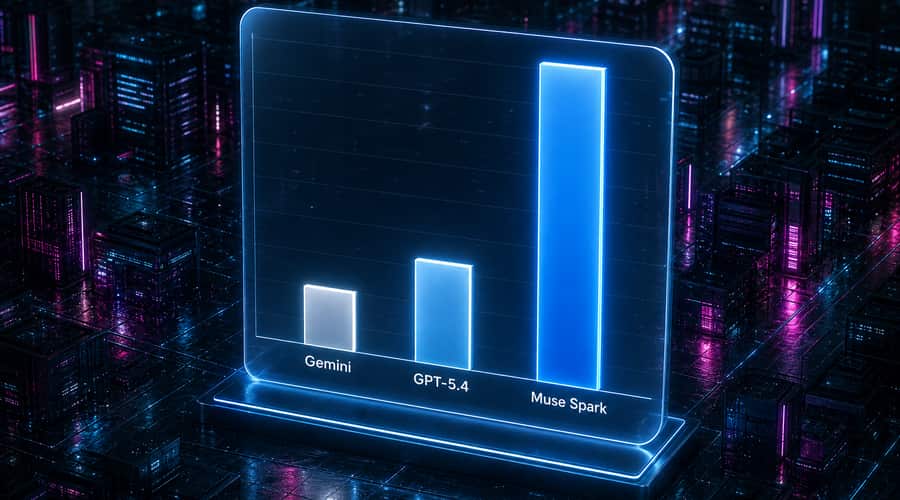
The model that was supposed to prove Meta could catch up has become a cost problem for everyone else. Muse Spark, developed by Meta Superintelligence Labs under Chief AI Officer Alexandr Wang, doesn't beat the field on every benchmark. It doesn't have to. On HealthBench Hard, BenchLM.ai's July 22 snapshot places Muse Spark at 42.8, ahead of GPT-5.4 at 40.1 and far ahead of Gemini 3.1 Pro at 20.6. The gap isn't close.
That score needs context. HealthBench Hard is a 1,000-prompt subset of OpenAI's HealthBench, built to test open-ended medical and health reasoning with rubric-based grading. According to BenchLM.ai, the benchmark is display-only in its overall scoring system, so it doesn't single-handedly decide which model is best. Keep that caveat close. A health benchmark is not a clinical validation study, and you shouldn't treat any chatbot score as permission to replace a doctor, a compliance review, or a hospital procurement process.
Still, Meta has found a lane where the numbers are hard to ignore. Fortune reported in April that Muse Spark was the first model from Meta's new Superintelligence Labs, built after Meta took a $14.3 billion, 49% nonvoting stake in Scale AI and brought Wang in as its first chief AI officer. Fortune also noted that Meta's own launch material showed Muse Spark leading rivals on HealthBench Hard while trailing top models on some reasoning tests. That's the important shape of the story: not total domination, but a real advantage in a sector where buyers notice small differences and lawyers notice every risk.
On the broader Artificial Analysis Intelligence Index, the original Muse Spark launch score was 52, behind Gemini 3.1 Pro and GPT-5.4 at 57 and Claude Opus 4.6 at 53, according to the leaderboard coverage circulated at launch. So don't sell this as Meta suddenly owning frontier AI. It doesn't. What Muse Spark has done is pick its fights: health reasoning, output efficiency, and, with the July 9 release of Muse Spark 1.1, agentic coding work.
Pricing is the real pressure point
Price is the weapon. Reuters reported on July 9 that Meta opened developer access to Muse Spark 1.1 through a public preview of the Meta Model API, charging $1.25 per million input tokens and $4.25 per million output tokens. New API accounts get $20 in credits. The consumer version stays free inside the Meta AI app and on meta.ai, where Meta says Muse Spark 1.1 is available in "Thinking" mode.
You should care because agentic work burns tokens. A coding assistant that reads a repo, plans a migration, opens files, writes patches, runs tests and tries again can generate a long bill before a human reviewer sees the result. Meta's rate gives startups a cheaper place to test those workflows, especially if they don't need the very top model on every reasoning task. Frankly, if the pricing holds and access widens beyond the preview gates, a lot of AI startups will have to revisit their infrastructure spreadsheets.
The efficiency story reinforces the same point. Artificial Analysis figures cited in April put Muse Spark at roughly 58 million output tokens across its benchmark suite, compared with 157 million for Claude Opus 4.6. That is not small. A model that gets strong results in selected verticals while producing far fewer tokens costs less to operate when your product runs thousands of completions a day - and that shows up on the leaderboard too.
Meta's own July 9 launch post says Muse Spark 1.1 was built for agentic tasks, with gains in tool use, computer use, coding and multimodal understanding. It also says the model can actively manage a 1 million token context window, keeping earlier actions available while compacting long sessions. That's a real constraint. Developers already know that long context is only useful if the model can remember the right parts of the work.
The health AI wedge is harder
Med-tech and life sciences companies can't ignore a HealthBench Hard gap that size, but they can't move on it casually either. Health AI carries switching costs you feel in contracts and audits: clinical validation, data integration, risk reviews, regulatory arguments and procurement committees. Once a hospital system or pharma company commits to a vendor, it doesn't move quickly. Inertia is the default, and the default is expensive to break.
That is why Muse Spark's free consumer access is less important than the API price and the benchmark record. A wellness app can experiment quickly. A hospital system can't. For enterprise buyers, Meta now has a more credible opening conversation than it had with Llama 4, which Fortune described as widely panned after its 2025 release. But a benchmark lead is still only the first meeting. The harder proof comes from pilots, error analysis, safety documentation and the boring paperwork that decides whether a model can touch sensitive workflows.
There is also the identity problem. Quartz and Fortune both framed Muse Spark as a departure from Meta's open-source Llama playbook, and that tension has not gone away with Muse Spark 1.1. Llama gave developers something they could download, inspect and run on their own terms. Muse Spark is closed. Meta can say it still has open-weight plans elsewhere, but this model is a commercial service, not a community release. Meta hasn't answered it.
The near-term picture is clear enough. Muse Spark is not the model that ends the AI race. It is the model that turns parts of the race into a price fight while giving Meta a serious health AI talking point. If you're building on top of frontier models, you don't have to switch today. But you do have to test the assumption that OpenAI, Anthropic or Google is automatically the right default for every expensive workflow.
Also read: OpenAI raises its compute bet to $750 billion but its own CFO isn't sure it can pay the bill • Samsung launches three foldables at once in London and bets Gemini AI can make them mainstream • Monday.com cuts 620 jobs and raises its margin outlook in the same breath