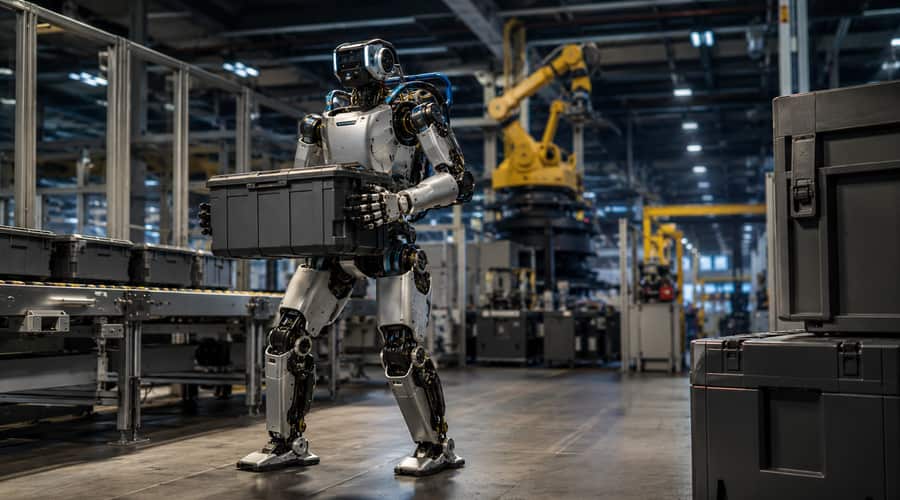
Boston Dynamics is pushing Atlas closer to the kind of work that matters in factories and warehouses.
The latest footage of Atlas lifting and moving a full-sized refrigerator is more than a flashy demo. It is a clear signal that Boston Dynamics wants its humanoid robot judged on industrial usefulness, not novelty, and that the company believes whole-body manipulation is now strong enough to matter in commercial settings.
That matters because lifting an awkward object like a refrigerator is exactly the kind of task humanoid robots have struggled with. Balance shifts, grip force has to be managed carefully, and the robot has to keep planning its motion while the load is moving. Boston Dynamics has spent years proving that Atlas can run, jump and recover from instability, but this latest display points to a different benchmark: usable strength in the messy real world.
Boston Dynamics has not framed Atlas as a toy or a stunt machine for some time. In January, the company said it was moving to a product version of Atlas, describing it as an enterprise-grade humanoid robot built for material handling, order fulfilment and other industrial work, with deployments already committed for 2026 at Hyundai and Google DeepMind, according to the company's announcement. The refrigerator video extends that message. It shows a robot that is no longer being sold on agility alone, but on the combination of strength, dexterity and control that factories actually need.
The timing is important too. Humanoid robotics has turned into a crowded race, with companies such as Figure AI, Agility Robotics, 1X Technologies and Tesla all trying to prove their machines can do something economically useful at scale. Reuters reported in January that Tesla's Optimus output is expected to ramp only gradually, while Boston Dynamics and Hyundai are already talking openly about industrial deployment paths for Atlas. In that context, every public demonstration becomes a competitive signal, and Boston Dynamics just raised the bar on the kind of physical work it wants to be associated with.
A refrigerator is a useful test object because it is heavy, bulky and awkward in a way that clean lab demos often are not. It forces the robot to deal with shifting load distribution and maintain control while moving through space, which is exactly the kind of challenge that turns a humanoid from a research artifact into a potential worker.
Boston Dynamics says the current Atlas can lift up to 50 kilograms, has 56 degrees of freedom, a 2.3 meter reach and can operate autonomously, under teleoperation or through a tablet interface. It also says the robot is designed to work in environments from minus 4 to 104 degrees Fahrenheit and can automatically return to a charging station and swap batteries when needed. Those details are the unglamorous side of the story, but they are the ones that determine whether a robot can survive a long shift on a real floor.
The company is also trying to make Atlas easier to manufacture and deploy. Boston Dynamics said the new version has fewer unique parts and was designed with automotive supply chains in mind, which suggests the company is thinking beyond one-off demonstrations and toward repeatable production. That is the difference between a robotics spectacle and a business.
The commercial race
Hyundai remains central to the story. Boston Dynamics says its majority shareholder is preparing to deploy tens of thousands of robots across its own manufacturing operations, and Hyundai has separately said Atlas will start in tasks like parts sequencing before expanding into heavier and more complex work over time. That gives Boston Dynamics a rare advantage in robotics: a major industrial customer with the scale to test the product in real operations rather than in staged pilots.
For the broader sector, the takeaway is simple. If Atlas can reliably move large objects, keep its balance, and do so in repeatable commercial settings, the argument for humanoids in logistics gets stronger. If it cannot, then the refrigerator footage becomes another impressive clip in a field full of them. The difference is whether the robot can move from a controlled demonstration to a workflow that earns its place on a factory floor.
That is why this video is landing now. Boston Dynamics is no longer just reminding the market that Atlas exists. It is making a case that humanoid robots are entering the phase where strength, autonomy and deployment readiness have to show up together. In a market racing toward contracts, that is the metric that counts.
Also read: Schiff's data center bill forces hyperscalers to shoulder their power tab and reshapes AI investment • Figure AI turns a robot sorting demo into a test of labor economics • ByteDance's Lance Puts Open, Efficient Multimodal AI Within Reach