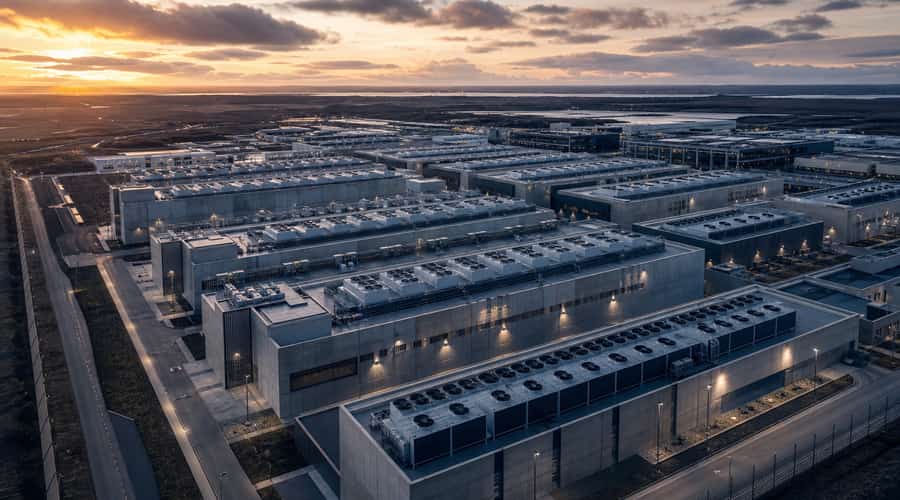
Csquare, the colocation operator assembled by Brookfield Infrastructure from the wreckage of Cyxtera's bankruptcy, has publicly filed its S-1 with the SEC and is targeting a NYSE listing under the ticker CSQR, with Morgan Stanley and TD Securities leading the offering.
The backstory matters here. Cyxtera went public in 2021 through a SPAC merger that valued it at $3.1 billion, built almost entirely on leased rather than owned real estate. Two years later, in June 2023, it filed for Chapter 11. Brookfield swept in, acquired the assets for $775 million, folded them into Evoque Data Center Solutions, a business it had assembled in 2019 from AT&T's colocation portfolio, and rebranded the combined entity as Centersquare, then Csquare, in April 2024. Now, less than two and a half years after that rescue, Brookfield is trying to take it public again. The question is whether the AI infrastructure boom has changed the math enough to make this work where it failed before.
On paper, the company is substantial. Csquare operates more than 80 data centers across 30 markets in North America and Europe, with 3.5 million square feet of space and more than 500 megawatts of power capacity serving over 2,000 enterprise and hyperscale clients. Proceeds from the offering are earmarked for debt repayment and general corporate purposes. That's a tell: Csquare executed four secured data center revenue note transactions between March and December 2025, a significant volume of debt activity in nine months. The IPO is, in part, a deleveraging exercise.
The market backdrop could hardly be more favorable on the surface. North American colocation vacancy has hit a record low of roughly 1%, according to industry data, with 92% of capacity currently under construction already precommitted. Average grid-connection wait times in primary markets now exceed four years. Hyperscaler capital expenditure collectively crossed $600 billion in 2026, as reported by MUFG Americas, and AI workloads are pushing tenants toward higher-density configurations that command meaningfully better economics per square foot than traditional enterprise colocation. Csquare, with 500-plus megawatts already energized and relationships with both enterprise and hyperscale clients, is positioned to capture some of that repricing.
The S-1 also surfaces real risks. Brookfield is reportedly targeting a mid-to-high-teens EBITDA multiple, a valuation that requires sustained demand growth from both enterprise and hyperscale tenants. Customer concentration in hyperscale colocation is a real variable: when a handful of large cloud providers represent a disproportionate share of revenue, lease renewal negotiations carry outsized consequences. The S-1 hasn't yet disclosed the specific revenue figures or the precise customer breakdown, so the market will be reading those numbers carefully when they appear.
The Cyxtera comparison will follow this company into its roadshow whether it wants it to or not. Cyxtera's failure was structural: it was built on leased real estate at a moment when the industry was rapidly bifurcating between operators who owned their buildings and those who did not. Csquare inherits some of that same lease-heavy footprint, though Brookfield has spent two years renegotiating terms, exiting certain locations, and consolidating the operational base. Whether that cleanup is sufficient is exactly what the public market is now being asked to price.
What has clearly changed is the demand environment. In 2021, when Cyxtera debuted, the AI infrastructure buildout was a thesis. In 2026, it's a capital allocation reality that has reshaped the economics of every kilowatt of data center power in a primary market. That shift doesn't guarantee Csquare will succeed as a public company, but it does mean the asset base it's bringing to market is genuinely more valuable today than it was when Brookfield acquired it for $775 million. The gap between that acquisition price and whatever valuation the IPO produces will tell you most of what you need to know about how Brookfield executed the turnaround.
For the broader market, this filing is a meaningful test. Infrastructure investors have been watching to see whether the public equity market is willing to underwrite AI-adjacent colocation at the multiples private capital has been demanding. Csquare is the first serious data point of that appetite in the current cycle. If the listing prices well and holds, expect a wave of similar filings. If it struggles, the repricing will ripple back into private infrastructure valuations faster than most sponsors would like.
Also read: Microsoft walked away from a $3 billion Oracle cloud deal because of a security framework Oracle wouldn't build • Robinhood cuts 290 jobs and notably refuses to blame AI for it • ChatGPT's majority is gone and OpenAI's IPO story just got harder to tell