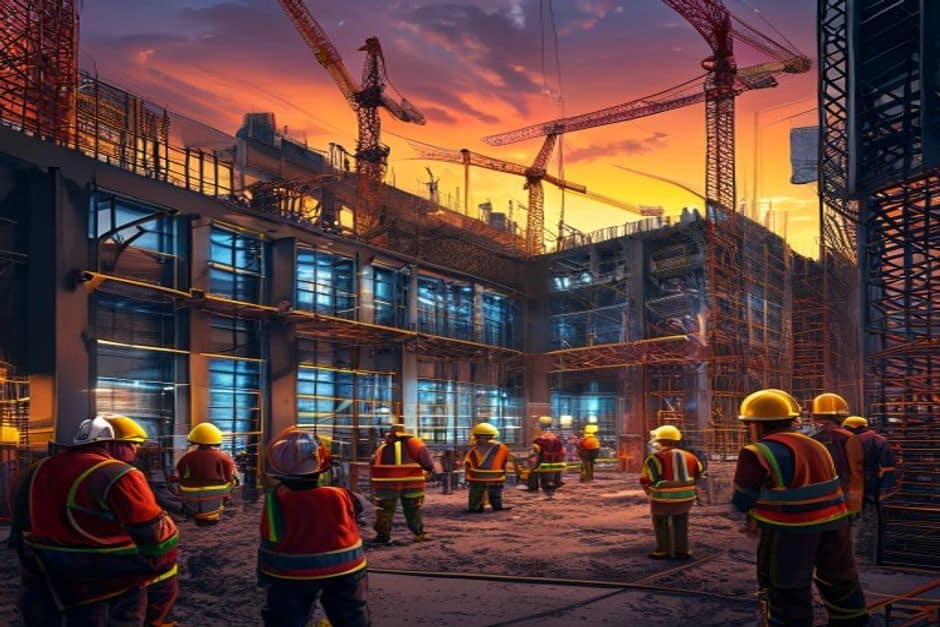
The AI infrastructure boom is running straight into a physical reality that Silicon Valley has spent years treating as someone else's problem: you cannot build a data center without electricians, pipefitters, and the unions that represent them.
The numbers involved in AI's physical buildout have become almost difficult to process. Microsoft, Google, Amazon, and Meta have collectively announced hundreds of billions of dollars in data center investment over the next several years. Nvidia's order books are full. The grid operators are overwhelmed with interconnection requests. And somewhere between the chip fab and the server rack, tens of thousands of construction workers have to show up and actually build the buildings, pull the cable, install the cooling systems, and connect the whole apparatus to a power grid that was not designed to absorb this kind of load. The people doing that work are, in large and growing numbers, members of the North America's Building Trades Unions, and their organizations are becoming a structural force in the AI economy whether or not the technology industry has noticed.
According to reporting from the Associated Press, building trades unions have developed working relationships with some of the world's wealthiest technology companies precisely because the scale of AI infrastructure construction has outpaced the available non-union labor market in many regions. When a hyperscaler needs to break ground on a million-square-foot data center campus in eighteen months, the fastest path to a reliable skilled workforce often runs through union halls. The IBEW, which represents electrical workers, and the United Association, which covers plumbers and pipefitters, have particular leverage because data centers are extraordinarily power-intensive and cooling-dependent facilities. The specialized trades those unions represent are not interchangeable with general construction labor, and the shortage of qualified workers in both categories is acute enough that tech companies have found themselves negotiating terms that would have been foreign to their procurement teams five years ago.
The arrangements being struck are not purely transactional. Several technology companies building large-scale data center campuses have entered project labor agreements with regional building trades councils that include provisions beyond standard wage rates. Job pipelines, apprenticeship program investments, and commitments to use union contractors for follow-on expansion phases have all appeared in various deals. Some agreements have included local hiring preferences that tie the economic benefit of a large construction project more explicitly to the surrounding community, which carries political value for tech companies trying to navigate permitting processes in jurisdictions where organized labor retains real influence over elected officials.
That last point is where the power dynamic gets interesting. Data center development requires land use approvals, environmental permits, grid connection agreements, and in many cases incentive packages from state and local governments. Building trades unions are among the most consistent and organized voices in local politics across the industrial Midwest, the Mid-Atlantic, and parts of the South where data center construction is concentrated. A technology company that has a working relationship with the regional building trades council is not the same as one that is fighting a permitting battle against a skeptical city council where union members are active constituents. The alignment of interests, even when it is not explicit, creates a permitting environment that is measurably more navigable.
This dynamic has begun to register with AI infrastructure investors and developers in ways it had not previously. The dominant mental model in venture-backed AI has treated physical infrastructure as a commodity input managed by hyperscalers at arm's length. The startup builds the model, the cloud provider rents the compute, and the construction of the underlying facility is someone else's supply chain problem. That abstraction is holding less well as power constraints, permitting timelines, and skilled labor shortages have become genuine rate-limiting factors on expansion plans. Infrastructure delays are now capable of pushing compute availability timelines out by quarters, which has direct consequences for training schedules and product roadmaps.
The acceleration argument and its limits
The case that union partnerships accelerate data center construction is grounded in workforce availability rather than ideology. In markets where union density is high and the alternative is competing for a shallow pool of non-union specialized tradespeople, a project labor agreement can meaningfully shorten the time from groundbreaking to energization. Unions dispatch trained workers through a system designed for exactly this kind of large-scale mobilization, and apprenticeship pipelines provide a longer-term supply of qualified workers that non-union contractors in tight labor markets often cannot match.
The counterargument is that project labor agreements add cost and procedural complexity, and that in markets with lower union density, they can restrict the competitive bidding process in ways that inflate construction budgets. Both things can be true simultaneously in different geographies, and the technology companies navigating this landscape are making location-by-location calculations that weigh labor availability, permitting risk, power costs, and incentive structures together rather than optimizing any single variable.
What is shifting is the recognition that organized labor is a variable to be managed strategically rather than ignored. The AI buildout is the largest construction program the technology industry has ever undertaken, and it is happening in physical communities with existing political economies that do not automatically defer to the preferences of companies headquartered in California or Washington. For founders and investors whose AI strategies depend on compute availability at scale, the timeline and cost of the physical infrastructure beneath that compute is no longer a background assumption. It is a constraint worth tracking as closely as chip lead times or energy prices, and the labor organizations shaping that buildout deserve a place in that analysis.
Also read: The real question is not whether local AI can match cloud performance but whether startups should care • Reddit demos make local AI look easy but the gap to production is where startups get burned • Consumer GPU hardware is closing the gap with cloud AI faster than anyone expected