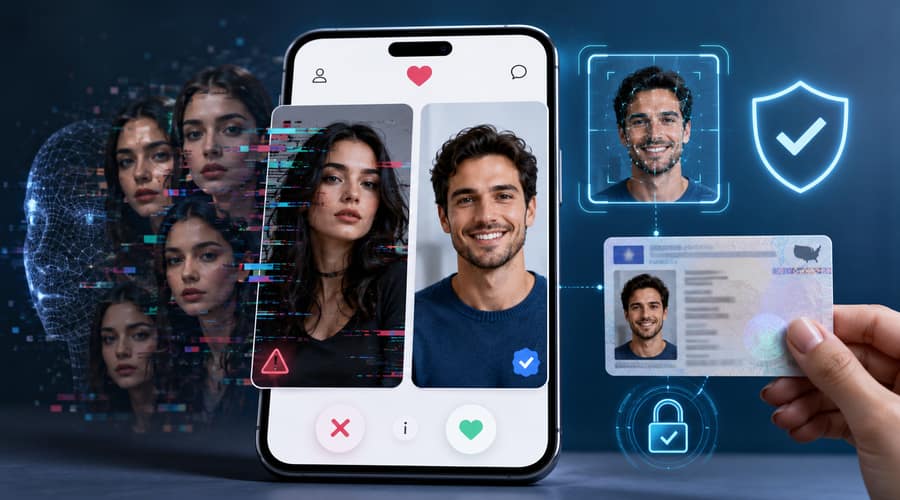
Frustration with AI-enhanced fake profiles is pushing UK founders to build dating services that prioritize verification over scale. One startup rejects 50 applicants monthly. Another checks selfies against passports. The question is whether trust can become a competitive advantage.
Dennie Smith runs Geek Meet Club, a dating service with about 3,300 members that rejects roughly 50 applicants every month. As AOL reported this week, Smith says she is "very good at spotting a fake," citing an example where someone submitted a photo of Boris Johnson. The club prioritizes offline connection through events and monthly quizzes, and Smith advises members to meet in person as soon as possible to verify legitimacy. Her approach is manual, labor-intensive, and deliberately small.
Jo Mason, a former City of London banker, took a different path with Cherry Dating. Her platform uses software that cross-references a member's selfie with their driving licence or passport, a method she recognizes from her finance career where banks use similar anomaly detection. The friction is intentional. A significant number of prospective members abandon sign-up when they reach the ID verification stage, but Mason views that as filtering, not failure.
The scale of the AI deception problem
According to a survey of 2,000 UK dating app users commissioned by fraud-prevention firm Sumsub, 54 percent of respondents were open to, or already using, AI to edit or create images of themselves for dating profiles. More strikingly, 84 percent said AI content has made it harder to trust people or date successfully, up from 64 percent in 2025. Romance scams cost UK victims over £100 million last year, and the dating sector had a 6.35 percent identity fraud rate in 2025, tied with online media for the highest among the industries Sumsub tracked.
Research commissioned by Mason found that 47 percent of British respondents feel no dating app currently meets their needs, while 40 percent say dating apps have actually reduced their motivation to seek out a partner. These numbers suggest that the mass-market apps are not just failing to solve the trust problem; they are actively making it worse.
Why friction might be the product
The mainstream dating apps face a structural constraint that startups like Cherry and Geek Meet Club do not. Tinder, Hinge, and Bumble need to maximize user acquisition and retention to satisfy growth metrics. Adding friction, whether through ID verification or application vetting, slows sign-up and reduces the pool of potential matches. For a niche service, the tradeoff is different. Cherry Dating's ID check churns a percentage of potential users, but the ones who complete the process are more likely to be genuine. Geek Meet Club's 50 monthly rejections maintain a signal-to-noise ratio that mass-market apps cannot sustain.
The economic case for verification is not just about user satisfaction. The Federal Trade Commission reported that Americans lost $1.3 billion to romance scams in 2022, while broader FTC data showed investment scams and imposter scams caused even larger reported losses that year. The point for dating platforms is still clear. For every scammer removed from a platform, potential harm is reduced. Platforms that cannot demonstrate reasonable efforts to verify user identities may face increasing regulatory pressure as AI makes deception cheaper and more scalable.
What this means for founders
The Cherry and Geek Meet Club models offer two distinct approaches to the same problem. Cherry uses technology to automate verification at scale, albeit with drop-off risk. Geek Meet Club uses human judgment and offline events to build trust through community. Both require accepting that growth will be slower than the mass-market alternative.
For founders considering entry into the dating space, the lesson is that trust is not a feature to be added to a growth product. It is a structural constraint that must be designed into the user experience from the beginning. A dating app that promises verified users must accept that verification will churn users who are unwilling to provide real identification. A community-based service must accept that human vetting does not scale linearly.
The irony is that the very AI tools that have made deception easier are also making verification more valuable. As the cost of generating fake profiles falls, the premium on genuine connections rises. The startups that survive will be those that treat verification as a product differentiator, not a compliance cost. For Cherry Dating, that means holding firm on ID checks even as users bounce. For Geek Meet Club, it means rejecting applicants rather than diluting the community. Both are bets that in a world of infinite fake profiles, scarcity of real ones becomes an asset.