DeepSeek has quietly released v4 Flash through its official API at a price point so aggressive it threatens to reset expectations for what enterprise inference should cost.
The number that stopped developers mid-scroll this week: $0.04 per million input tokens. That is what DeepSeek is charging for v4 Flash, its latest model variant, through the official API. Output tokens run $0.10 per million. For context, those figures put a capable reasoning and coding model within striking distance of the cheapest inference options Western labs currently offer, and in several real-world deployment scenarios, comfortably beneath them. The AI pricing floor just dropped again, and this time it came with a full model lineage behind it.
What makes the pricing genuinely surprising is the "Flash" designation, which in most model families signals a distilled or stripped-down variant optimized for speed at the expense of capability. That tradeoff does not appear to apply here. Benchmarks circulating in developer communities on Reddit and X suggest v4 Flash retains meaningful reasoning depth and coding proficiency inherited from the v4 architecture, which itself was built on DeepSeek's Mixture-of-Experts approach , a design that activates only a relevant subset of parameters per token rather than running the full model on every inference call. You get a disproportionate amount of capability for the compute you are paying for.
That architectural efficiency is not new for DeepSeek, but v4 Flash applies it at a price point that directly challenges GPT-4o-mini and Claude 3 Haiku in the segment that actually drives volume decisions. High-throughput enterprise applications , customer support pipelines, document processing, coding assistants, retrieval-augmented generation at scale , are extraordinarily price-sensitive. Shaving fractions of a cent per thousand tokens translates directly into whether a product's unit economics work. At $0.04 input, DeepSeek v4 Flash enters that conversation with serious credibility.
The practical effect is straightforward: any startup or enterprise team currently running cost-benefit analysis on AI infrastructure now has a new baseline to pressure-test their existing provider relationships against. Wrapper-layer startups in particular, companies whose core business depends on reselling or packaging LLM intelligence, stand to see margin structures change materially if adoption accelerates. The question is no longer whether capable inference can be cheap. It demonstrably can. The question is whether switching costs, latency requirements, data residency concerns, or trust in a Chinese-origin model keep Western alternatives competitive at a premium.
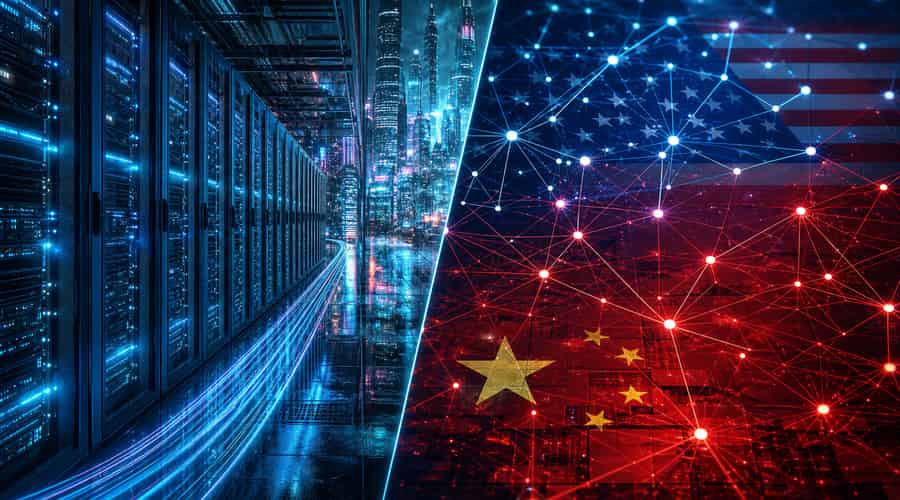
That last point is where the release gets complicated. DeepSeek is a Chinese firm operating in an environment of intensifying scrutiny around AI sovereignty and cross-border data flows. Several enterprise buyers, particularly in regulated industries or defense-adjacent verticals, will not route production workloads through its API regardless of price. That constraint preserves a market segment for Anthropic, OpenAI, and Google. But it does not protect them in the broader commercial middle market, where procurement decisions are driven by cost and capability rather than geopolitical posture.
The more durable consequence is what this release does to pricing expectations industry-wide. DeepSeek has now anchored the conversation twice in eighteen months , first with R1's reasoning capabilities at unexpectedly low cost, and now with v4 Flash's inference pricing. Western labs will face renewed pressure to explain their margin structures at a moment when the competitive reference point has shifted again. Some will cut prices. Some will bundle harder. All of them will have a harder time arguing that premium pricing reflects capability differences alone.
Watch whether OpenAI or Google responds with updated mini-tier pricing before the end of Q2. And watch enterprise adoption curves for v4 Flash specifically , if deployment numbers come out of DeepSeek's ecosystem in the next sixty days showing meaningful uptake from non-Chinese companies, the geopolitical hesitation argument weakens considerably. The cost of intelligence is falling faster than most roadmaps anticipated, and DeepSeek keeps being the one holding the shovel.
Also read: A swarm of ten AI agents can now outmaneuver a hundred human trolls and nobody sees it coming • Teen boys are trading real relationships for AI girlfriends and experts warn the workforce will pay the price • DeepSeek V4 arrives with a million-token context window and a direct challenge to the open-source coding crown