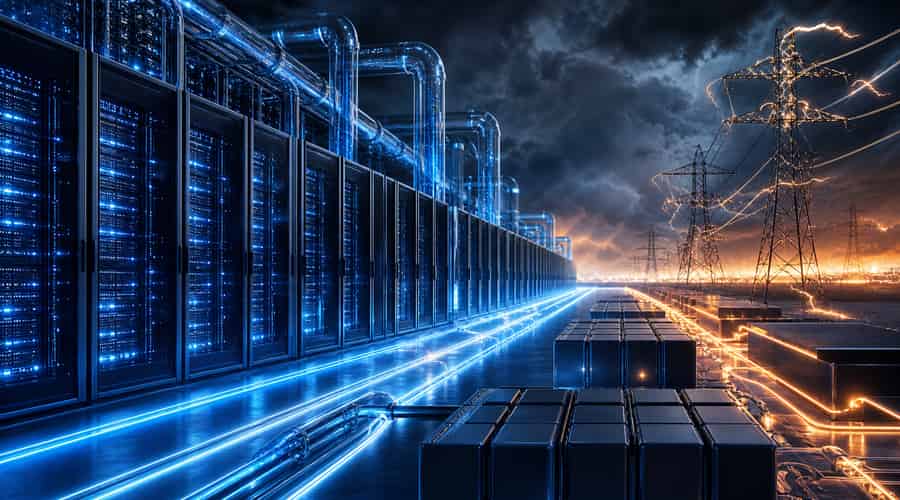
Delta Electronics is turning the AI buildout into a power story. The latest bottleneck is no longer just GPUs, but the electrical, cooling, and grid infrastructure needed to make those GPUs useful.
The AI race has spent the past two years obsessing over chips. That made sense when Nvidia GPUs were the scarce prize. But Delta Electronics is now pointing to the next constraint in plain sight: even the best chips cannot train models or serve customers if data centers cannot get enough power into the rack, move enough heat out of the room, and connect to a grid that is already under pressure.
That is why Delta's June 2 launch at COMPUTEX 2026 matters. The Taiwanese power-management company introduced a prefabricated AI Modular Data Center Solution that it says can reduce deployment time by up to 60%, while combining 800V In-Row Power with liquid cooling systems for high-density AI racks. That is a supplier announcement, of course, but the market signal behind it is bigger than one product. AI infrastructure is becoming a systems problem.
As Bloomberg recently reported, Delta Electronics posted record profit as demand rose for high-end power systems and liquid cooling used in AI data centers. That result helps explain why investors are starting to look beyond the obvious chip winners. The money pouring into AI factories has to pass through power shelves, UPS systems, batteries, coolant distribution units, microgrids, busbars, transformers, and building controls before it becomes useful compute.
Delta has been unusually explicit about the direction of travel. At NVIDIA GTC 2026 in March, the company showcased 800 VDC power racks, embedded battery backup units, megawatt-scale coolant distribution units, solid-state transformer technology, solid oxide fuel cells, and energy storage systems designed for next-generation AI factories. At Data Center World 2026 in April, it described a grid-to-chip architecture that combines power, cooling, batteries, and intelligent controls into one operating layer.
The numbers are not small. Delta's 800 VDC approach is designed to deliver up to 1.1 MW per rack at up to 98% efficiency. Its 3MW liquid-to-liquid coolant distribution unit is built for 3,000 kW of cooling capacity and flow rates up to 3,000 liters per minute. Its Ultron DPM Gen-2 UPS platform spans 250 to 2,500 kVA and can scale up to 20 MW with redundancy. These are not accessories. They are the machinery that determines whether a data center can support the density AI buyers now expect.
For years, data center efficiency was often discussed through broad metrics like power usage effectiveness. AI is making the conversation more physical. A rack that once drew a manageable amount of power can now demand levels that force operators to rethink distribution, backup, cooling, fire safety, and the layout of the building itself. When that happens, the supplier that understands the path from grid connection to chip voltage becomes more strategically important.
The second-order winners are getting harder to ignore
This is where Delta begins to look less like a quiet components company and more like a direct beneficiary of the AI capital spending cycle. Nvidia still captures the central narrative because GPUs remain the engine of modern AI. But every hyperscaler and cloud provider also has to solve the supporting infrastructure problem. That creates room for power electronics suppliers to behave like the memory trade once did: cyclical, capacity sensitive, and tied closely to the pace of server investment.
There is a catch. The same scarcity that can help suppliers can raise costs for everyone else. If grid approvals take longer, if liquid cooling systems become harder to source, or if power conversion equipment stretches lead times, the bill eventually lands with cloud customers and AI startups. A young company buying inference capacity does not care whether the added cost came from a GPU, a substation, a battery cabinet, or a cooling loop. It just sees higher compute prices.
That matters because AI business models are already being tested by expensive training runs and heavy inference demand. Startups can optimize models, use smaller systems, or lean on open-source tools, but they cannot negotiate with physics. If power density becomes the governing constraint, access to cheap and reliable compute will depend increasingly on which cloud providers secured energy, cooling, and electrical infrastructure early.
Delta's prefabricated approach is one answer to that pressure. Factory-built and pre-tested modules can reduce site complexity and shorten the time between capital commitment and usable capacity. That will appeal to companies trying to deploy fast while avoiding construction delays. But prefabrication does not remove the need for grid access, permitting, land, water strategy, and long-term operating discipline. It speeds part of the process. It does not make the hard parts disappear.
The next phase of AI infrastructure will be judged by more than who can buy the most accelerators. The winners will be the companies that can secure power, cool dense racks, protect uptime, and deploy capacity quickly enough to meet demand without letting costs run away. Delta Electronics is useful to watch because it sits directly inside that shift. The AI boom is still about intelligence, but the market is starting to price the pipes, wires, batteries, and cooling systems that make it possible.
Also read: Kioxia has become Japan's clearest AI memory trade. • A New York bar is turning Kalshi into small-business insurance • Special turns DOGE cost cutting into an AI acquisition strategy