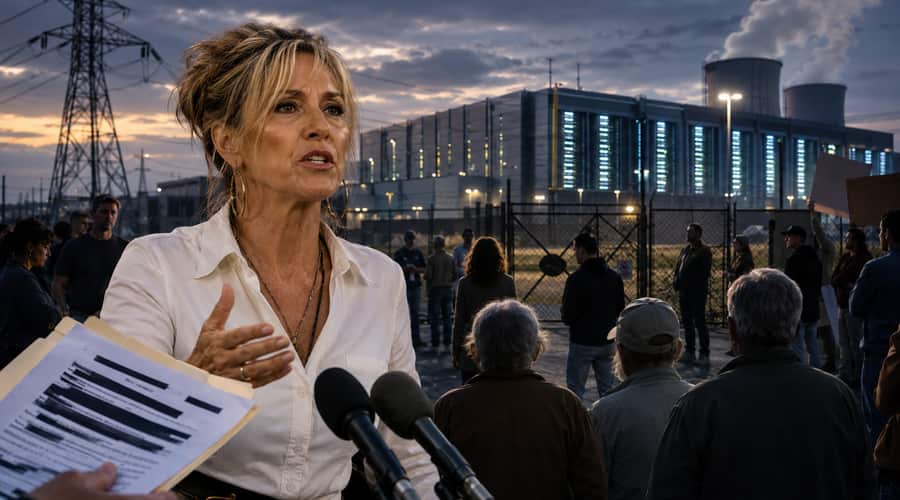
America's AI buildout is running into a trust problem, and Erin Brockovich is putting a public map around it.
Data centers have become the physical face of the AI boom. They are no longer abstract cloud infrastructure sitting somewhere far away. They are planned beside farms, neighborhoods, water systems and power grids, and Brockovich says communities are angry because too many of these projects appear to arrive before residents are told what is happening.
The environmental advocate has launched BrockovichDataCenter.com, a public reporting site that asks residents to flag concerns about AI data centers near them. The point is not to argue that every facility is bad. The point is to show where the process is breaking down. After putting out a call in late April, Brockovich said her team received nearly 4,000 submissions in the first month, with the map showing 2,716 pins across 49 states.
As TechCrunch recently reported, Brockovich is focusing less on the existence of data centers than on the secrecy around how they get approved. That distinction matters. The industry likes to talk about jobs, tax revenue and national competitiveness. Residents are asking a more immediate question: why did they learn about a massive industrial project only after the important decisions were already made?
For communities, the frustration starts with transparency. Brockovich has pointed to projects announced after permits are secured, developers who do not return calls and local officials who sign nondisclosure agreements before neighbors know a proposal is being discussed. That is a difficult way to build trust, especially when the facilities involved can require large amounts of electricity, water and land.
This is where the AI story becomes local. A chatbot may feel weightless to the user, but the infrastructure behind it is anything but. Data centers need power contracts, cooling systems, transmission upgrades and reliable water access. In places already dealing with rising utility bills or drought stress, residents are not wrong to ask who pays for the expansion and who carries the risk if projections prove too optimistic.
Tom's Hardware reported that Brockovich's map listed 33 operational AI data centers, 44 under-construction projects and 27 proposed sites as of late May, alongside thousands of community-reported locations. TechRadar also noted that Texas led the complaint count, with hundreds of resident submissions. Those numbers will change, but the pattern is already clear enough. The faster companies build, the more local communities want proof that someone is listening.
There is also a political lesson here for entrepreneurs and infrastructure investors. Speed can look like execution from a boardroom, but from a town hall it can look like a decision made somewhere else. Once residents believe they have been excluded, every company claim becomes harder to believe, even the reasonable ones. Jobs and tax revenue may be real, but they do not cancel out noise, water use, grid pressure or property concerns.
AI companies are learning that land use has a memory
The tech sector is used to launching products first and handling objections later. That habit does not translate cleanly to physical infrastructure. You can patch software. You cannot quietly patch a 1 million-square-foot facility after a community decides it was pushed through without consent.
That is why Brockovich's campaign has landed at an awkward moment for the industry. OpenAI, Microsoft, Google, Meta, Amazon and other AI leaders are all tied to an enormous buildout of computing capacity. They need more chips, more power and more buildings to support new models and customer demand. But every new site now carries a second question beyond engineering: did the community actually understand what was being approved?
Industry groups such as NetChoice argue that data centers can help local economies through tax revenue, construction activity and broader digital infrastructure. In some places, that case is persuasive. Loudoun County, Virginia, became a global data center hub partly because local officials saw the tax base as a major benefit. But Brockovich's critique is that industry messaging often leads with the upside and leaves residents to discover the tradeoffs later.
That creates a practical problem for the companies spending billions on AI infrastructure. Local opposition is no longer a side issue. It can delay permits, reshape zoning rules and turn data centers into election issues. New Jersey towns have already moved to restrict or ban projects after residents raised concerns about electricity use, water demand and noise. Other communities are likely to study those fights closely.
The smart move for builders is not a better advertising campaign. It is earlier disclosure, clearer energy and water accounting, and public answers before permits are locked in. If a project truly benefits a community, it should be able to survive daylight. If it cannot, the resistance will only grow.
Brockovich has made this fight about transparency, but the market implication is broader. AI companies can keep scaling only if the physical systems underneath them remain politically acceptable. The next phase of the AI race will not be decided only by model performance or chip supply. It will also be decided in planning meetings, utility hearings and small towns that have learned to ask harder questions before the trucks arrive.
Also read: Europe wants access to Anthropic's Mythos before AI risk widens • Binance is pushing stock trading into the crypto app era • Bain says AI savings are still missing the profit line