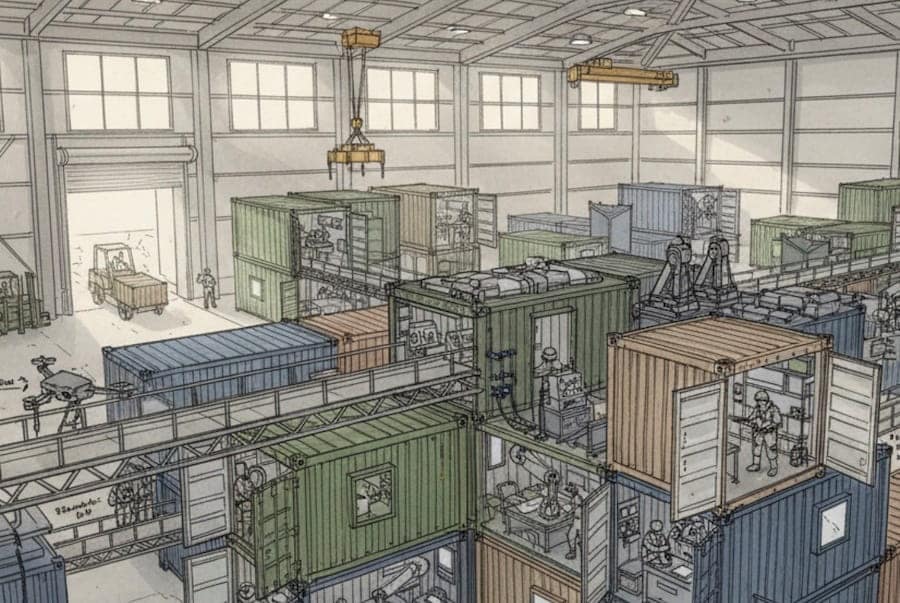
Firestorm Labs' $82 million Series B is more than another defense round, it is a bet that the next battlefield advantage will come from moving manufacturing into shipping containers and producing drones at the edge.
Defense startups usually sell speed. Firestorm Labs is selling proximity. The San Diego company just raised $82 million in a Series B led by Washington Harbour Partners, bringing total funding to $153 million and giving the market a clearer view of what it thinks the next phase of military manufacturing looks like. This is not a drone company in the usual sense. Firestorm is trying to turn containers into portable factories that can produce, repair, and sustain unmanned aircraft close to where they are needed. That is a much bigger idea than building a better airframe. It is a bet that the real bottleneck in future conflict will not just be design. It will be logistics.
Axios Pro reported that Firestorm's xCell system uses two shipping containers outfitted with additive manufacturing gear, including HP 3D printing technology, and can produce a fixed-wing drone within hours using standard 240-volt power. The company says the containers can also repair drones and components from both Firestorm and other manufacturers. That matters because it changes the operating assumption behind drone supply. Instead of waiting for a centralized factory to ship replacement parts or complete aircraft into a contested environment, units can produce and patch systems on site. In defense, that is not just convenient. It is survivability.
The investor list tells you how seriously the market is taking the concept. NEA, In-Q-Tel, Lockheed Martin Ventures, Booz Allen Ventures, Geodesic Capital, OCV Partners, and others are all in the round. This is not a random crossover of generalist capital chasing a hot theme. It is a defense and dual-use stack of backers that understand why point-of-need manufacturing matters. If your supply chain is exposed, your factory is too far away. If your replacement parts cannot arrive quickly, your aircraft does not stay in the fight. Firestorm's model is built around that simple, brutal truth.
The container is the point. It is modular, transportable, and easy to deploy with minimal local infrastructure. That gives Firestorm a practical edge in military environments where mobility matters and fixed production sites are vulnerable. The company is essentially saying that the factory itself should be treated like deployable hardware. Move the factory forward and you reduce the distance between design, production, repair, and use. That compression can change how a military plans inventory, how it resupplies units, and how quickly it can replace losses.
That also makes Firestorm more interesting than a standard drone builder. The company is not just trying to produce a better asset for the military. It is trying to produce a better manufacturing model for the military. That is a harder problem and, potentially, a more valuable one. If the factory is mobile, then the supply chain becomes an operational layer rather than a fixed vulnerability. If the same container can repair competing platforms, the market expands beyond one airframe family. And if the whole system can operate near the battlefield, the procurement question shifts from what drone to buy to where the drone ecosystem should live.
That is a meaningful change for defense tech investors. A startup that owns an attractive manufacturing workflow can become harder to displace than a startup that only sells a single vehicle. Drones come and go. Production architecture, once embedded in procurement and deployment, tends to stick. Firestorm appears to understand that. Its value proposition is not only mission-ready autonomy, but mission-ready manufacturing. That is a phrase investors can underwrite because it fits directly into the Pentagon's growing obsession with resilience, dispersion, and domestic industrial capacity.
The Defense Logic Is Changing
Firestorm's rise also reflects a larger shift in defense thinking. For decades, the industrial model assumed major systems would be produced centrally and shipped outward. That model still matters, but it looks increasingly mismatched to a world where drone attrition can be high, front lines can move quickly, and logistics are vulnerable to disruption. The lesson from recent conflicts has been clear. A side that can replace platforms quickly has a real advantage. A side that cannot replenish fast enough loses tempo. Firestorm is trying to solve that with manufacturing that can follow the fight.
That is why the backing from In-Q-Tel and traditional defense investors matters. They are not just buying into the drone market. They are buying into distributed industrial infrastructure as a defense layer. It is a shift from centralized weapons production to field-ready manufacturing, and it echoes a broader trend in defense startups, where software, autonomy, and production are getting bundled into one system instead of treated as separate markets. In that sense, Firestorm is less like a drone company and more like a logistics company with weapons relevance.
The business case is stronger than it first appears because Firestorm can sell to multiple customer types. The primary customer is the U.S. government, but the company's model has applications for allied militaries, oil and gas operators, and other industries that need remote manufacturing or repair. That diversification matters because the same containerized production logic that supports military logistics can also support civilian resilience. In a market where defense startups often need a second revenue line to justify scale, that optionality is valuable.
What The New Capital Buys
Firestorm says the new money will help it scale production, deepen its engineering bench, and support broader deployment of its xCell systems. Axios also reported that the company is negotiating an additional $100 million in debt and other investments to support international growth, inventory backlogs, and further research and development. That suggests the Series B is less an endpoint than a bridge to a much bigger manufacturing plan. If the system works, the company needs to produce more of it. If demand keeps rising, the challenge becomes building enough containers, enough throughput, and enough software to make point-of-need production repeatable.
That is where the startup's next test begins. Building a portable factory is hard. Making it reliable, maintainable, and fast enough for real-world defense use is harder. The promise is compelling because it attacks a weakness every military understands, the distance between need and supply. But the product will only matter if it can survive the conditions it was built for, from power limitations to battlefield damage to the complexity of field maintenance. The investors behind Firestorm are betting that those problems are solvable. If they are right, the company may end up defining a new category in defense: the factory as a deployable asset.
Also read: Taylor Swift deepfake scam ads show how AI has made celebrity fraud cheap and scalable • Cambricon's latest quarter shows China's Nvidia substitution trade is getting real • MIT and IBM are betting the next AI winners will mix models with quantum hardware