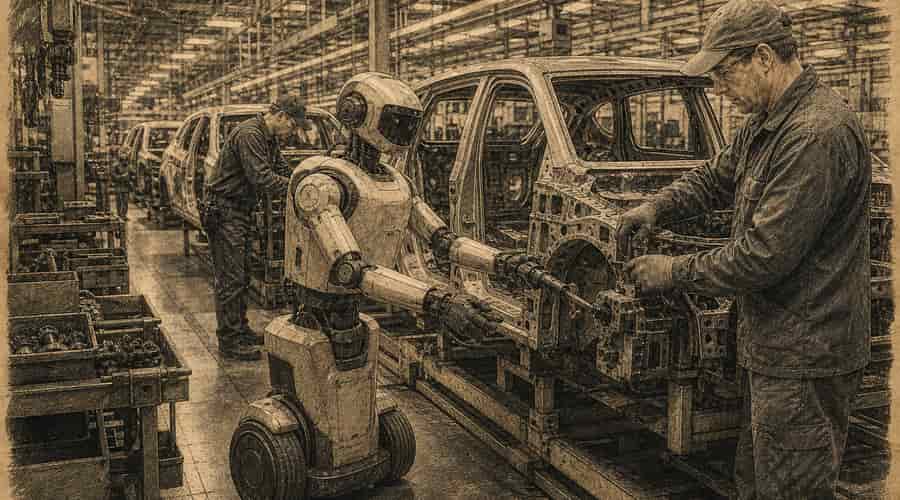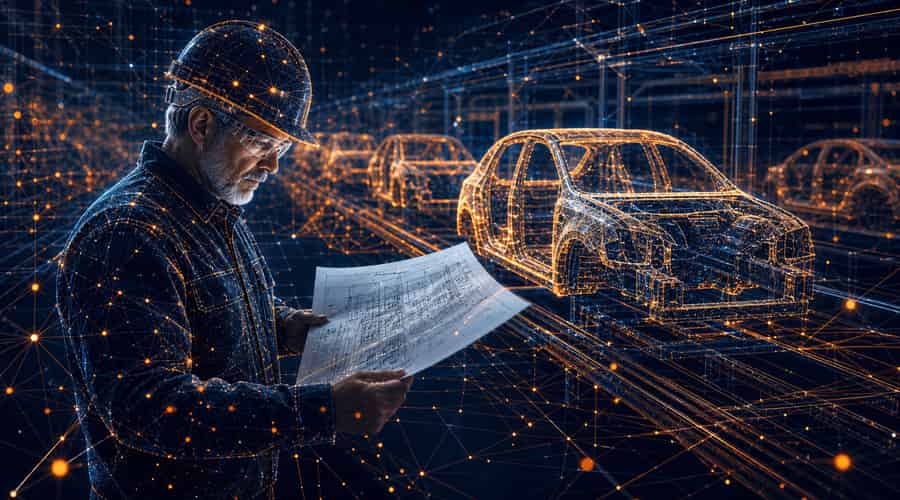
Ford's quality rebound did not come from handing more work to AI. It came after the company put experienced engineers back into the parts of the process where judgment still matters.
Ford has a good headline to point to this month. In J.D. Power's 2026 U.S. Initial Quality Study, the company ranked as the top mass-market brand, with 152 problems per 100 vehicles. Road & Track reported that the F-150, Mustang, and Super Duty each won their segments, and Ford finished behind only Porsche and Genesis overall.
Take the win seriously. Then look at what Ford had to do to get there.
According to Business Insider, Ford executives told reporters that the company hired, promoted, or brought back about 350 experienced technical specialists as part of a quality reset that began in 2023. That is not a small staffing tweak. It is an admission that the company had lost too much institutional memory and had leaned too hard on automated systems that were supposed to catch problems before customers did.
Charles Poon, Ford's vice president of vehicle hardware engineering, said the company had introduced AI, fed it design requirements, and assumed that would produce a high-quality product. It didn't. The mistake was not believing AI could help. The mistake was treating requirements documents as if they contained everything an engineer learns after years of watching real vehicles fail in real conditions.
You should pay attention to that distinction, because it is exactly where a lot of AI strategy goes soft.
The engineers Ford needed were not just carrying checklists. They knew where trouble tends to hide: the part that behaves differently once volume production starts, the interface between software and hardware that no single team quite owns, the old platform decision that keeps showing up in warranty claims years later. Some of that can be written down. A lot of it is pattern recognition earned the slow way.
Ford's recall record shows the cost of learning that too late. Business Insider reported that Ford had issued 51 recalls so far in 2026 as of Thursday, more than double Chrysler's count of 19. The company also set an ugly mark in 2025, with 152 recalls, nearly twice General Motors' previous record of 77 safety bulletins in 2014. That is not a spreadsheet problem. It is a customer problem, a dealer problem, a regulator problem, and a brand problem all at once.
The largest recent example was not abstract either. In February, Ford recalled 4,380,609 vehicles over an Integrated Trailer Relay Module software defect that could cause trailer brake lights, turn signals, and in some cases trailer braking function to stop working. Car and Driver reported that the recall covered models from the 2021 through 2026 model years, including the F-150, F-250 Super Duty, E-Transit, Expedition, Maverick, Ranger, and Lincoln Navigator. Ford said at the time that it was not aware of crashes, injuries, or fires tied to the defect.
That last sentence matters. Good reporting keeps the caveat in. A giant recall is serious without pretending every defect has already caused harm.
Ford's chief operating officer Kumar Galhotra has framed recalls as a lagging indicator, meaning many of the problems now appearing trace back to older designs and older development habits. That is plausible. It is also convenient. The J.D. Power result measures initial quality after 90 days of ownership, while recalls can surface from years-old engineering decisions. Both can be true at the same time: Ford's newer vehicles can be improving, and the company can still be paying for earlier quality mistakes.
The lesson is in the reversal
Ford did not throw AI out. That would be the wrong conclusion. The Verge reported that Ford has expanded automated testing, including more than 100,000 AI-powered tests, and created a 40-person software quality assurance team to catch issues earlier. The sharper change is that the company put experienced engineers back into the loop, leading mandatory design reviews and helping train the very systems that were supposed to replace some of that judgment.
Frankly, that is the part other manufacturers should copy first.
There is a lazy version of the AI story that says every experienced employee is a cost center waiting to be automated away. Ford's experience gives you the harder version. If the worker's value is mostly routine processing, software may take a large piece of it. If the value is knowing how a product fails after years of launch scars, warranty data, supplier drift, and angry customers, you had better know exactly how that knowledge gets transferred before you cut it loose.
The accounting can look clean at the start. Headcount falls. Automation spending sounds strategic. Executives get to talk about modernizing development. Then a recall arrives, and the math changes. A defect affecting millions of vehicles becomes a logistics operation across dealerships, a set of federal filings, a software fix, a customer notification campaign, and another headline that tells buyers the company still has not quite earned their trust back.
Do not misread Ford's J.D. Power result as a tidy redemption story. It is evidence that the repair work is starting to show up in new vehicles. The more useful fact is how the repair work was done: by combining AI tools with people who knew what the tools were missing.
For any company now asking how many engineers, operators, analysts, or specialists an AI platform can replace, Ford's quality reset is the document to study. Poon and Galhotra are telling you the assumption was wrong. The machines still have a job. They just need adults in the room.
Also read: Hong Kong's AI-fueled IPO boom is rewriting where Chinese tech capital goes to grow, Cloudflare cut 20% of its workforce while growing its engineering team, and Matthew Prince says every company will do the same, and Arizona is asking for more Colorado River water to feed data centers while facing a 77% cut in its share