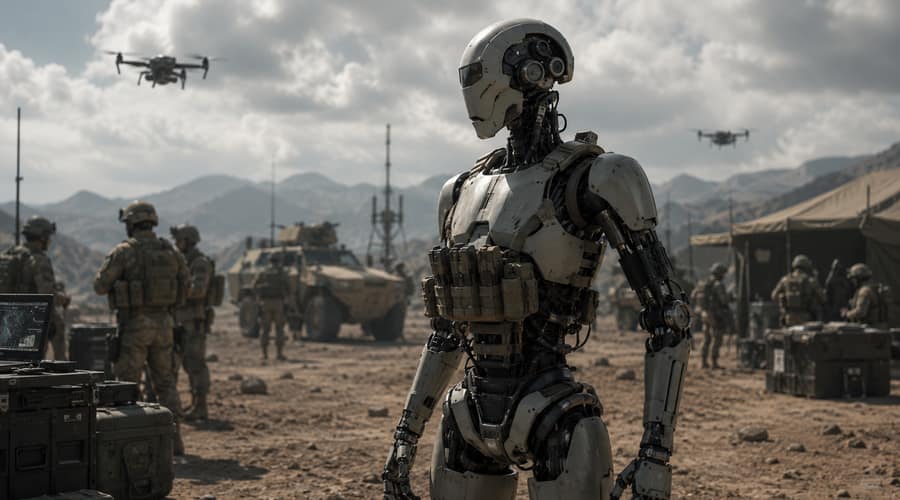
AI can write, code and summarize at speed, but putting it inside a humanoid body still exposes a harder problem: the real world is messy, heavy and unforgiving.
Foundation Future Industries is trying to move humanoid robots from factory floors into military work, and that tells us something important about where AI is still surprisingly weak. The hard part is no longer getting a model to sound intelligent. It is getting a machine to carry weight, survive bad weather, follow orders in dangerous terrain and do useful work without creating a bigger problem for the people around it.
According to CNBC, the San Francisco startup has sent two Phantom MK-1 humanoid robots to Ukraine for field testing focused on logistics in hazardous areas. The company says the robots are meant for dual-use work, meaning industrial jobs and military applications, and it has secured U.S. government research contracts totaling $24 million for testing across inspection, logistics and weapons-handling use cases.
That is a serious step for a young robotics company founded in 2024. It is also not the same as a robot soldier joining a battlefield unit. The current Phantom MK-1 can reportedly carry about 44 pounds, or roughly 20 kilograms, but the model still faces limits around battery life, waterproofing and durability. Those are not small details in Ukraine, where mud, debris, weather and electronic warfare have become daily engineering tests.
The case for a humanoid military robot is easy to understand on paper. Most human environments are built for human bodies. Doors, stairs, vehicles, tools and storage spaces all assume arms, hands, legs and a head-height field of vision. If a robot can use that same world without redesigning everything around it, it becomes more flexible than a tracked vehicle or a fixed industrial arm.
That is the promise Foundation is selling. CEO Sankaet Pathak has framed the company around replacing people in dangerous jobs, especially missions that involve delivery, inspection and resupply near the front line. The company plans to send an upgraded Phantom 2 model to Ukraine this year, with double the payload capacity of the MK-1 and better performance for field conditions.
The catch is that humanoid robots are complicated in exactly the places war punishes complexity. Legs look impressive in a demo, but wheels and tracks are cheaper, steadier and easier to repair. Hands can open doors and manipulate tools, but they also add failure points. A humanoid platform has to balance, see, lift, navigate and communicate while running on limited power. Each added feature makes the machine more useful, but also more fragile.
This is where AI’s limits become practical instead of philosophical. Large models can interpret instructions, but a robot still has to translate those instructions into motion. It has to know how much force to use, where to step, when to stop and what to do when the environment changes. In a warehouse, those variables can be controlled. In a war zone, they cannot.
The Politics Around The Machine
Foundation’s story has drawn extra attention because Eric Trump, son of President Donald Trump, is an investor and serves as a strategic adviser to the company. A spokesperson has said he was already an investor before taking the advisory role, but the connection will be watched closely as the company pursues defense work. Senator Elizabeth Warren has already criticized the contracts as "corruption in plain sight."
That political layer matters for investors because defense procurement is not a normal enterprise sales cycle. Access helps, but it can also create scrutiny. A young company selling military robotics needs technical credibility, manufacturing discipline and clean governance. If any one of those looks weak, competitors and lawmakers will press on it.
The company also enters a crowded and increasingly well-funded field. Boston Dynamics, Figure, 1X and Apptronik are all pushing humanoid development in different directions, while defense-tech companies are already selling drones, autonomous aircraft software and ground systems that are less dramatic but more immediately useful. The market does not reward the most human-looking robot. It rewards the one that works often enough to justify the cost.
Foundation says it wants to scale production to thousands of units this year and expand testing with the U.S. Army, Navy and Air Force over the next 12 to 18 months. Those targets will be difficult to meet. Manufacturing humanoids is not like shipping software. Motors, sensors, batteries, actuators, supply chains and field servicing all have to mature together.
Still, the timing explains why capital is paying attention. Defense technology has become one of the strongest startup narratives of the past two years, and Ukraine has turned battlefield robotics from a speculative pitch into a procurement priority. If humanoids can take even a narrow set of dangerous jobs from soldiers, the market will open. If they remain expensive demonstration machines, simpler robots will take the contracts.
The next signal to watch is not whether Phantom 2 looks impressive on video. It is whether Ukrainian operators keep using it after the demo ends, and whether the Pentagon moves from research money to repeat deployment budgets. AI may be advancing quickly, but embodiment is still the hard lesson. A robot that can talk like a person is interesting. A robot that can carry supplies through a dangerous, wet, broken landscape and come back useful is the real test.
Also read: Asian AI startups are becoming the next stop for Silicon Valley windfalls • Dell is preparing an XPS laptop with Nvidia N1X for Computex • DeepSeek V4 Flash Tops Blind AI Tests