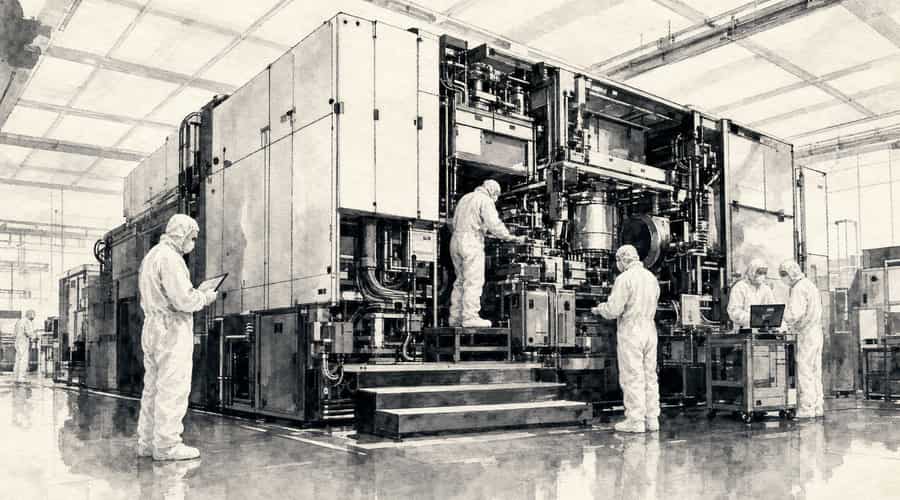
GE Vernova lifted its full-year 2026 financial outlook on April 22, citing a sharp rise in orders for gas turbines and grid hardware driven by the energy demands of artificial intelligence infrastructure.
The AI boom has a power problem, and GE Vernova is increasingly the company utilities call when they need to solve it. The energy equipment maker , spun out of General Electric in 2024 as its own standalone entity , announced it is raising its 2026 financial outlook, pointing to accelerating demand from utility providers scrambling to keep lights on at the hyperscale data centers that power modern AI workloads. Orders for heavy-duty gas turbines and grid solutions have climbed meaningfully above what the company anticipated entering the year.
The core tension driving this demand is not complicated: AI computing clusters require constant, uninterrupted power at massive scale, and renewable sources like wind and solar cannot yet reliably deliver that kind of continuous uptime on their own. Utilities supplying the big cloud and AI operators , Microsoft, Google, Amazon, Meta , are responding by locking in firm thermal generation capacity as a backstop. That means gas turbines, and right now GE Vernova makes some of the most sought-after ones on the market.
Beyond generation, the transmission and distribution network itself is becoming a chokepoint. GE Vernova's grid solutions segment, which covers the hardware and electrification software that moves power from plant to server farm, is also outperforming earlier projections. Upgrading aging grid infrastructure to handle the new load profiles created by large data center clusters is an enormous undertaking, and it is happening simultaneously across North America, Europe, and parts of Asia. Equipment manufacturers with proven grid hardware are in a strong position for the foreseeable future.
What makes this moment strategically interesting is the narrative tension it creates around decarbonization. The energy transition story of the last decade was built on a gradual displacement of fossil fuel generation. The AI infrastructure build-out is complicating that timeline in real time. Utilities are not abandoning clean energy targets, but they are signing contracts for gas capacity they would not have considered two years ago, because intermittent renewables alone cannot support a 200-megawatt data center running at full tilt around the clock. GE Vernova sits at exactly that intersection.
For investors, the company is becoming something of a bellwether for what might be called the physical layer of AI. Everyone has focused on semiconductors, data center real estate, and hyperscaler capital expenditure, but the unglamorous business of making sure there is enough reliable electricity to run all that compute is where GE Vernova operates. The upgraded outlook is validation that this segment of the AI trade has real, durable earnings power behind it.
Watch how the company's order backlog develops through the second and third quarters of 2026. If utilities continue front-loading equipment purchases to secure capacity ahead of projected AI infrastructure demand, GE Vernova's numbers could continue to surprise. The more interesting signal will be whether competitors can ramp production fast enough to close the supply gap, or whether this is a market where GE Vernova holds pricing power for longer than the current consensus expects.
Also read: The sudden dual exit of Fermis CEO and CFO exposes the fragility of the AI nuclear power sector • Tencent and Alibaba are racing to back DeepSeek at a valuation that has jumped sevenfold in under a year • Morgan Stanley says AI could hand the gaming industry $22 billion in extra profit by gutting development costs