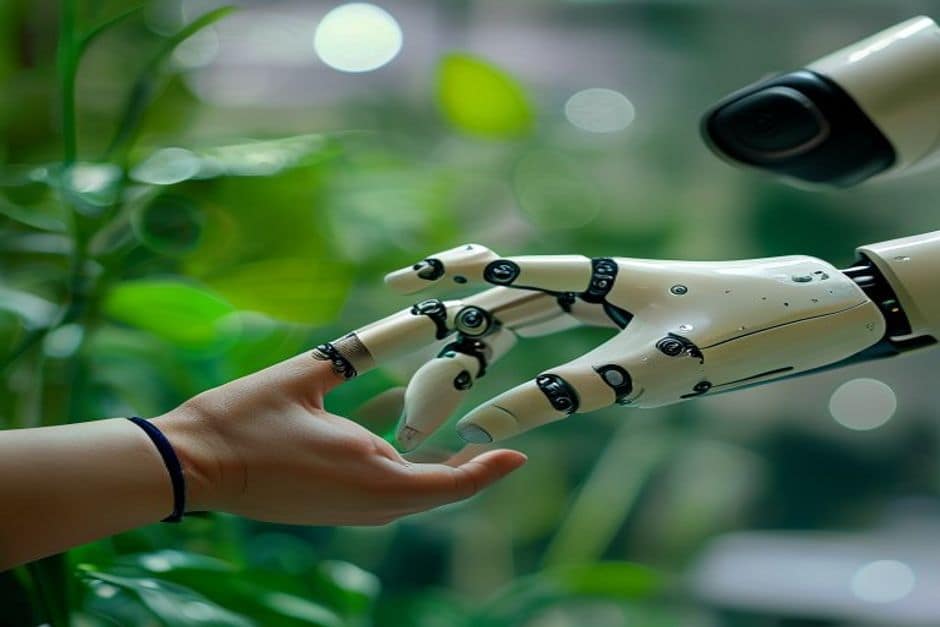
Genesis AI, backed by Khosla Ventures and Eclipse with a $105 million seed round raised in 2025, has unveiled GENE-26.5, its first robotics foundation model, alongside in-house robotic hands designed to match human size and shape so that workers wearing sensor-loaded gloves can generate the manipulation data the model needs to learn dexterous tasks.
The company has about 60 employees spread across Paris, California, and London, which makes its ambition even more striking. Genesis is not building a software layer that sits on top of third-party robotic hardware. It is building the hand, training the model with human demonstration data, and developing the simulation environment that ties the two together. The demo reel released alongside the announcement includes cracking eggs, slicing tomatoes, preparing smoothies, playing piano, solving a Rubik's Cube, and performing lab manipulation tasks. Those are not cherry-picked simple motions. They represent a range of dexterous manipulation challenges that have been hard problems in robotics for decades, because they require precise grip calibration, surface awareness, and adaptive force control that general-purpose robot arms have historically struggled to achieve at human speed and reliability.
The hand design is the decision that makes everything else possible. Existing robotic hardware companies build grippers and hands optimised for specific industrial use cases, often with very different geometries from a human hand. That means human demonstration data, collected by recording how people move through tasks, has to be translated across a significant morphological gap. Genesis decided to eliminate that gap by designing a hand that matches human size and shape closely enough that the sensor data from a gloved human demonstrator can be used to train the robot hand directly. A worker wears gloves equipped with sensors, performs a task naturally, and that data becomes training material for the foundation model. The translation loss is minimal because the hardware is analogous.
The approach puts Genesis in a different category from model-only robotics startups like Physical Intelligence, which raised $400 million from Bezos Expeditions, Sequoia, and others to build generalist robot policies that run on third-party hardware, or Skild AI, which is also building foundation models for robots without proprietary hardware. Those companies are betting that the foundation model layer captures enough of the value that hardware can be commoditised. Genesis is betting the opposite: that controlling the hardware creates a data flywheel that model-only players cannot replicate, because they are dependent on hardware partners for demonstration quality and morphological consistency. If you do not own the hand, you cannot guarantee that the training data collected from human gloves translates cleanly into the robot's movement space. That dependency limits how fast you can iterate.
Full-stack robotics also means higher capital requirements and longer timelines, which is why the Khosla and Eclipse backing at $105 million seed level is significant. That is an unusual amount for a seed round even in 2025 terms, and it reflects investor confidence that the strategy is defensible enough to justify the capital intensity before commercial revenue is established. The trade-off is real: Genesis has to succeed at hardware manufacturing, foundation model training, simulation, and deployment simultaneously. Physical Intelligence needs to succeed only at model quality. Single-layer bets are more focused, but Genesis is arguing that focus without vertical control leaves the model layer exposed to hardware commoditisation in both directions, from cheaper arms and from foundation models that any competitor can fine-tune.
The data ethics angle is the one that deserves more scrutiny than it usually gets in robotics coverage. Genesis collects manipulation training data by asking workers to wear sensor gloves and demonstrate tasks. Those workers are teaching a system that may eventually replace or reduce the need for similar human labor. That is not unique to Genesis. It is standard practice in manipulation robotics, and many companies are doing versions of the same thing with teleoperation, motion capture, and kinesthetic demonstration. But the scale matters. If Genesis succeeds and GENE-26.5 becomes a foundation model that generalises across kitchen, lab, and assembly tasks, the workers who collected the training data have contributed to a commercial asset without an obvious share in its upside. That is the standard arrangement in most data-collection work, but it is becoming harder to ignore as the commercial value of manipulation data grows and the labor implications of capable robot hands become more concrete.
For San Francisco readers, the Genesis launch is a useful lens for the broader robotics investment thesis. The market is splitting between model-only startups that need hardware partners and full-stack companies that own the physical layer. Neither approach is obviously right, and both have funded well-credentialed teams with large rounds. The resolution will likely come down to whether foundation model transferability across different hardware platforms improves fast enough that hardware differentiation stops mattering, or whether the morphological consistency of matched hardware and data proves to be a durable moat. Genesis is betting on the latter, and the demonstration quality in its launch videos suggests the hardware-model integration is already producing results that third-party hardware arrangements have struggled to match. Whether 60 people can scale that advantage into a deployable commercial product is the question the next 18 months will answer.
Also read: Mira Murati's court testimony that Altman misled her exposes OpenAI's governance under extreme pressure • Ethos raises $22.75M from a16z to rebuild expert networks around voice onboarding • Alphabet and Amazon's AI startup gains are now driving more than half their headline earnings