
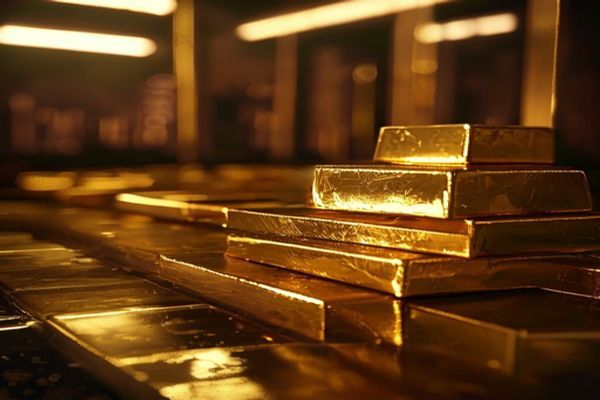
Gold is back above $4,800, driven by central bank buying and geopolitical uncertainty, leaving investors asking how much further this rally can run.
Gold has revisited the $4,800 mark, and the question on every commodity investor's mind is straightforward: where is the ceiling this year? The precious metal has been on a relentless upward trajectory, shrugging off the usual headwinds that historically temper its advances. This is not a speculative spike. It is a structural revaluation driven by forces that show no signs of easing.
Central banks are at the heart of this move. Institutions from Beijing to Warsaw have been accumulating gold reserves at a pace not seen in decades. According to data highlighted by the World Gold Council, global central bank gold purchases exceeded 1,000 tonnes in 2023, and the trend has only accelerated into 2024. China's People's Bank has been particularly aggressive, adding to its reserves for over a year of consecutive months. Poland, Singapore, and India have followed suit, diversifying away from the US dollar and euro in response to sanctions regimes and a fragmented geopolitical landscape.
The drivers behind gold's ascent are multiple and reinforcing. First, the geopolitical backdrop remains deeply uncertain. The Russia-Ukraine conflict shows no credible path to resolution, tensions in the Middle East continue to disrupt shipping routes and energy markets, and the broader rivalry between Washington and Beijing colours every major trade decision. Gold thrives in environments where certainty is scarce.
Second, real interest rates have shifted. While the Federal Reserve has kept rates elevated, the market consensus has moved toward eventual cuts. When the cost of holding a non-yielding asset like gold falls, the metal becomes comparatively more attractive. As BlockBeats recently noted, gold's push back above $4,800 reflects this recalibration of rate expectations alongside persistent geopolitical risk.
Third, the de-dollarisation narrative has moved from fringe discussion to actual policy in several major economies. The BRICS bloc has openly discussed trade settlement mechanisms that bypass the dollar. For these nations, gold serves as a neutral reserve asset that cannot be frozen or sanctioned. This is not theoretical positioning. It is happening on balance sheets right now.
Where the Top Might Be
Forecasting a precise ceiling is difficult, but the current momentum has drawn some bold projections from major banks. Analysts at Goldman Sachs have floated scenarios where gold reaches $5,000 or beyond if central bank buying maintains its current pace. UBS has similarly raised its targets, pointing to sustained demand from emerging market central banks and retail buyers in Asia.
The risk factors investors should watch are equally clear. A sharp rebound in the US dollar, driven by stronger than expected economic data, could cool the rally. If the Federal Reserve signals that rate cuts are further away than markets anticipate, the opportunity cost of holding gold rises. There is also the matter of profit-taking. Any asset moving this fast will see corrections, and gold is no exception.
Still, the structural case remains strong. Unlike equity markets, where valuations are stretched by historical standards, gold is being bid up by institutions with multi-decade time horizons. Central banks are not day trading. They are building reserves for a world they believe will be more fragmented and less dollar-dependent.
For individual investors, the practical takeaway is one of allocation rather than timing. Gold above $4,800 is not cheap, but its role as a hedge against currency devaluation, geopolitical shock, and monetary policy uncertainty remains intact. Those considering exposure should think in terms of portfolio insurance, not speculative return. Watch central bank purchase data each quarter, track Federal Reserve commentary on rates, and keep an eye on BRICS trade settlement developments. Those three signals will tell you more about gold's next move than any chart pattern.