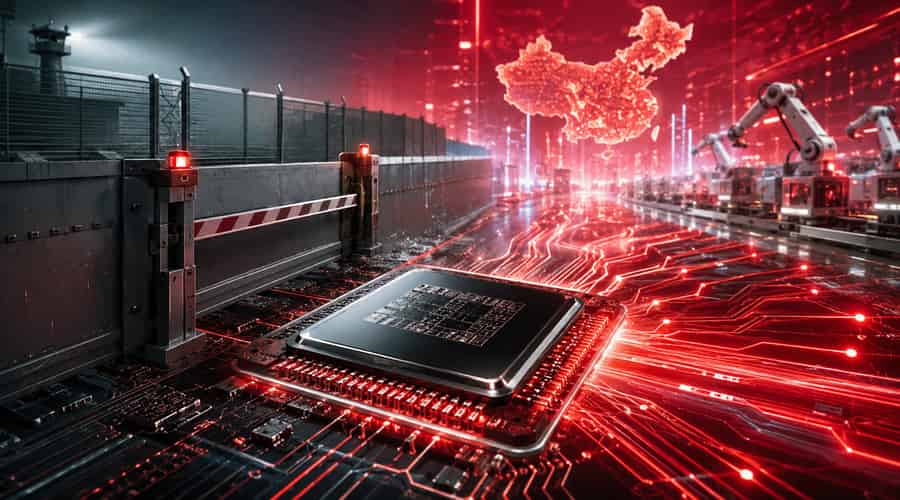
Huawei is turning Washington’s chip restrictions into a public argument that pressure has accelerated China’s semiconductor ambitions, not contained them.
Huawei’s latest message to the United States is not defiance for its own sake. Xu Zhijun, Huawei’s rotating chairman and deputy chairman, has said the company is grateful for the pressure from Washington because it pushed China’s semiconductor supply chain to grow faster and take itself more seriously.
That is not the story US policymakers wanted to hear. Export controls were designed to slow China’s access to advanced chips, chipmaking tools and the AI hardware stack behind modern computing. Huawei is now arguing that the restrictions did something else as well: they forced Chinese companies to invest in domestic design, packaging, software tools and manufacturing partnerships with a level of urgency that might not have existed otherwise.
The timing matters. Huawei made the comments after unveiling Tau Scaling Law and LogicFolding, its new approach to improving chip performance by reducing signal travel time rather than relying only on smaller transistor geometry. The company presented the work at the 2026 IEEE International Symposium on Circuits and Systems in Shanghai, where He Tingbo, president of Huawei’s semiconductor business, laid out a roadmap that would bring the architecture into Kirin chips later this year.
According to Reuters, Huawei says its Kirin chips scheduled for launch in the fall of 2026 will be the first to use LogicFolding, and the company expects high-end designs by 2031 to reach transistor density equivalent to 1.4-nanometre processes. Huawei also said it has designed and mass-produced 381 chips over the past six years using ideas tied to the same scaling approach, covering areas from smartphones to AI computing.
Those are big claims, and they deserve scrutiny. Huawei has not provided independent benchmark data, yield information or cost comparisons that would prove the approach can compete commercially with TSMC, Nvidia or other leaders at scale. Advanced packaging and three-dimensional stacking are not new ideas either. TSMC, Samsung, SK Hynix and others have spent years developing their own versions of these techniques.
Still, the strategic signal is hard to ignore. China has been blocked from importing ASML’s most advanced extreme ultraviolet lithography machines, and US rules since 2022 have tightened access to advanced AI accelerators such as Nvidia’s A100 and H100. Huawei was also placed under heavy US trade restrictions in 2019. The result was supposed to be a ceiling. Instead, Huawei is trying to build a ladder around it.
This is where the export-control debate becomes uncomfortable. Restrictions can slow an opponent down when the missing inputs are genuinely irreplaceable. But if the target has enough capital, political backing and market demand, restrictions can also create a protected home market for local alternatives. The chips may be less efficient. The software stack may be rougher. The yields may be lower. But domestic customers still need compute, and that demand gives local suppliers revenue, feedback and time.
Nvidia Is Caught In The Middle
Nvidia shows the other side of the policy problem. Washington has tried to keep the most powerful US AI chips out of China while preserving some commercial access through compliant products and licensing. That middle ground has become harder to manage. Recent reports have said US approvals for Nvidia’s H200 sales to selected Chinese customers have not translated cleanly into shipments, while Beijing has been pushing companies toward domestic suppliers including Huawei.
For Nvidia, the risk is not just lost sales in one large market. It is the erosion of software and developer influence. The company’s strength is not only the chip. It is CUDA, networking, systems design and the habits of engineers who build on Nvidia hardware because the ecosystem works. If Chinese AI labs and cloud companies are pushed into Huawei Ascend systems, even imperfect ones, they begin solving their problems around a different stack.
That is why Xu’s comment lands with such force. It turns US policy into Huawei’s marketing argument. The message is simple: pressure made us stronger, and now the whole local industry understands why self-sufficiency matters. For Chinese equipment makers, EDA developers, materials suppliers and foundries such as SMIC, that gives every bottleneck a national priority label.
None of this means Huawei has solved the hardest semiconductor problems. China still trails the frontier in lithography, process technology and high-volume production of the most advanced chips. LogicFolding may improve density and performance, but it could also bring heat, yield and manufacturing complexity that make the economics difficult. A roadmap is not the same as a product shipping in volume.
But investors and policymakers should be careful about measuring export controls only by immediate damage. The better question is what behavior they create over five or ten years. Huawei’s comeback in smartphones with Kirin chips made by SMIC already showed that restrictions did not remove the company from the field. Its latest chip architecture push suggests it is now using the constraints as a design brief.
The next test will be practical, not rhetorical. If Huawei’s fall 2026 Kirin chips show meaningful gains, and if Ascend AI systems follow the same path later in the decade, Washington will face a sharper trade-off. It can tighten controls further and risk accelerating local substitution, or loosen selected sales and preserve some US influence inside China’s AI hardware market. Either way, the semiconductor race is no longer just about who has the best chip today. It is about whose ecosystem keeps learning fastest under pressure.
Also read: Nvidia is bringing its AI chip fight to Windows PCs next week • Microsoft is betting its enterprise future on durable AI agents and the infrastructure race has already begun • Federal lawmakers move to ban emotion-reading AI as the science behind it crumbles