Huawei's new 122.88TB SSD is not just another dense storage product. It is a reminder that export controls can slow China's chip industry, but they do not stop engineers from finding another path.
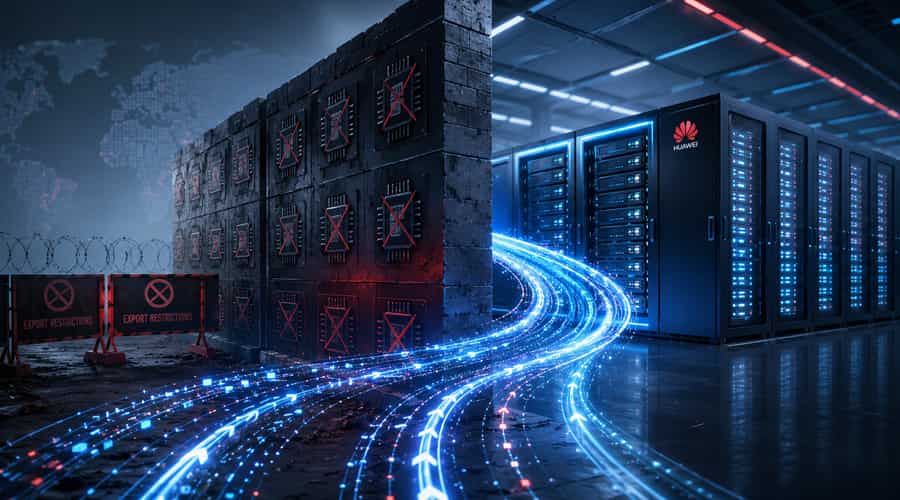
Huawei has turned a storage problem into a sanctions story. The company has produced high-capacity SSDs for AI and data center systems in 61.44TB and 122.88TB configurations, using a packaging method designed to work around its limited access to advanced 3D NAND chips.
The core idea is simple enough. If Huawei cannot freely buy the most advanced high-layer NAND used by global memory leaders, it can try to put more available NAND dies into a tighter physical design. That is what its Die-on-Board packaging approach appears to do, placing NAND dies directly onto the printed circuit board instead of relying on conventional packaged NAND parts.
As Blocks & Files reported from Huawei's ID Forum 2026 event in Paris, the technology is being used in Huawei storage products including OceanDisk SSDs and the OceanStor Pacific 9926 system. The company also discussed a future 245TB version, which matters because the storage race is now moving beyond ordinary enterprise capacity and into the needs of AI data lakes, model inference and dense data center racks.
Most attention on chip restrictions has focused on GPUs, accelerators and leading-edge logic. That is understandable. Nvidia, TSMC, SMIC and Huawei's Ascend chips sit closer to the center of the AI compute debate. But storage is part of the same infrastructure stack. AI systems do not only need chips that calculate quickly, they need fast and dense access to large amounts of data.
Huawei's challenge is that the highest-density NAND supply chain still depends heavily on foreign technology and suppliers. Samsung, Kioxia, SanDisk and Micron use advanced 3D NAND designs and mature packaging routes for high-capacity SSDs. Huawei, because it remains on the U.S. Entity List, cannot simply source whatever parts it wants when those products depend on U.S.-origin technology.
That is where YMTC enters the story. The Chinese memory company has developed competitive NAND, including 232-layer technology, but it still trails the most advanced global suppliers in density. For a normal SSD maker, that gap becomes a capacity disadvantage. For Huawei, it becomes an engineering target.
Die-on-Board packaging does not magically make NAND more advanced. It changes how much storage can be packed into the device by reducing the inefficiencies of conventional packaging. Blocks & Files said Huawei describes a 33% capacity density improvement from the approach. That is a meaningful gain if the alternative is waiting for domestic NAND suppliers to fully catch up.
Packaging is becoming a strategic weapon
This is part of a broader pattern in Chinese semiconductors. When access to the cleanest process node is restricted, companies look for performance elsewhere: chiplets, system design, packaging, power tradeoffs and software tuning. It is not always elegant. Sometimes it costs more energy, takes more space or creates thermal problems. But it can be good enough for a domestic market that values self-sufficiency as much as benchmark leadership.
Huawei's storage design has those same tradeoffs. Putting dies directly on a board creates its own problems, especially around heat, signal integrity and serviceability. A product may reach impressive capacity on paper while still needing careful validation in real data center workloads. This is especially true for AI infrastructure, where storage systems are judged not only on raw capacity but on bandwidth, endurance, latency, power draw and failure behavior under constant load.
Still, the direction is important. Huawei's OceanStor Pacific 9926 configuration with 36 x 122.88TB NVMe SSDs is reported to provide 4.42PB of raw capacity in a 2U chassis, or 11PB effective capacity with 2.5:1 compression. That does not beat every Western storage configuration. Dell and Kioxia have shown a denser 2U system using 40 Kioxia LC9 Series 245.76TB SSDs. But Huawei does not need to lead every comparison to change the market calculation.
For founders and investors, the practical question is not whether this one SSD defeats the global memory industry. It does not. The better question is whether export controls remain a durable moat when constrained companies can keep shifting the battle to packaging and systems integration.
That matters because AI infrastructure pricing is already being shaped by scarcity. GPUs get the headlines, but memory, storage, power equipment, networking and advanced packaging all influence what it costs to build useful AI capacity. If Chinese suppliers can build more of that stack domestically, even with some efficiency penalty, they reduce dependence on restricted imports and put pressure on global pricing over time.
There is also a compliance angle. A recent U.S. federal procurement rule adds CXMT and YMTC to covered semiconductor restrictions beginning August 1, 2026, extending Washington's concern from telecom systems into memory components. That makes storage provenance a bigger issue for government contractors and anyone selling into sensitive supply chains.
Huawei's 122.88TB SSD should be read in that context. It is a storage product, but also a signal. Restrictions can narrow the route, yet they can also push a company to redesign the route entirely. The next thing to watch is whether Huawei can move from a clever packaging answer to broad, reliable, cost-competitive deployment in AI data centers. That is where this story either becomes a technical footnote or a real shift in the infrastructure market.
Also read: Tech layoffs pass 100,000 as companies fund AI ambitions • Meituan pushes open avatar video deeper into startup territory • Ordinary WiFi is becoming a new biometric risk for startups