Huawei's Tau Scaling Law and LogicFolding architecture are not proof that China has beaten TSMC. They are proof that US export controls have given Huawei a market, a mission, and a reason to build around the blockade.
Xu Zhijun, Huawei's rotating chairman, said the quiet part out loud in June. TechRadar reported that he thanked the United States for forcing China's semiconductor industry to grow up faster, saying Huawei would not have pushed this hard without Washington's pressure. You don't have to admire the line to understand the warning inside it. Sanctions were meant to slow Huawei down. They also gave it the clearest business plan in Chinese technology.
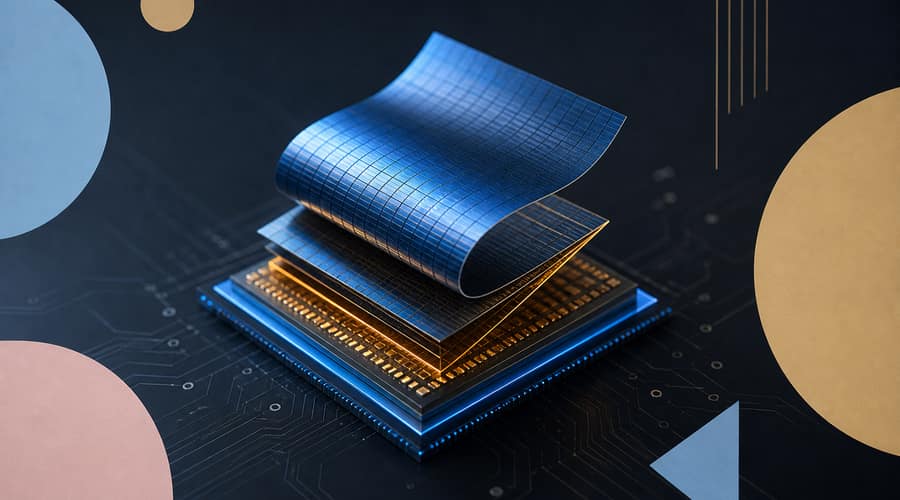
At the IEEE International Symposium on Circuits and Systems in Shanghai in May, He Tingbo, the head of Huawei's chip division, put technical language around that plan. Huawei's Tau Scaling Law moves the conversation away from the old race to shrink transistors and toward reducing the time signals take to move through chips and systems. Its LogicFolding architecture then tries to get more density by stacking and folding logic vertically, not by pretending Huawei suddenly has ASML's most advanced EUV machines.
According to Tom's Hardware, Huawei claims LogicFolding can lift transistor density by 55% and improve power efficiency by 41%, with a path to chips that it describes as 1.4nm class by 2031. Sit with that phrase, 1.4nm class. It doesn't mean Huawei has matched TSMC's lithography. It means Huawei is trying to get effective density by architecture and packaging while the front door to leading-edge fabrication stays shut.
That's the distinction investors need to keep clear. Tom's Hardware and other chip analysts have treated LogicFolding as a 3D logic stacking approach, not a conventional process-node breakthrough. The comparison to 1.4nm depends on what you count. Still, dismissing it as marketing would be lazy. TSMC's own road map leans heavily on advanced packaging and vertical integration because physics is getting expensive for everyone, not only for sanctioned Chinese firms.
The chip story also doesn't stand alone. Huawei announced the Ascend 920 in April 2025, just after the US moved against Nvidia's H20 sales to China. Tom's Hardware, citing DigiTimes Asia, reported that the Ascend 920 was expected to use a 6nm process, exceed 900 TFLOPS per card, and offer 4 TB/s of bandwidth with HBM3. That wasn't an H100 killer. It was aimed at the narrower, more useful target Chinese customers had actually been buying: the H20.
Then the market moved. Jensen Huang has now said Nvidia's AI accelerator share in China has fallen to zero, down from a position that once looked close to untouchable. You can argue over how much of that loss came from US rules, Chinese buying pressure, or Beijing's own preference for domestic chips. The result is harder to argue with. Huawei and other Chinese suppliers now get a protected home market in the one category where scale matters most.
Washington expected that cutting off TSMC access and ASML tools would create a ceiling Chinese firms couldn't break. It did create a ceiling. But a ceiling can also tell engineers exactly where to push. Huawei now has HarmonyOS on more than a billion active devices, according to figures reported after its HarmonyOS NEXT event, and its chip work sits inside a broader stack that includes phones, servers, AI accelerators, operating systems, and cloud hardware. That is not a side project. It's an ecosystem built under pressure.
The freshest evidence came this month. The South China Morning Post reported, through coverage picked up by Tom's Hardware, that a Huawei-linked research group used more than 1,000 Ascend 910C chips to post-train DeepSeek's 1.6 trillion parameter V4-Pro model. That still doesn't prove Chinese accelerators can replace Nvidia for full frontier-model pretraining. It does prove you should stop treating Huawei's AI chips as a theoretical threat. They are being used on real workloads now.
Research groups are not all saying the same thing. CSIS has argued that export controls still hurt China badly in advanced semiconductor manufacturing equipment, especially below 7nm where EUV access matters. ITIF, in a November 2025 report on decoupling risks, warned that overly broad controls can isolate US firms from major markets and create openings for Chinese competitors. Both can be true. Frankly, that's the problem for Washington. A policy can slow an opponent in one layer and strengthen it in another.
For anyone holding Western semiconductor stocks, the question isn't whether Huawei has caught TSMC. It hasn't. The question is what kind of rival export controls are helping to finance. Nvidia lost a China business that had once mattered deeply to its data-center growth. ASML still has the EUV monopoly, but Huawei is now making a public argument that architectural scaling can route around part of that dependence. You don't need to believe every Huawei projection to see why that changes the risk.
The export-control strategy was built for a static adversary. Huawei has been many things, including subsidized, protected, and politically useful to Beijing. Static is not one of them.
Also read: GCash's parent Mynt wins approval to file for what would be the Philippines' largest-ever IPO • Kuaishou's Kling AI is spinning out at a $20 billion valuation and the revenue numbers make that hard to argue with • HSBC puts a hard number on AI and the banking industry will have to reckon with it