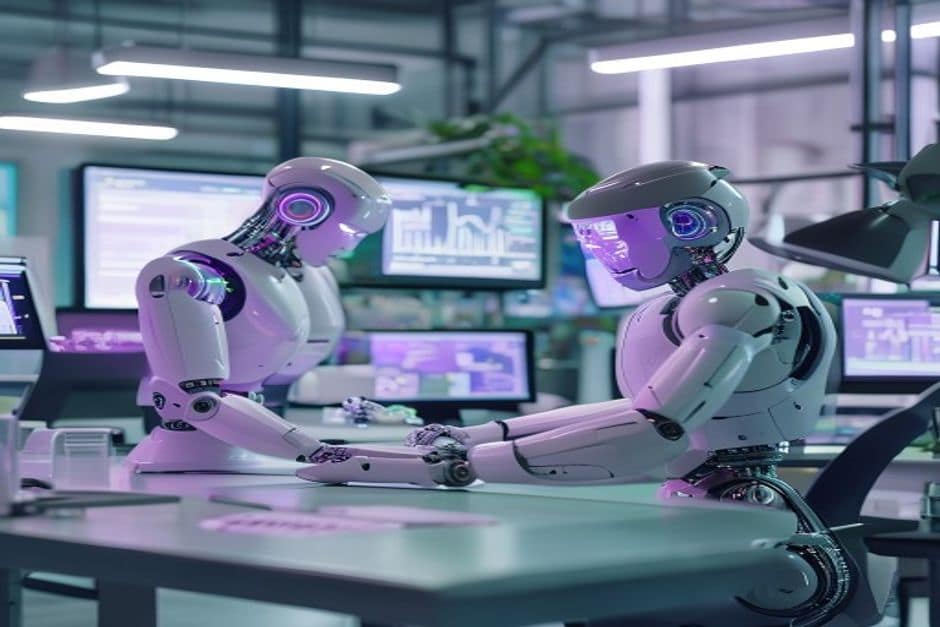
London-based robotics startup Humanoid has unveiled KinetIQ, a Vision-Language-Action model it claims can teach humanoid robots new physical skills in two calendar days through simulation-based training followed by real-world transfer, as the company seeks around $200 million in a Series A round to fund mass production planned for 2027.
KinetIQ combines visual recognition, language understanding, and motion control into a single integrated system. The training pipeline runs in simulation first, compressing what would take months of real-world trial-and-error into two days by effectively running thousands of years of synthetic experience before transferring the learned behaviour to a physical machine. Human workers demonstrate tasks using the robot's cameras and grippers, the AI records and analyses the movements, and the resulting policy generalises across variations in the environment. The company showed Reuters footage of this process operating in its London office, making the claim grounded in demonstrated hardware rather than benchmark scores alone.
Humanoid founder Artem Sokolov has reportedly invested $30 million of his own capital as the startup's only external shareholder before the Series A. The UK government's Department for Science, Innovation and Technology visited the London HQ in January as part of a £52 million robotics adoption push that included Humanoid's Robot-as-a-Service offering. Defense is an explicit target vertical, which aligns with the UK government's designation of defense and robotics as priority areas for regulatory streamlining. The combination of government interest, solo founder capitalisation, and a $200 million raise attempt positions Humanoid as one of the more ambitious European robotics bets of the year.
Whether KinetIQ represents a genuine moat or an impressive demo metric depends on what happens outside controlled conditions. Sim-to-real transfer is the central unsolved problem in manipulation robotics. Every lab running Isaac Sim or MuJoCo can generate millions of simulated trajectories. The gap is always in the transfer: subtle differences in friction, lighting, surface texture, and object weight cause policies trained in simulation to fail on real hardware. If Humanoid's two-day claim holds across diverse real-world tasks in messy factory environments rather than curated demo setups, that is material progress. If it holds only for constrained pick-and-place tasks in controlled conditions, it is a compelling pitch but not yet a production-grade system. The Reuters video shows real hardware working, but the editorial question is what tasks were demonstrated and under what conditions.
For SF readers, the more important story is how factory and defense demand is reshaping humanoid robotics financing and risk profiles. Foundation Future Industries, another London startup, is explicitly targeting defense alongside industrial work. Kova Labs in Finland is building autonomous systems for contested environments where GPS is jammed. The defense market creates revenue earlier than pure commercial robotics, because government buyers will pay for capability at lower volume and accept longer development cycles. That shapes cap tables: defense-focused robotics startups attract sovereign capital, defence primes as strategic investors, and government contracts as revenue bridges.
The ethical dimension is real and growing. Humanoid robots trained for factory work and humanoid robots trained for military applications share the same foundational learning infrastructure. A VLA model that teaches a robot to assemble car parts can, with different training data, teach it to navigate buildings or operate in adversarial environments. Dual-use capability is not a theoretical concern in this category. It is the explicit product roadmap for several startups simultaneously targeting industrial and defense buyers. Investors who fund these companies are implicitly funding both applications, and the disclosure standards for that dual exposure are minimal compared to established defense primes. As capital from sovereign funds and defense-aligned investors increasingly flows into humanoid startups, the ethical risk migrates from academic discussion to board room liability.
The competitive context makes Humanoid's timeline credible but tight. Tesla targets Optimus at 1,000 units this year and potentially one million by 2030. Figure AI has BMW as a customer and $2.25 billion in funding. Agility Robotics is running Digit in Amazon warehouses. Chinese manufacturers like Unitree and UBTECH are deploying at scale with lower unit costs. A London startup planning mass production in 2027 has roughly 12 months to close a $200 million round, build manufacturing capacity, and demonstrate customer deployments before the competitive window tightens. The technology claim is plausible. The execution challenge is immense.
Also read: Johnson Controls' AI data center cooling backlog shows infrastructure scarcity is now the real AI bottleneck • Qwen3.6 Heretic v2 shows the local AI community is now engineering refusal-free frontier models • Gen Z treats subscriptions as event tickets, and platform loyalty is officially dead