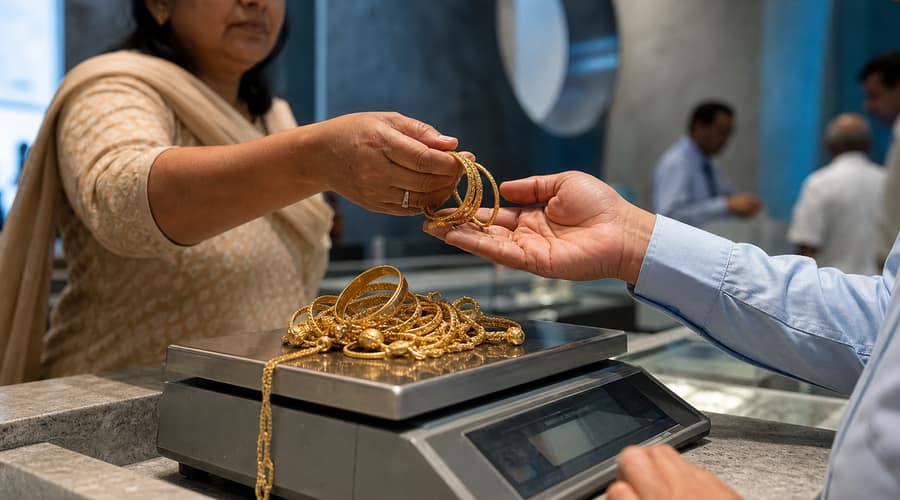
Indian households are selling old gold into a falling market, and that changes the math for anyone counting on India to keep bullion prices supported through 2026.
Gold in India isn't just another asset on a screen. It's jewellery in a locker, wedding money, family savings and, for many households, the one store of value that doesn't ask for paperwork. So when Indian families start selling old jewellery instead of waiting for the next wedding season, you should pay attention.
The Economic Times reported on June 29 that consumers sold nearly 50 tonnes of old gold during the April to June quarter, citing the India Bullion and Jewellers Association. That was up 43% from a year earlier. The reason was not mysterious. Prices had fallen from about Rs 1.8 lakh per 10 grams at the beginning of the year to roughly Rs 1.4 lakh, and IBJA national secretary Surendra Mehta told the paper that households feared a further slide to Rs 1.2 lakh.
That is the turn in the story. Indian households usually buy dips. This time, many are booking cash.
The World Gold Council had already shown the same pressure building before the latest quarter. As the Times of India noted in May, India's net recycling or scrap supply rose 20% year over year in Q1 2026 and 44% from the previous quarter to 31.2 tonnes. Many holders were not liquidating everything, according to that report, but they were willing to monetise part of their gold after prices had risen more than 80% over the previous year. That is not panic. It is households doing the arithmetic.
The scale is what makes this a market story, not just a jewellery trade story. Indian households are estimated to hold nearly 30,000 tonnes of gold, according to industry figures cited by The Economic Times. Recycled gold contributed an estimated 125 to 150 tonnes in 2025, and industry estimates now put possible 2026 recycling volumes at 200 to 250 tonnes if the current selling continues. You don't need every family to empty a locker for that to matter. A small shift in a hoard that large is still a serious supply event.
Fresh demand is weakening at the same time. Ahmedabad jewellers told the Times of India in May that nearly 80% of jewellery sales were happening through exchange schemes, with customers swapping old gold for new ornaments rather than buying fresh metal. Tanishq had already run a zero deduction exchange scheme across gold karats during the 2025 festive and wedding season. Local jewellers were preparing similar offers. That tells you where the pressure sits: retailers still want footfall, but they don't want every sale to depend on imported bullion.
India's import bill explains the policy pressure behind that shift. SBI Research, cited by the Times of India, said gold imports rose from $57.9 billion in FY25 to $72.4 billion in FY26 even as volumes fell by around 5% in both years. The value was up because prices were up, not because Indians were suddenly buying much more metal. The government then raised the import duty to 15% after cutting it to 6% in June 2024. Higher duty can support recycling, but it also risks widening the gap between domestic and international prices and pushing some trade into informal channels.
Frankly, that is the uncomfortable part for gold bulls. A higher price has not only made Indian gold owners feel richer. It has made them more willing to sell.
There is still a strong bullish case for gold. JPMorgan has forecast gold at $6,300 an ounce by the end of 2026, according to the New York Post, and the bank expects central banks to keep buying. That institutional demand is real. But it doesn't cancel out what is happening in India. Central banks buy for reserves, politics and currency diversification. Indian households buy and sell through a different logic: weddings, cash needs, family timing and price memory. When that second group starts adding supply, the market feels it in a very practical way.
The 2013 correction is the useful warning here. Gold fell hard from its peak, recycling rose, and import demand weakened. The recovery was not immediate. That does not mean 2026 has to follow the same script, but you should not treat household selling as a footnote. In India, retail behaviour is not background noise. It is one of the load bearing facts of the gold market.
The better question is whether this is a quick cashing out at high prices or the start of a deeper change in how younger Indian consumers think about gold. The evidence so far points more to cashing out than rejection. Families are still exchanging jewellery, jewellers are still trying to keep wedding demand alive, and the household hoard is still enormous. But for the rest of 2026, the old assumption looks weaker: India may not be the buyer of every dip. Some of its households are now the sellers on the other side.
Also read: Gold breaks below $4,000 for the first time since November as the Fed pivot trade unravels, Ledn lets gold holders borrow against tokenized vaults without selling a single ounce, central banks are choosing gold over Treasuries and the repatriation wave is only getting started