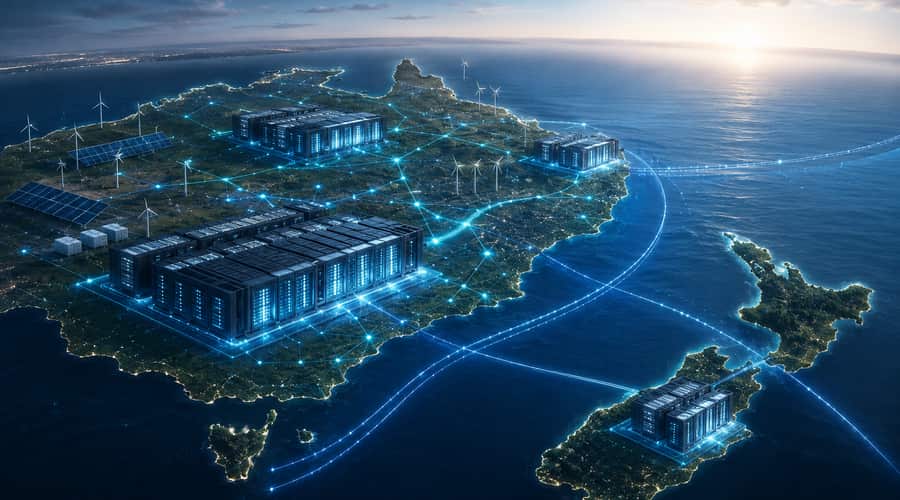
Infratil’s latest result shows how quickly AI infrastructure has moved from a technology story to an infrastructure funding race. CDC Data Centres is now the centre of that bet.
Infratil has put a clear number on the AI buildout now taking shape in Australia and New Zealand. The New Zealand-listed infrastructure investor reported an 11% lift in FY26 earnings to NZ$989 million and pointed directly to CDC Data Centres, its largest digital infrastructure holding, as one of the main reasons the next phase looks bigger than the last.
This is not just another data centre growth story. It is about where the capital for artificial intelligence is going when Singapore is tight, Japan is expensive, and large technology companies need politically stable, power-backed locations close enough to serve serious enterprise and government demand. Australia and New Zealand are moving from the edge of that conversation to the middle of it.
According to Infratil’s FY26 results released on May 26, CDC now has more than one gigawatt of capacity contracted after signing what Infratil described earlier this month as Australasia’s largest ever data centre contract, a 555MW deal with a US customer. That single agreement changed the scale of CDC’s pipeline and gave investors something very tangible to attach to the AI infrastructure theme.
For years, AI was mostly discussed through chips, models and software platforms. That is still important, but the next constraint is more physical. Power, land, cooling, grid access and capital are now becoming just as decisive as model performance. That is where Infratil has an advantage that a pure software company does not.
CDC operates across Canberra, Sydney, Melbourne, Auckland and other expansion markets, and its recent pipeline shows how fast demand is being converted into committed capacity. Infratil’s May contract update showed 671MW of operating capacity, 572MW under construction and a further 1.6GW of future build capacity through to 2034. Those numbers matter because AI workloads do not wait politely for infrastructure to catch up.
The company is also guiding CDC toward more than A$1 billion of EBITDAF in FY28, with annualised contracted EBITDAF of about A$2 billion once the contracted 1GW is fully deployed. That is the kind of earnings trajectory infrastructure investors understand. It turns AI from a promise into a leased asset with long-term customers, staged delivery and funding needs that can be modelled.
Jason Boyes, Infratil’s chief executive, has been unusually direct about the size of the opportunity, saying demand for efficient AI infrastructure may be the investment opportunity of a lifetime. That is a strong statement, but it is less dramatic when viewed against the build commitments already in motion. CDC’s FY27 capital expenditure guidance has been lifted to A$3.8 billion to A$4.2 billion excluding land, up from A$1.9 billion to A$2.2 billion in FY26.
Australasia is selling stability as much as capacity
The real attraction for global compute buyers is not only that Australia and New Zealand have room to build. It is that the region offers a combination of stability, renewable energy potential and data sovereignty credentials at a time when hyperscalers are reassessing exposure across Asia Pacific.
CDC’s Melbourne expansion shows how this is being framed locally. The company opened its Brooklyn campus in February and said it now operates 18 data centres across Australia and New Zealand, with five more under construction. With the Laverton campus added, CDC says Melbourne alone will provide more than 800MW of sovereign digital capability, positioning the city as a major data centre hub.
That word sovereign is doing a lot of work. Governments want sensitive workloads hosted closer to home. Enterprises want latency, security and certainty. AI companies want dense, high-performance facilities that can support GPU-heavy workloads without running into immediate power or cooling limits. A well-capitalised regional operator can sit in the middle of all three needs.
There is also a financing angle. Moody’s assigned CDC Australia a Baa2 investment grade rating in April, giving the business better access to debt markets as it scales. For a capital-heavy sector, that matters. The winners in AI infrastructure will not only be those with customers, but those able to fund years of construction without losing financial flexibility.
Infratil’s own portfolio shows the broader logic. Alongside CDC, it is leaning into Longroad Energy in the United States, where renewable generation is also being pulled into the AI demand cycle. The connection is simple enough: more compute needs more power, and more power needs patient capital. Infrastructure funds are no longer sitting behind the AI boom. They are helping decide where it can actually happen.
The risk is that enthusiasm runs ahead of execution. Data centres need grid connections, skilled labour, permitting, cooling systems and customers that keep taking capacity as planned. If any of those pieces slow down, the earnings curve moves with them. But for now, CDC has what many AI infrastructure projects are still trying to secure: contracted demand, operating campuses, investment grade debt access and a pipeline measured in gigawatts.
For investors and founders watching the AI market, the takeaway is clear. The geography of AI is widening. Capital that once defaulted to the largest US and Asian hubs is now looking for secondary markets with enough power, policy certainty and construction capacity to carry the next wave. Infratil is betting that Australasia can be one of those markets, and CDC has just given that bet a much larger balance sheet impact.
Also read: AI-made lawsuits are forcing courts to write new rules. • A quantum AI test on IBM hardware points to a new compute race • Japan's cablemaker selloff tests the AI infrastructure trade