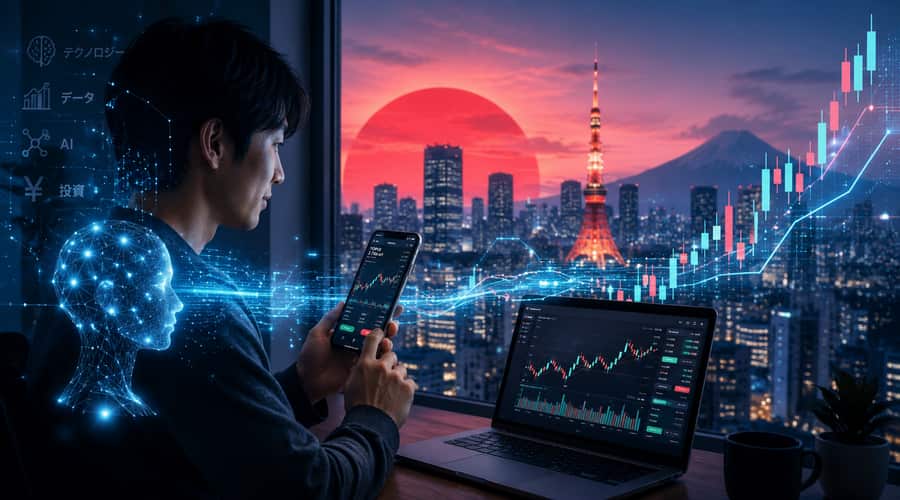
Japan's AI trade is no longer just pushing stock prices higher. It is also changing where individual investors send their orders, and that matters for market transparency.
The Japanese equity boom has moved beyond a simple story about chip stocks and SoftBank. Retail traders are now part of the market structure story, with more individual orders being routed through proprietary trading systems and dark pools as AI enthusiasm keeps money moving through Tokyo.
That is a different kind of signal. The rally has already shown how quickly momentum can swing: the Nikkei 225 reached an intraday all-time high of 63,799.32 on May 14, dropped as low as 59,558.06 during trading on May 20, then closed at a record 63,339.07 on May 22. But a shift in execution habits can last longer than one burst of momentum. When individual investors start relying more heavily on smart order routing, off-exchange venues and broker-operated systems, the market becomes harder to read from the public order book alone.
According to Reuters, SoftBank Group and other AI-linked names were among the stocks that powered the Nikkei to records earlier in May before profit-taking hit the same group. That tells us the AI trade in Japan is concentrated enough to move the index, but broad enough to pull in different types of investors. Retail flow is one of the most important of those layers because Japan's individual investors have long had an outsized role in shaping sentiment at turning points.
There is nothing mysterious about why retail traders are showing up. Japan has become one of the cleanest ways to express the global AI infrastructure theme outside the United States. SoftBank gives investors exposure to Arm and the wider AI funding cycle. Tokyo Electron and Advantest sit closer to semiconductor equipment and testing. Fujikura, which supplies materials used in AI data centers, became a symbol of how far the trade had spread before its sharp pullback in May.
The more interesting question is not whether retail investors like AI stocks. They clearly do. The question is how their orders are being handled once they press buy or sell. Japan Exchange Group data and research show that dark pool trading has become visible enough for regulators and exchanges to track more closely, with a flagging system introduced after 2020 reforms to identify dark pool transactions routed to ToSTNeT. A recent JPX working paper also noted that online brokers using smart order routing have increased the number of retail orders executed in dark pools.
That can be good for execution. A retail investor may receive price improvement if a broker finds a better match away from the Tokyo Stock Exchange's main lit market. In a fast rally, that matters. Nobody wants to lose money to a poor fill just because an order went to the most obvious venue instead of the best one.
But there is a tradeoff. Dark pools and proprietary trading systems are less visible before trades happen. They can reduce market impact for big orders and improve execution for smaller ones, but they also move activity away from the public market where everyone can see bids, offers and depth. If enough trading migrates off-exchange, the public price can start to feel less complete, even if it remains the reference point for the whole system.
Why Retail Flow Matters
Japan's retail investor base is not a sideshow. Individual investors influence liquidity, turnover and the emotional temperature of the market. They are often more sensitive to strong narratives than large institutions, and AI is currently the strongest narrative in global equities. It gives investors a clean story: chips, data centers, automation, robotics and national industrial competitiveness all feeding into one theme.
That is why the off-exchange boom deserves attention. If retail orders are increasingly routed through venues that ordinary market watchers cannot see in real time, it becomes harder to know whether a stock is rising because broad demand is building or because visible liquidity is thin while unseen order flow is being matched elsewhere. In calm markets, that may not matter much. In a crowded AI trade, it can matter a lot.
The concern is not simply that institutions are front-running retail traders. That claim is too easy and often too blunt. The bigger issue is information asymmetry. Brokers, market makers and venue operators may have a clearer view of where retail demand is building than the investors whose orders create that demand. Even when execution is technically better, confidence can suffer if investors feel the market's plumbing works in ways they cannot inspect.
Japan is also trying to modernize its markets at the same time that retail participation is becoming more sophisticated. Zero-commission trading, mobile brokers, smart routing and derivatives access all make the market feel more open. That is genuine progress. But the same tools that democratize access can also fragment liquidity, especially when the most popular trade in the market is concentrated in a handful of AI-linked companies.
The practical takeaway is simple. Investors watching Japan's AI rally should not only watch the Nikkei level. They should watch where trading happens, how much volume shifts away from lit venues, and whether regulators push for more disclosure around retail order routing. The next phase of the AI trade will not be judged only by earnings from SoftBank, Tokyo Electron or Advantest. It will also be judged by whether Japan's market structure can handle a retail boom without making price discovery feel less trustworthy.
Also read: Microsoft's Claude pullback shows AI coding still has a budget problem • Japan’s Nikkei 225 breaks 64,000 as the AI trade spreads • Meta’s AI reset now has Zuckerberg admitting the risk is real.