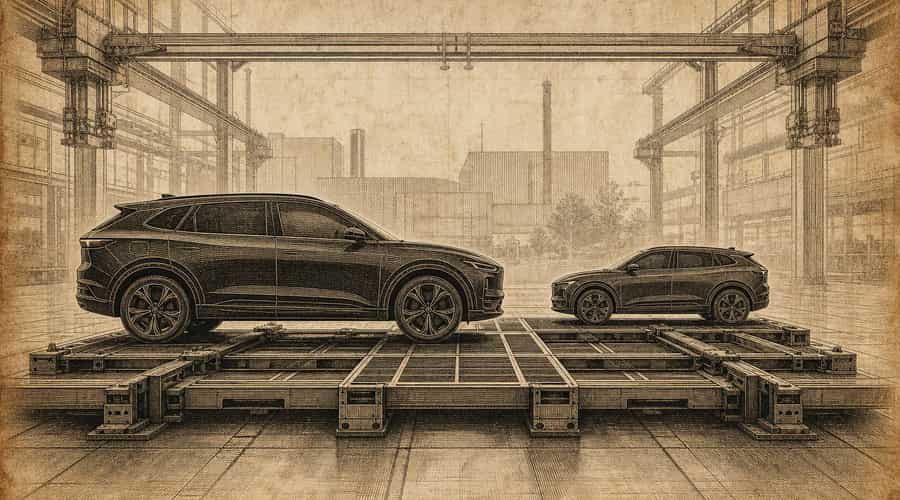
Škoda is preparing an EV push at both ends of the market, with a cheaper Epiq and a larger Peaq that could test how far a value brand can move upscale.
Škoda's next electric story is not really about one new SUV. It is about a brand trying to cover the part of the market where buyers want a lower bill and the part where families will still pay for size, range, and a badge that does not feel like a compromise.
WIRED reported on June 14 that the Czech automaker is working around two very different electric bookends. The Epiq is the smaller, cheaper one, a compact SUV expected to cost around $30,000 in U.S. money, though it is not planned for North America. The Peaq sits at the other end: a large family SUV, likely available with seven seats, built on Volkswagen Group's MEB platform and expected to become the most expensive Škoda yet.
That is a useful way to read Volkswagen Group's wider problem. European carmakers are under price pressure from Chinese rivals, particularly BYD, but they also cannot afford to give up the more expensive family-EV segment. Škoda is being asked to do both jobs at once: protect the affordable end with the Epiq and stretch the brand upward with the Peaq.
The Epiq is the easier part of the argument to understand. WIRED said it will be similar in outside size to the Fabia while offering interior space closer to the Kamiq or Karoq. T3 recently reported that the Epiq is being positioned as Škoda's most affordable EV, with UK pricing from £24,950, up to 475 liters of boot space, a 25-liter front storage compartment, and a claimed range of up to 440 kilometers on the larger battery version.
Those details matter because cheap electric cars in Europe are no longer a side project. The Guardian reported last week that BYD wants to become the world's largest automaker within five years, plans to sell 1.5 million vehicles overseas this year, and expects to start assembling cars at its Hungary plant in the fourth quarter of 2026. This is not only a China story anymore. It is happening inside the European market.
Volkswagen Group's answer is scale. The Epiq is tied to the same family of small electric cars as the Volkswagen ID.Polo, ID.Cross, and Cupra Raval. The point is not that every brand gets a cloned version of the same car. The point is that the group can spread batteries, motors, software, purchasing, and factory investment across several badges while letting Škoda keep the practical, value-led tone that has worked for it.
That tone still matters. If the Epiq arrives as a real family car at around the price of a well-equipped petrol crossover, Škoda has a stronger case against cheaper imports than it would have with a small EV that feels like a stripped-down compliance product. Price gets people to look. Space and everyday usefulness are what make the badge believable.
The Peaq is the riskier bet
The Peaq asks a more uncomfortable question. Can Škoda sell the most expensive model in its history without confusing the very identity that made customers trust it?
WIRED said the Peaq is expected to be 16 feet, 5 inches long, with the official presentation due soon and technical details still undisclosed. It should sit above the Enyaq and Elroq and draw from the Vision 7S concept, which Škoda previously showed with an 89-kWh battery. The Times, after seeing a camouflaged pre-production car earlier this year, described a nearly five-meter SUV with a longer wheelbase than the Kodiaq, a third row that could fit a very tall adult, a 13.6-inch vertical infotainment screen, massaging seats, a Sonos audio system, and a large panoramic roof.
That is not the usual territory for a brand whose strength has often been sensible engineering and a bit more room for the money. German outlet WELT reported this week that the Peaq's production version is expected to be unveiled on June 23, with market launch planned for the second half of 2026, and that the entry version may be priced just under €50,000. Škoda has not announced an official price, so the figure should be treated as an expectation, not a fact.
The MEB platform gives Škoda room to attempt this move. The same architecture already supports models across Volkswagen Group, including the Volkswagen ID.4, ID.7, ID.Buzz, Škoda Enyaq, and other group cars. That shared base lets a brand like Škoda sell a larger and more expensive EV without carrying the whole development burden alone.
There is a limit, though. A shared platform can lower cost and speed up development, but it cannot create brand permission by itself. Buyers who consider a Peaq against a Kia EV9, Volvo, or Volkswagen model will not be buying a platform. They will be judging whether Škoda can still feel honest when the price tag moves into territory once reserved for more aspirational badges.
This is why the Epiq and Peaq belong in the same story. The Epiq defends Škoda's old promise as EVs get cheaper and Chinese competition gets closer. The Peaq tests whether that promise can stretch into a larger, better-equipped family SUV without snapping. Volkswagen Group needs both outcomes, because the hard part of the EV transition is no longer announcing electric cars. It is making the same parts bin serve buyers who want a bargain and buyers who still expect something that feels above ordinary.
Also read: States are writing America's AI rules before Congress does • Google is turning Gemini Omni into a video editing test for AI • Germany’s ESMA carve-out is testing Europe’s single market promise