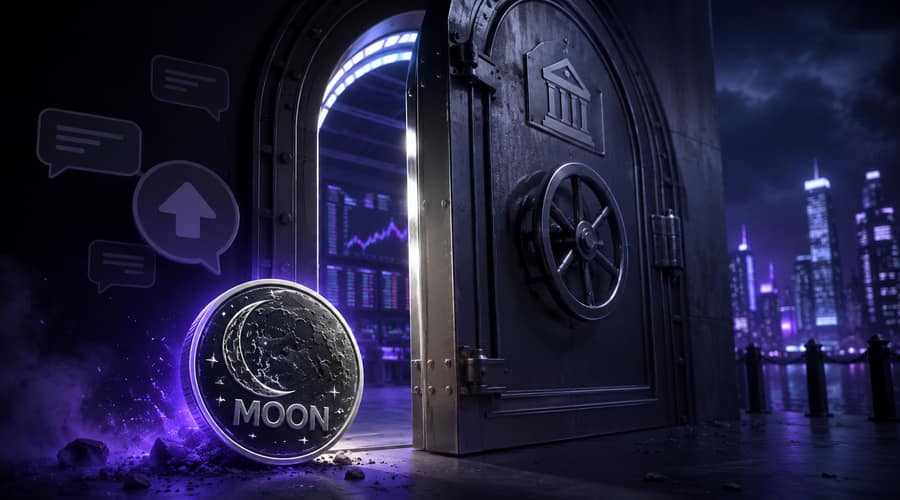
Kraken's scheduled MOON delisting turns Reddit's community token experiment from a live market into a warning about social crypto without long-term platform support.
Reddit's MOON token is about to lose its most visible centralized exchange market, and that matters far beyond one small token tied to one subreddit. Kraken has scheduled MOON for removal on May 29, 2026, which leaves holders with a familiar crypto problem: a community can keep talking about a token, but liquidity is what decides whether the market still has a pulse.
MOON was built around r/CryptoCurrency, where users earned tokens for posts, comments and community participation. At its peak, the idea was easy to understand. Reddit already had reputation, karma and communities with strong identities. Turning some of that activity into an on-chain asset looked like a practical way to test whether internet communities could own part of the value they helped create.
That promise now looks much thinner. According to Kraken's May 2026 delisting notice, trading and deposits for MOON and a batch of other assets will be disabled at 14:00 UTC on May 29, while withdrawals remain open until August 27 and remaining balances may be liquidated between September 1 and September 5. CoinGecko data on May 26 showed MOON trading near $0.0074, down almost 70% over seven days, with a market value of roughly $572,000 and 24-hour volume of about $4,200.
The easy reading is that MOON failed because the price collapsed. That is too simple. Tokens rise and fall all the time. The bigger issue is that MOON depended on three things staying aligned: Reddit's product support, community demand and exchange access. Once Reddit stepped back from Community Points in 2023, the project lost the issuer commitment that made it feel different from any other small-cap token.
Reddit's decision at the time was not framed as an attack on crypto. The company pointed to scaling demands, resource costs and a more difficult regulatory environment. That explanation was sensible from a corporate point of view. Running a consumer-facing token program across large communities is not the same as adding badges or loyalty points. Once real money value appears, moderation, legal review, user support and market behavior all become part of the product.
That is where the original vision began to strain. Community Points tried to make contribution measurable and tradable, but a tradable reward changes how people behave. Users are no longer only posting because they care about the conversation. Some are farming attention, optimizing for distributions and treating community status like a speculative asset. That can work for a while in a bull market. It is much harder to defend when prices fall and the platform no longer wants the responsibility.
Kraken's move does not erase MOON from existence. Tokens can still live on-chain, and decentralized exchanges can provide some market access. But that is a very different experience from being listed on a mainstream exchange with simple fiat pairs and familiar account tools. For ordinary users, the removal of centralized exchange support turns a once-visible consumer crypto experiment into something more technical, less liquid and less accessible.
Social platforms are choosing safer rewards
The lesson for other platforms is not that rewards are dead. It is that public, transferable tokens create obligations that many consumer companies do not want. A platform can run badges, creator payouts, subscriptions, tipping systems or internal loyalty points with far more control. Those models may be less exciting to crypto traders, but they are easier to manage and less likely to turn every product change into a market event.
This is why stablecoin rewards, closed loyalty systems and non-transferable reputation tools may have a better chance than community tokens for mainstream platforms. They can still reward contribution, but they do not need to invite speculative trading around every user action. For companies like Reddit, Discord or X, that distinction matters. Engagement is valuable. Uncontrolled financialization of engagement can become a liability.
Crypto builders should pay attention to the exchange side as well. A token with a passionate community can still fade if trading venues decide the volume, compliance burden or market quality no longer justifies support. Kraken did not need to make a philosophical statement about Reddit's experiment. The delisting schedule itself says enough. Thin liquidity and weak institutional backing eventually become hard to ignore.
There is still a possible future for community-owned networks, but MOON shows how narrow the path is. The next version needs clearer governance, less dependence on a single corporate sponsor and a reward structure that does not invite users to confuse contribution with a guaranteed financial claim. Otherwise, the same cycle repeats: excitement, farming, exchange listings, issuer retreat and a long walk back to illiquidity.
For now, the practical takeaway is straightforward. Reddit's token era is not ending with a dramatic shutdown. It is ending through market plumbing: disabled deposits, vanishing order books and a withdrawal deadline. That is less theatrical, but it may be more important. The next social crypto project will have to prove it can survive after the platform, the exchange and the speculative crowd stop carrying it.
Also read: Ondo faces its hardest governance test after Nathan Allman's death • Nasdaq has won SEC approval for Bitcoin index options • Solana Foundation's interim CMO Vibhu Norby humiliates himself challenging Hyperliquid to promote Foundation-backed Phoenix