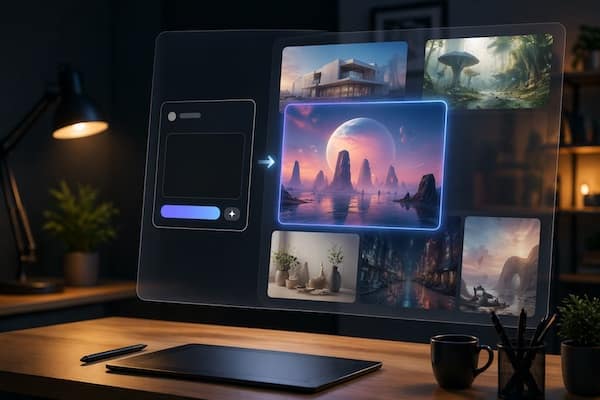
Krea AI has quietly shifted the creative workflow for designers and non-designers alike, with its Realtime feature turning rough text prompts into live visual concepts in seconds.
The pitch is disarmingly simple: you type, and something appears. Not after you hit enter, not after a loading spinner, but as your words are forming. Krea AI's Realtime tool, accessible at krea.ai/realtime, renders AI-generated imagery on the fly, updating continuously as users refine their prompts. For anyone who has spent hours trying to communicate a visual idea to a designer or a client, that kind of instant feedback loop is genuinely useful in ways that a static image generator simply is not.
Most AI image tools work in discrete steps. You write a prompt, you wait, you get a result, you iterate. That process is fine for final outputs, but it is a poor fit for the early, messy, exploratory phase of design work, when you are still figuring out what you actually want. Krea's Realtime collapses that gap. The model updates its output continuously, which means the tool behaves more like a sketchpad than a render farm. You can watch a mood shift as you swap "warm" for "cold," or see a composition transform as you add "minimalist" to the prompt. The feedback is visceral in a way that changes how you think about the concept.
The obvious beneficiaries are early-stage designers and product teams who need to align on visual direction before committing to production work. Mood boards, concept decks, brand identity exploration , these are areas where Realtime can compress hours of back-and-forth into a single working session. But the less obvious use case may be more significant: non-designers who have historically struggled to articulate visual ideas. Founders pitching investors, marketers briefing agencies, architects communicating with clients , anyone who has ever said "I know it when I see it" now has a tool that lets them find it in real time.
Krea has been building toward this kind of workflow-native AI for a while. The company, founded in 2022, has positioned itself as a creative tool for professionals rather than a consumer novelty, and the Realtime feature reflects that focus. It is not trying to replace Midjourney for finished art generation. It is trying to fit into the moment before that, when direction is still being established.
Speed as a design material
There is a subtler argument to make here about what happens when iteration speed approaches zero. In traditional design workflows, each round of feedback costs time, which means teams unconsciously limit how many directions they explore. When a concept can be visualised in seconds rather than hours, the economics of exploration change. You can afford to chase three directions instead of one, to test a contrarian instinct instead of defaulting to the safe option. Realtime does not just speed up the existing workflow; it makes a different kind of workflow possible.
The technical mechanism behind the feature relies on continuous inference rather than generating a full image from scratch with each change, which is how Krea achieves the live update effect without the usual latency. The trade-off is that Realtime outputs are not always the highest fidelity images the platform can produce. But for ideation, fidelity is rarely the bottleneck. Speed and responsiveness are.
Krea offers access through a subscription model, with Realtime included in paid tiers. The platform has also built out adjacent tools, including an AI video generator and image enhancement features, positioning Realtime as one part of a broader creative suite rather than a standalone novelty. That integration matters for teams that want a single environment to take a concept from rough sketch to polished output.
The competitive landscape is moving fast. Adobe has been pushing generative AI features into Firefly and Creative Cloud, while Canva has integrated AI generation directly into its design canvas. But neither of those products offers the same real-time, prompt-as-you-type rendering experience that Krea has built. The incumbents are adding AI to existing workflows; Krea is building a workflow around the AI from the ground up.
Watch for enterprise adoption to be the real test. If creative teams at agencies and product studios start using Realtime as a standard part of their briefing process, Krea will have earned a durable place in the professional stack. If it stays a tool that individuals discover and evangelise without institutional uptake, the window for differentiation will narrow as the larger platforms catch up. The next six to twelve months will tell that story.
Also read: Users report sharp performance drop in Claude Opus 4.6 as Anthropic allegedly redirects compute toward next model • China has doubled its AI scientific computing capacity in two months without a single American chip • Allbirds stock surges 700% after the footwear brand bets its survival on biodegradable AI hardware